

What if the AI tools meant to make work easier also put business data or intellectual property at risk? AI security consulting in South Dakota helps businesses consider cybersecurity as they bring AI into their operations, including how to protect networks, communications, sensitive information, and valuable work.
AI can support business processes, but using it securely takes more than choosing a tool. Consider how AI fits with your systems, who can access it, and what information it may handle. Cybersecurity matters because AI decisions can affect the networks and data your business relies on every day.
This article explains how AI consulting can help businesses plan for security as they adopt AI, which considerations matter, and when professional support may help. It also covers what to expect from consulting and how network security, data protection, and AI planning can work together to address exposure and practical business needs.
Key Takeaways
- Plan AI adoption alongside security controls so implementation accounts for business systems, access, and sensitive information.
- Review how AI tools connect to networks and communications, and identify where security protections need to be strengthened.
- Set clear safeguards for sensitive data and intellectual property before employees use AI tools; the European Union states that penalties under the EU AI Act can reach 35 million.
- Choose AI security support that connects consulting with cybersecurity and network protection, then explore how BENDIX imaging’s AI consulting can fit your needs.
AI consulting and implementation services in South Dakota
AI security consulting connects tool selection and implementation with safeguards for business systems. In South Dakota, this work can include reviewing AI applications, their access to data, and the security controls around them.
Available AI Security Services
Services may include AI inventories, security reviews, implementation planning, and assessments of permissions, integrations, and data sources. Consultants can also test systems before launch and after significant changes to models, prompts, data, integrations, or permissions. This can help identify exposure before a changed application becomes part of daily operations.
Ask how the engagement will address current applications and future changes. Recurring assessments informed by the NIST AI Risk Management Framework can help organizations revisit risk as adoption grows. The scope should specify which systems are reviewed, what findings are provided, and how security considerations relate to business operations.
Consultant Selection Criteria
South Dakota consultants and national firms may differ in how they define project scope, coordinate implementation, and support ongoing security. Managed security providers may focus on continuous security operations, while AI consultants may focus on AI-specific risks and implementation. Compare the actual scope and responsibilities rather than assuming either model covers every need.
Ask which AI applications, data flows, and integrations the engagement will assess. Find out how testing addresses production changes, who receives the findings, and how recommendations fit existing security operations. These questions help show whether the work is tailored to your systems or limited to a general AI overview.
Local Providers and Support
Small businesses and local governments can look for South Dakota consultants that combine AI assessment with cybersecurity and managed technology support. The fit depends on the systems involved, the information they handle, and whether implementation support is needed. For funding, eligibility depends on applicant type, project purpose, and whether consulting qualifies under an active program. A consultant can define the project scope, while the program administrator determines eligibility.
As of 2026, South Dakota was among states without a dedicated AI law, and it had not enacted specific AI disclosure requirements for employers. The Gramm-Leach-Bliley Act is relevant to how AI handles protected data. The European Union states that penalties under the EU AI Act can reach 35 million, a consideration for organizations serving EU customers. At the University of South Dakota, people using University data with AI must complete approved training first.
Network protection and encrypted communications
AI tools connect to business networks through user accounts, applications, and integrations. Each connection creates a route that security teams need to understand. The University of South Dakota’s generative AI security policy includes secure communication and network protection under CIS Control 13. For South Dakota organizations, that makes network boundaries and communication paths important parts of AI planning.
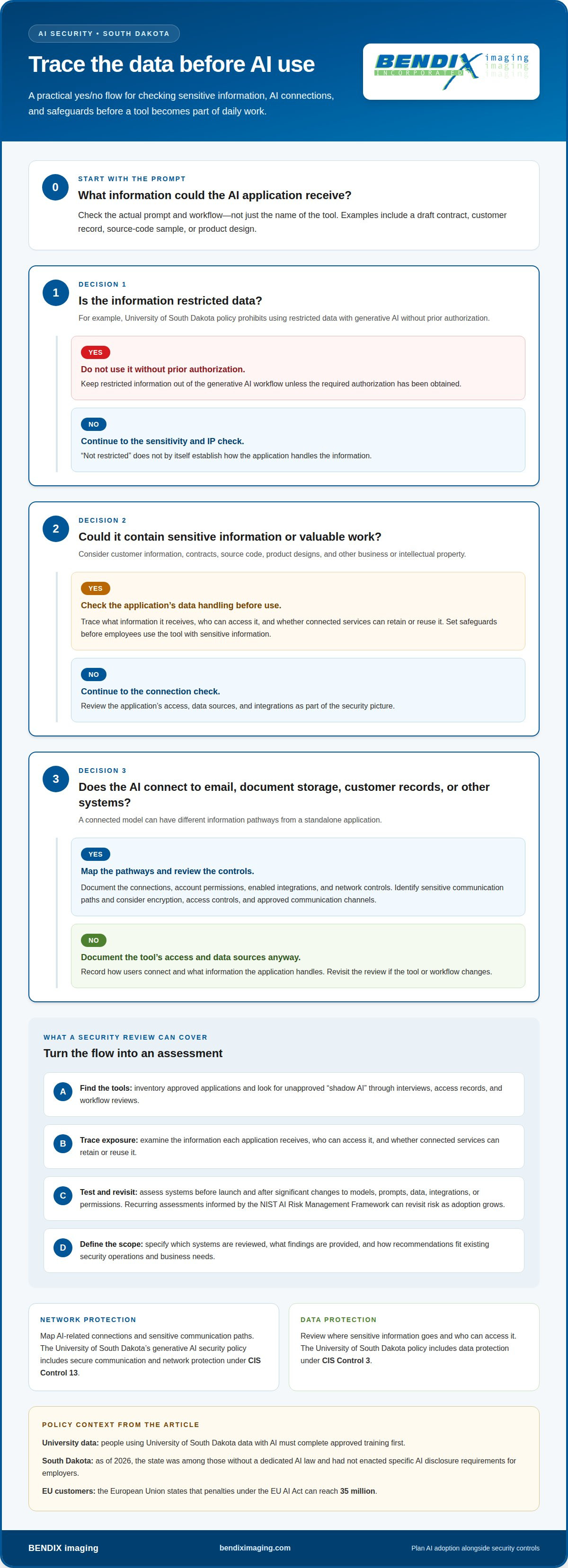
Start by mapping how each AI system exchanges information. A model connected to email, document storage, or customer records may have different pathways from a standalone application. Consultants can review those connections, account permissions, and network controls, then identify where sensitive traffic may need stronger protection. The goal is to understand how information moves, not just which AI tool employees use.
Encryption helps protect information as it travels between systems, alongside access controls and secure configuration. A review should consider who can connect, which integrations are enabled, and whether communications use approved channels. For example, a Sioux Falls business using AI automation for routine document work should understand which systems the workflow can access and what data it can transmit.
This analysis matters across sectors, including businesses and government organizations. Operations use different applications and handle different information, so safeguards should match the network design. Consultants can assess remote access, internal connections, and third-party integrations, then prioritize changes based on exposure and business impact.
For a practical review, have the security team document AI-related connections, identify sensitive communication paths, and test controls before deployment or after system changes. This gives decision-makers a clearer basis for implementation and ongoing oversight. Organizations planning network safeguards can also explore network security planning as part of their AI security work.
Sensitive data exposure and intellectual property leakage
Generative AI can turn a routine prompt into a data-handling decision. A draft contract, customer record, source code sample, or product design may contain sensitive information. If staff enter it into an AI application without understanding its handling, the organization can lose control over where that information goes. The University of South Dakota prohibits using restricted data with generative AI without prior authorization. Its policy also includes data protection under CIS Control 3.
How can consultants assess generative AI and shadow AI risks? They can inventory approved software and identify unapproved tools through interviews, access records, and workflow reviews. An assessment can then trace what information each application receives, who can access it, and whether connected services can retain or reuse it. This gives decision-makers a clearer view of exposure across employee use, not only officially adopted systems.
Consultants can also classify information before recommending safeguards. A manufacturer’s design files, a law office’s client records, and a healthcare organization’s patient information, for example, call for different handling decisions. The Gramm-Leach-Bliley Act may be relevant to how AI handles protected data. Organizations should assess applicable obligations based on the information and services involved, rather than assuming every AI tool presents the same risk.
What steps help secure AI systems and sensitive data? A consultant can map data flows, review permissions, establish rules for what employees may submit, and recommend controls for storage and access. The review should cover both AI applications and the software connected to them. An AI assistant linked to shared files, for example, may create different exposure from a standalone writing tool.
For Claude or another generative AI service, assess the intended use, data categories, connected accounts, and approval process before adoption. Documenting these decisions gives managers a practical basis for later review. Treat trade secrets and internal intelligence as protected business assets, and include data safeguards in implementation planning.
The University of South Dakota's generative AI security policy also includes data recovery under CIS Control 11.
Which cybersecurity consulting firms in South Dakota offer AI security services?
Businesses seeking AI security consulting in South Dakota should look for providers that connect AI planning with practical cybersecurity work. A focused assessment can identify risks, while broader security support may help address them across business systems. Compare firms by project scope, implementation role, and reporting. A provider’s location alone does not show whether its approach fits your organization or technology environment.
Ask prospective firms to describe a typical engagement without disclosing another customer’s confidential information. Their explanation should identify the systems reviewed, how findings are prioritized, and what recommendations or implementation support follow. A business adding an AI application to an existing workflow, for example, needs to know how the review considers current accounts, software, and processes. Request clear deliverables and responsibilities before work begins.
Distinguish consulting from managed security services. Consulting may assess AI risks and recommend changes, while a managed provider may handle ongoing security operations. Some organizations need both, but the scope should clarify who is responsible for each task. Ask how the firm adapts its work to different environments, such as a municipal office’s systems or a small company’s applications. Look for specific responsibilities, not broad assurances.
A practical selection process starts with your intended AI use and the systems it may affect. Ask how AI security consulting in South Dakota will assess security before implementation and after relevant changes. Then compare the proposed scope, reporting, and follow-through. Focus on whether the firm’s analysis leads to clear actions suited to your organization, rather than a generic overview of AI.
If you’re evaluating support, discuss your AI security needs and the systems involved.
South Dakota organizations serving EU customers should consider the EU AI Act, regardless of their location. Include this in discussions about intended AI use and the systems involved, and ask how the proposed review reflects your organization’s context.
Healthcare organizations should implement robust cybersecurity measures to mitigate AI-related risks. When evaluating a consultant, healthcare teams can ask how recommendations support that effort and how responsibilities for follow-through are defined. This helps connect AI security work with practical organizational needs.
BENDIX imaging: Artificial Intelligence (AI) Consulting
BENDIX imaging helps South Dakota businesses plan and implement AI with security in mind. Its Artificial Intelligence (AI) Consulting can help assess how proposed tools fit business processes, systems, and information needs before adoption.
Consider AI consulting when evaluating an application, planning implementation, or reviewing how AI connects with existing technology. BENDIX imaging’s Cyber Security and Network Security offerings address related concerns across business systems, while Managed IT Services support broader technology operations. The right scope depends on your goals, the systems involved, and the risks identified during assessment.
Bring a clear use case, the applications under consideration, and the business systems they may connect to. This gives the discussion a practical starting point and keeps it focused on your priorities. Contact BENDIX imaging to discuss AI consulting for your business.
Make your next AI decision with security in view
Before expanding AI use, choose a business workflow and define what a successful, secure implementation needs to protect. This gives your team a focused starting point for discussing applications, system access, and sensitive information. AI security consulting in South Dakota can connect these decisions with your organization’s security needs.
The next step is a practical conversation about your goals, the tools under consideration, and the systems they may affect. BENDIX imaging offers Artificial Intelligence (AI) Consulting, Cyber Security, and Managed IT Services to support businesses considering AI and broader technology needs. The right engagement should address your actual environment and priorities, rather than rely on generic recommendations.
Bring your planned use case and key questions to the discussion. From there, you can identify what needs assessment and how security considerations fit into implementation. Contact BENDIX imaging to discuss your AI plans and take a clear next step.


