

Does your current IT provider actually verify your defenses, or are they just grading their own homework while your business remains one click away from a $1.24 million disaster? It's a valid concern. You're right to be skeptical of generic national firms that don't understand the unique landscape of South Dakota business. Between the fear of ransomware and the confusion of meeting updated FTC Safeguards, it's easy to feel like you're falling behind. We believe a small business cybersecurity audit shouldn't be a bureaucratic nightmare. It should be a proactive shield for your livelihood.
In this guide, you'll master the process of evaluating your digital defenses to safeguard your company against evolving 2026 threats. We'll provide a clear roadmap to identify vulnerabilities and ensure you're meeting state reporting thresholds before the South Dakota Attorney General gets involved. We'll walk through five vital steps, including asset inventorying, threat identification, and the critical new "Govern" pillar of the NIST CSF 2.0 framework. By the end, you'll have a prioritized list of security fixes and the confidence that your local operations in Watertown, Brookings, or Sioux Falls are truly protected.
Key Takeaways
- Understand why hackers specifically target Watertown and Brookings firms and how one ransomware event can trigger a bankrupting $1.24 million recovery process.
- Discover why a professional small business cybersecurity audit is the only way to uncover hidden entry points in your network and employee-owned hardware.
- Learn the difference between high-level DIY checklists and the technical depth of a professional vCSO assessment that provides actionable remediation plans.
- Master the first vital steps of defense by inventorying every asset in your Sioux Falls office and identifying risks ranging from human error to automated AI attacks.
- Transition from reactive "quick fixes" to a multi-year security strategy that integrates managed IT and print services into a single, unified shield.
Why Your South Dakota Small Business Needs a Cybersecurity Audit in 2026
Do you think your Watertown or Brookings office is too small for a hacker's attention? That's a dangerous myth. In 2026, 43% to 73% of all cyber incidents involve small or mid-sized businesses. Attackers don't want a challenge; they want the path of least resistance. They know local firms often lack the enterprise-grade defenses of national corporations, making you the ideal target for automated scripts and AI-driven probes. A small business cybersecurity audit isn't a luxury; it's a defensive necessity to ensure your doors stay open.
The financial stakes have never been higher for Eastern South Dakota business owners. A single ransomware event can carry a direct cost of up to $1.24 million when you factor in recovery, legal fees, and lost revenue. With critical downtime costing an average of $53,000 per hour, most local operations can't survive a week of paralysis. Beyond the immediate theft, South Dakota law (SDCL § 22-40-20) requires you to notify residents within 60 days of a breach. If you fail to meet these standards, you face civil penalties of up to $10,000 per day per violation. You can't afford to guess if your systems are secure.
The 2026 Threat Landscape in Eastern South Dakota
Threat actors are now using sophisticated AI to craft spear-phishing attacks that mimic the language of regional agricultural suppliers and medical networks. The old strategy of "security through obscurity" is dead. If you have an internet connection, you're visible. Modern attackers use automated reconnaissance to find unpatched software or weak passwords in minutes. Moving from basic antivirus to a comprehensive risk management strategy is the only way to stay ahead. By utilizing established information security audit methodologies, you can identify these gaps before a criminal does.
Compliance as a Competitive Advantage
Meeting 2026 standards for HIPAA or the FTC Safeguards Rule isn't just about avoiding fines. It's about business growth. Larger partners and government agencies now require proof of a clean small business cybersecurity audit before signing contracts. They won't risk their data by connecting to a vulnerable vendor. When you can prove your security posture is verified, you move to the front of the line. This transparency builds deep trust with your local customers in Sioux Falls and beyond, showing them that their sensitive data is protected by a vigilant, high-standard partner.
Core Components of a Comprehensive Cyber Risk Assessment
A real small business cybersecurity audit doesn't stop at your firewall. It digs into the plumbing of your entire operation. You need to identify every entry point, from the guest Wi-Fi in your lobby to the remote VPNs your staff uses from home. If you don't know where the doors are, you can't lock them. The NIST Small Business Cybersecurity Corner provides a solid framework for these assessments, but local execution is where most firms fail. You must map exactly where sensitive customer information is stored and how it moves through your network.
Auditing endpoints means looking at every laptop, tablet, and smartphone that touches your data. This includes employee-owned hardware used for work email. Are these devices encrypted? Do they have active endpoint detection? Identity management is your next hurdle. If you aren't enforcing universal Multi-Factor Authentication (MFA) across every account, you're essentially leaving the keys in the ignition. We've seen local firms in Sioux Falls lose everything because a single password was compromised on a non-MFA account.
Securing the "Hidden" Entry Points: Printers and VoIP
Most business owners ignore their printers. That's a mistake hackers count on. Modern criminals love unmanaged print devices because they're often left with default passwords and outdated firmware. They're a perfect backdoor into your server. Your VoIP systems are equally vulnerable. Without proper auditing, these systems can be used for eavesdropping or unauthorized access to your internal network. Keeping firmware current across all office equipment is a mandatory baseline for security. If you're unsure where your data is actually living, a professional managed IT assessment can map your entire digital footprint and close these gaps.
AI and Cloud Vulnerability Assessment
Is your team feeding sensitive customer data into "free" AI tools? You need to know now. An audit must evaluate how AI is being used and where that data ends up once it leaves your controlled environment. Similarly, cloud storage permissions on platforms like OneDrive or Google Drive often become a mess as employees join or leave the company. You must regularly review who has access to what. Don't assume your third-party SaaS providers are secure just because they're well-known names. Verify their security protocols as part of your broader risk management strategy.
Internal Self-Assessment vs. Professional vCSO Audits
Is your internal team grading their own work? A DIY audit is a logical first step for a startup with zero budget. It builds initial awareness and helps you understand basic vulnerabilities. You can find baseline resources through CISA cyber guidance for small businesses to start mapping your risks. However, a self-assessment often lacks the technical depth to catch sophisticated 2026 threats. You don't know what you don't know, and in the world of cyber defense, those blind spots are where ransomware thrives.
A professional small business cybersecurity audit provides an objective, deep-dive analysis that internal staff simply can't replicate. While your IT person is busy fixing printers and resetting passwords, a Virtual Chief Security Officer (vCSO) focuses exclusively on your strategic defense. This fractional model gives South Dakota firms access to executive-level security expertise without the $250,000 annual salary of a full-time hire. It’s about moving from a "hope for the best" mentality to a verified state of readiness.
When to Stop Guessing and Hire a Professional
If your internal IT team seems overwhelmed or lacks a dedicated security specialization, it's time to stop guessing. Self-conducted assessments frequently miss "lazy" configurations or systemic gaps in data governance. Consider the cost-benefit ratio. While a professional review requires an investment, it is a fraction of the $3.31 million average breach cost reported by IBM for organizations with fewer than 500 employees. If you're managing HIPAA or FTC Safeguards compliance, a professional review isn't just a suggestion; it's your primary defense against state-level fines and litigation.
The BENDIX imaging "Watchdog" Approach to Auditing
We don't do fluff. Our "Watchdog" approach is a direct, no-nonsense evaluation of your current IT provider's performance. We often find that national IT firms use generic templates that ignore the specific needs of rural South Dakota businesses. We look for the gaps they leave behind, such as unmanaged network segments or cloud permissions that were never properly revoked. We prioritize fixes based on their actual impact on your local operations in Watertown or Sioux Falls. Our goal is to provide a clear, prioritized roadmap that turns your small business cybersecurity audit findings into a multi-year strategy for stability and growth.
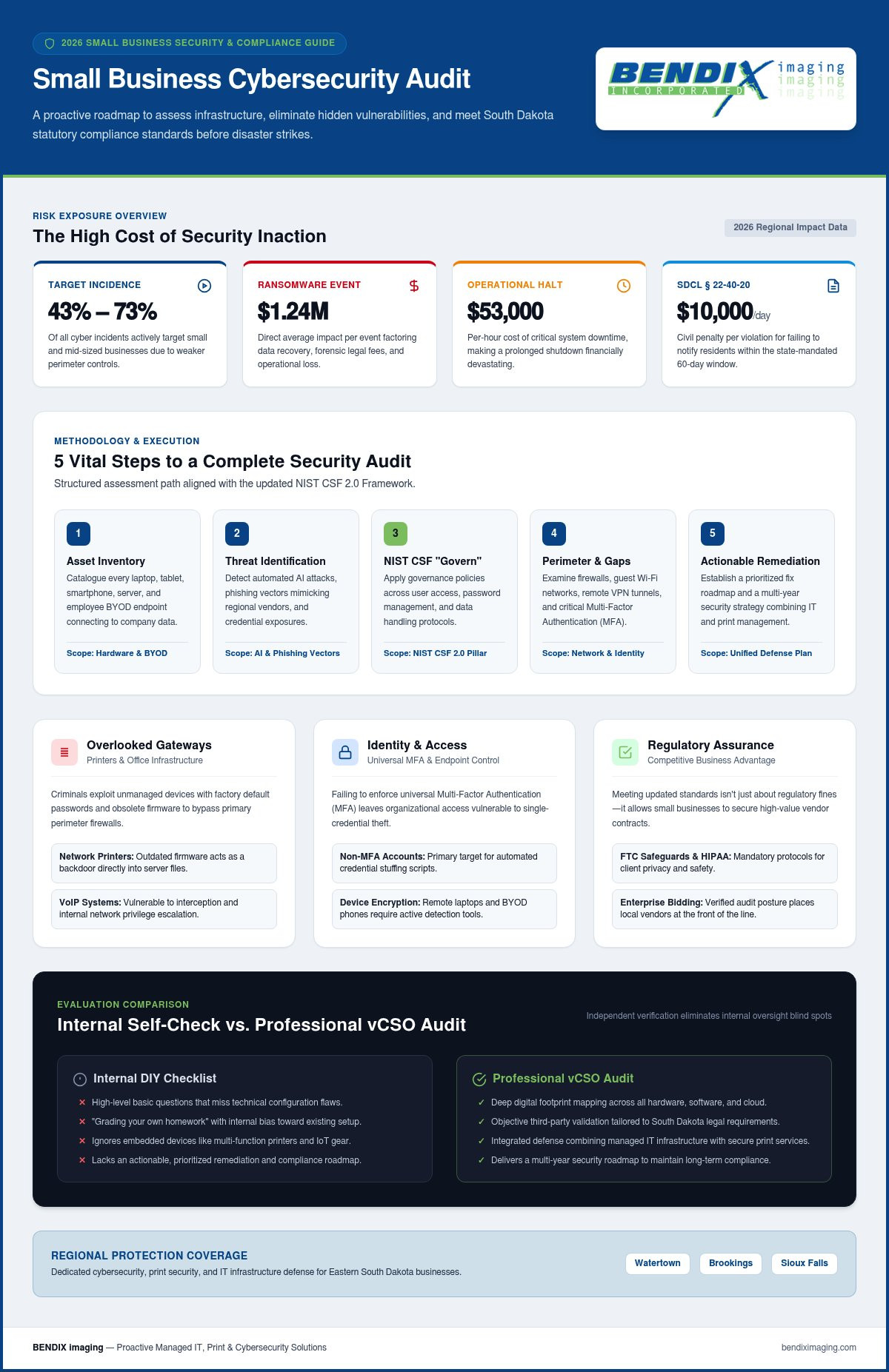
Five Vital Steps to Conduct Your Small Business Cybersecurity Audit
Stop guessing and start measuring. A small business cybersecurity audit follows a rigorous, logical sequence to ensure no stone is left unturned. You cannot rely on a generic checklist found online; you need a process that reflects the specific risks of operating in Eastern South Dakota. This five-step framework moves you from total uncertainty to a documented, defensible security posture.
Step 1: Mapping Your Digital Footprint
You cannot protect what you do not know exists. You must account for every desktop in your Sioux Falls branch and every tablet used by your field team in Watertown. This hardware register is only half the battle. You also need to identify "Shadow IT," which includes unauthorized AI tools or personal cloud storage apps employees use without official approval. Finally, don't ignore physical security. An audit must verify that your server room locks are functional and that office access is strictly controlled to prevent unauthorized physical entry.
Step 2: Identify Threats. Categorize your risks by looking at both external hackers and internal human error. Are your employees susceptible to the latest AI-driven phishing scams? Is there a risk of a disgruntled former staff member still having access to your VoIP system? Understanding these specific threat vectors allows you to tailor your defenses rather than wasting money on broad, ineffective tools.
Step 3: The "Stress Test" for Your Defenses
This is where the audit gets real. Don't just assume your firewall is working because the light is green. You must test your backup integrity by attempting a full data restoration. If you cannot restore your critical systems in under four hours, your current plan is a failure. We also recommend testing employee awareness through simulated phishing campaigns to see who clicks. An air gap backup strategy for 2026 ensures your most critical data remains physically or logically isolated from the main network, providing an immutable recovery point that ransomware cannot reach.
Step 4: Prioritize Risks. Use a 2026 risk matrix to decide what needs fixing today. Not every vulnerability is an emergency, but a missing MFA on a remote VPN is a "Code Red" issue. Step 5: Create a Remediation Plan. This final document outlines exactly how to close the gaps you found. If your current IT setup feels like a house of cards, it's time to secure a professional small business cybersecurity audit to verify your defenses and build a roadmap for long-term stability.
Securing Your Local Infrastructure: The Path Forward
Completing a small business cybersecurity audit is a major milestone, but it's only the beginning. If you treat that report as a one-time project and tuck it into a drawer, you're still leaving your business exposed. You must turn those findings into a multi-year strategy that treats security as a fundamental part of your operations. By integrating your managed IT with managed print services, you create a unified defense. This approach eliminates the blind spots that often occur when different vendors manage different parts of your office, ensuring that every device from your server to your lobby printer is a hardened endpoint.
Vigilance requires a consistent rhythm. In the fast-moving 2026 threat environment, an annual check-up is no longer sufficient. We recommend quarterly reviews to adjust your defenses against new automated scripts and evolving social engineering tactics. BENDIX imaging serves as your local watchdog, catching the lazy configurations and missed patches that national firms often overlook. We understand the specific needs of Brookings and Sioux Falls businesses because we operate in the same local economy. We are invested in your stability because your success strengthens our entire region.
Building Operational Maturity in South Dakota
Moving from reactionary "break-fix" IT to proactive business management is the hallmark of a mature operation. This shift does more than just protect your data; it protects your bottom line. Cyber liability insurance carriers in 2026 now mandate verified proof of a small business cybersecurity audit before they will even issue a quote. Without this documentation, you may find yourself uninsurable or facing astronomical premiums. Leveraging AI consulting allows you to use the same sophisticated tools that attackers use, giving you a predictive edge that identifies anomalies before they turn into breaches.
Next Steps: Your Watertown Business Technology Audit
Don't settle for a faceless national call center that treats your Watertown business like a ticket number. A local partner provides the accountability and transparency you need to build immediate trust. You can start improving your posture today by enforcing universal Multi-Factor Authentication and verifying your offline backup status. The road to a secure, compliant operation starts with a clear inventory of where you stand right now. Take control of your digital defenses before a crisis forces your hand.
Schedule your Business Technology Audit with BENDIX imaging today.
Secure Your Business Before the Next Threat Strikes
Are you willing to bet your company's survival on a generic security checklist? The 2026 landscape demands more than hope. A professional small business cybersecurity audit is the only way to expose the hidden vulnerabilities in your network, printers, and cloud storage. Waiting for a breach to happen isn't a strategy; it's a gamble that could cost your local office over $1.24 million in recovery fees and regulatory penalties. You now have the roadmap to move from reactive fixes to proactive, vCSO-led compliance.
BENDIX imaging acts as your dedicated watchdog in Watertown, Brookings, and Sioux Falls. We specialize in catching the lazy configurations that national firms miss, ensuring your data stays protected under South Dakota's strict reporting laws. Don't let your hard work be undone by a single unpatched device or a sophisticated phishing attempt. It's time to take control of your digital infrastructure with a partner who understands the rural SD business environment. Secure your business with a BENDIX imaging Technology Audit today. Your team, your customers, and your future deserve nothing less than total vigilance.
Frequently Asked Questions
How often should a small business conduct a cybersecurity audit?
You should review your defenses at least once a year. However, in the high-threat environment of 2026, quarterly reviews are becoming the standard for businesses in Sioux Falls and Brookings. If you add new cloud software, hire remote staff, or change your network infrastructure, you need an immediate assessment. Don't wait for an annual date if your operational footprint has already shifted and created new entry points.
What is the difference between a vulnerability scan and a full audit?
A vulnerability scan is an automated tool that searches for software bugs and open ports. It's just one part of a full assessment. A comprehensive small business cybersecurity audit evaluates your entire security posture, including employee policies, physical access to server rooms in Watertown, and data governance. While a scan tells you if a door is unlocked, an audit asks why the door exists and who holds the key.
How long does a typical small business cybersecurity audit take?
A typical review for a local firm takes between two and four weeks to complete. The initial data collection phase usually lasts a few days, followed by deep-dive analysis and remediation planning. Larger operations with multiple branches in Brookings or Huron may require more time to map complex network structures. We prioritize accuracy over speed to ensure no hidden backdoor or Shadow IT application is overlooked during the evaluation process.
What local South Dakota regulations should I be aware of for my audit?
You must comply with South Dakota Codified Law § 22-40-20, which mandates a 60-day notification deadline following a data breach. If a breach impacts more than 250 South Dakota residents, you're legally required to notify the state Attorney General. Failure to meet these standards can result in deceptive business practice charges and civil penalties of up to $10,000 per day. Your review must verify that your reporting procedures are ready for these local requirements.
Is a cybersecurity audit required for business insurance in 2026?
Yes, cyber liability carriers in 2026 no longer accept simple self-attestations. To qualify for coverage or renewals, insurers now mandate verified proof of baseline security audits and universal Multi-Factor Authentication (MFA). If you can't provide a documented remediation plan from a recent review, you risk being denied coverage or facing unmanageable premiums. Insurance companies are shifting the risk back to the business owner, making professional verification a prerequisite for financial protection.
Can I perform a cybersecurity audit myself or do I need a consultant?
You can use internal checklists for basic awareness, but a professional consultant provides the objectivity needed for a high-standard defense. Internal IT staff often have blind spots because they're auditing their own configurations. A local partner acts as a watchdog, catching the lazy setups or unmanaged printers that internal teams might ignore. For businesses in Watertown or Montevideo, a small business cybersecurity audit ensures that your defenses meet actual 2026 industry standards.
What is the first thing I should do if my audit reveals a major vulnerability?
Isolate the affected system immediately to prevent lateral movement across your network. Once the threat is contained, document the gap and follow your prioritized remediation plan to close it. Don't just apply a quick fix that ignores the root cause. If the vulnerability involves sensitive customer data, check your South Dakota reporting obligations immediately. A major find is a call to action, not a reason to panic, provided you have a local expert ready to assist.
How much does a professional cybersecurity audit cost for a small business?
Industry standards for pricing depend heavily on the number of endpoints, the complexity of your network, and your specific regulatory requirements. A firm in Sioux Falls with 10 employees will have different needs than a multi-location operation in Watertown and Brookings. While a professional assessment requires an upfront investment, it's a fraction of the $1.24 million average cost of a data breach. Investing in a vCSO-led review ensures you aren't paying for enterprise fluff.
{"@context":"https://schema.org","@type":"FAQPage","mainEntity":[{"@type":"Question","name":"How often should a small business conduct a cybersecurity audit?","acceptedAnswer":{"@type":"Answer","text":"You should review your defenses at least once a year. However, in the high-threat environment of 2026, quarterly reviews are becoming the standard for businesses in Sioux Falls and Brookings. If you add new cloud software, hire remote staff, or change your network infrastructure, you need an immediate assessment. Don't wait for an annual date if your operational footprint has already shifted and created new entry points."}},{"@type":"Question","name":"What is the difference between a vulnerability scan and a full audit?","acceptedAnswer":{"@type":"Answer","text":"A vulnerability scan is an automated tool that searches for software bugs and open ports. It's just one part of a full assessment. A comprehensive small business cybersecurity audit evaluates your entire security posture, including employee policies, physical access to server rooms in Watertown, and data governance. While a scan tells you if a door is unlocked, an audit asks why the door exists and who holds the key."}},{"@type":"Question","name":"How long does a typical small business cybersecurity audit take?","acceptedAnswer":{"@type":"Answer","text":"A typical review for a local firm takes between two and four weeks to complete. The initial data collection phase usually lasts a few days, followed by deep-dive analysis and remediation planning. Larger operations with multiple branches in Brookings or Huron may require more time to map complex network structures. We prioritize accuracy over speed to ensure no hidden backdoor or Shadow IT application is overlooked during the evaluation process."}},{"@type":"Question","name":"What local South Dakota regulations should I be aware of for my audit?","acceptedAnswer":{"@type":"Answer","text":"You must comply with South Dakota Codified Law § 22-40-20, which mandates a 60-day notification deadline following a data breach. If a breach impacts more than 250 South Dakota residents, you're legally required to notify the state Attorney General. Failure to meet these standards can result in deceptive business practice charges and civil penalties of up to $10,000 per day. Your review must verify that your reporting procedures are ready for these local requirements."}},{"@type":"Question","name":"Is a cybersecurity audit required for business insurance in 2026?","acceptedAnswer":{"@type":"Answer","text":"Yes, cyber liability carriers in 2026 no longer accept simple self-attestations. To qualify for coverage or renewals, insurers now mandate verified proof of baseline security audits and universal Multi-Factor Authentication (MFA). If you can't provide a documented remediation plan from a recent review, you risk being denied coverage or facing unmanageable premiums. Insurance companies are shifting the risk back to the business owner, making professional verification a prerequisite for financial protection."}},{"@type":"Question","name":"Can I perform a cybersecurity audit myself or do I need a consultant?","acceptedAnswer":{"@type":"Answer","text":"You can use internal checklists for basic awareness, but a professional consultant provides the objectivity needed for a high-standard defense. Internal IT staff often have blind spots because they're auditing their own configurations. A local partner acts as a watchdog, catching the lazy setups or unmanaged printers that internal teams might ignore. For businesses in Watertown or Montevideo, a small business cybersecurity audit ensures that your defenses meet actual 2026 industry standards."}},{"@type":"Question","name":"What is the first thing I should do if my audit reveals a major vulnerability?","acceptedAnswer":{"@type":"Answer","text":"Isolate the affected system immediately to prevent lateral movement across your network. Once the threat is contained, document the gap and follow your prioritized remediation plan to close it. Don't just apply a quick fix that ignores the root cause. If the vulnerability involves sensitive customer data, check your South Dakota reporting obligations immediately. A major find is a call to action, not a reason to panic, provided you have a local expert ready to assist."}},{"@type":"Question","name":"How much does a professional cybersecurity audit cost for a small business?","acceptedAnswer":{"@type":"Answer","text":"Industry standards for pricing depend heavily on the number of endpoints, the complexity of your network, and your specific regulatory requirements. A firm in Sioux Falls with 10 employees will have different needs than a multi-location operation in Watertown and Brookings. While a professional assessment requires an upfront investment, it's a fraction of the $1.24 million average cost of a data breach. Investing in a vCSO-led review ensures you aren't paying for enterprise fluff."}}]}


