

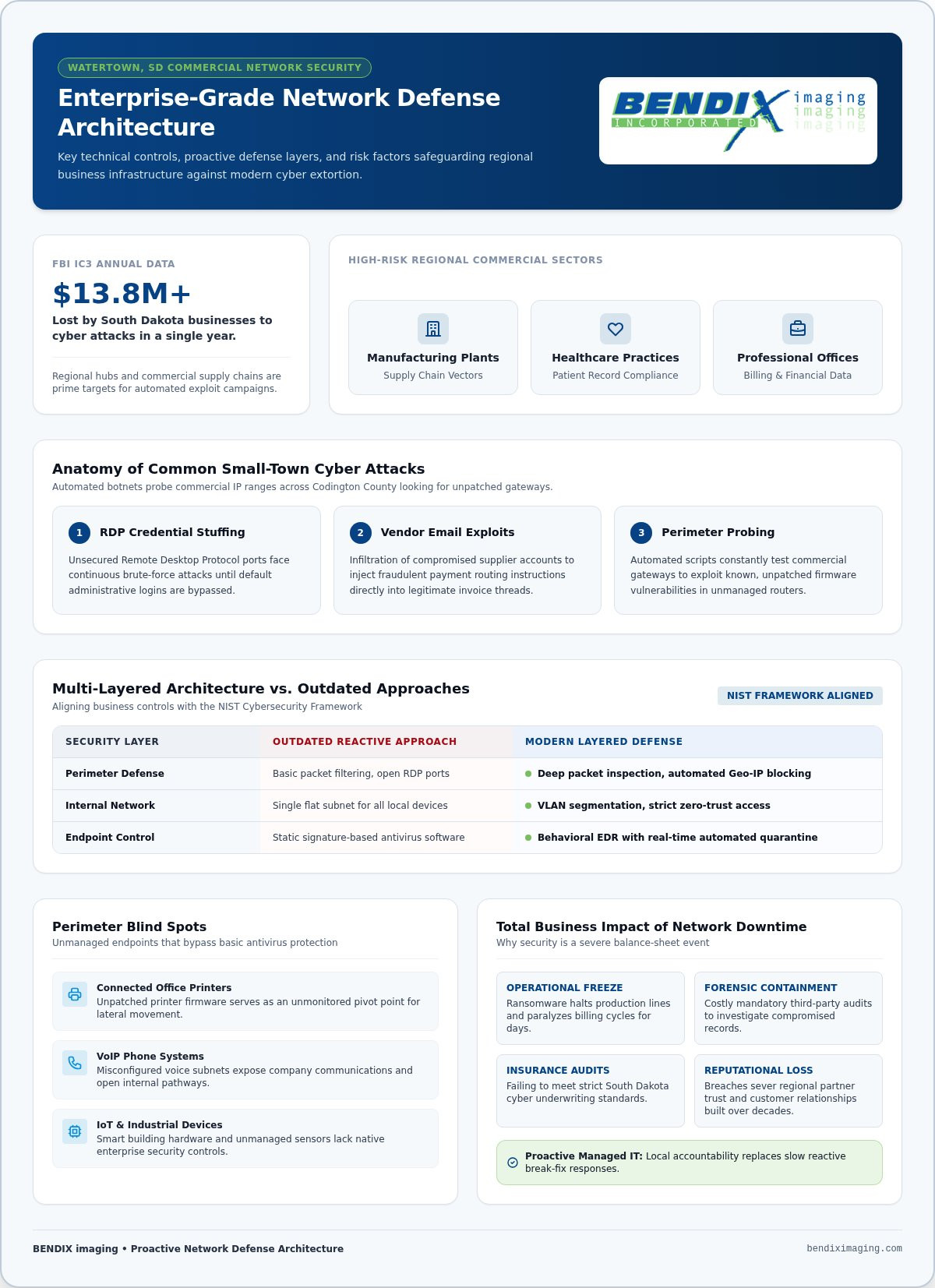
According to the FBI Internet Crime Complaint Center, South Dakota businesses lost over $13.8 million to cyber attacks in a single year, proving that regional commercial hubs are prime targets. If you manage a local manufacturing plant, healthcare practice, or professional office, you already know the grinding anxiety of ransomware threats and confusing compliance mandates. A standard perimeter firewall or an unresponsive out-of-state IT vendor is no longer enough to protect your enterprise. Implementing true network security Watertown SD leaders trust means locking down internal vulnerabilities, from exposed VoIP systems to overlooked office printers, before lateral movement cripples your business.
You shouldn't have to wonder whether your systems will survive an intrusion or pass a mandatory cyber insurance audit. Discover how Watertown businesses build resilient network security architectures to protect operations, achieve regulatory compliance, and eliminate cyber risks. We examine the exact technical controls, layered defense baselines, and proactive monitoring strategies you need to defend your infrastructure with uncompromising local accountability.
Key Takeaways
- Learn why automated threat actors increasingly target regional supply chains and how multi-layered defenses stop intrusions before they disrupt production.
- Discover the essential defense controls required to establish resilient network security Watertown SD businesses need to block encrypted malware and stop lateral movement.
- Understand the technical baselines needed to satisfy strict cyber insurance underwriting demands and South Dakota regulatory standards without operational headaches.
- Identify dangerous perimeter blind spots lurking in connected office printers, VoIP phones, and IoT hardware that standard antivirus software overlooks.
- Find out how partnering with an accountable local managed IT team provides proactive protection that reactive break-fix vendors simply can't deliver.
Why Watertown Businesses Face Rising Network Security Threats in 2026
Too many business owners in Codington County assume small-town geography provides natural immunity from online extortion. That assumption is dangerously outdated. Automated exploit scripts crawl commercial internet blocks indiscriminately, hunting for unpatched firewalls and misconfigured servers regardless of whether a business operates in Chicago or downtown Watertown. Attackers routinely treat regional manufacturing suppliers, medical clinics, and professional firms as soft entry points to compromise enterprise vendor networks. An unprotected network perimeter invites ransomware that halts production lines, freezes billing, and paralyzes cash flow within minutes. To defend operations, establishing robust network security controls across every local endpoint is mandatory.
The Anatomy of Common Small-Town Cyber Attacks
Modern cyber syndicates deploy automated scanning tools that systematically probe IP ranges assigned to Watertown commercial internet providers. Once an exposed vector appears, intrusions follow predictable playbooks:
- RDP Credential Stuffing: Unsecured Remote Desktop Protocol ports face relentless brute-force attacks until threat actors bypass default administrative logins.
- Vendor Email Exploits: Attackers infiltrate compromised supplier accounts to inject fraudulent payment routing instructions into legitimate local billing threads.
- Perimeter Probing: Automated bots test perimeter gateways around the clock, targeting known firmware vulnerabilities in unmanaged routers.
The True Financial Cost of Network Downtime
A network breach isn't just an IT glitch; it's a severe balance-sheet event. When ransomware encrypts local servers, production freezes and billing cycles stall for days. Beyond lost operational revenue, incident containment requires costly third-party forensic investigations to determine what customer records were compromised. In close-knit Eastern South Dakota communities, trust is hard to build and easy to lose. When confidential partner or patient data leaks, reputational fallout can permanently sever local client relationships that took decades to establish. Investing in proactive network security Watertown SD organizations rely on stops these preventable catastrophes before business reputation takes the hit.
Core Architecture of an Enterprise-Grade Business Network Defense
Relying on a simple router firewall creates a brittle shell. Once an intruder breaches that outer perimeter, a flat internal network gives them free rein across your entire operation. Building resilient network security Watertown SD businesses can actually rely on requires an integrated, multi-layered architecture aligned with the NIST Cybersecurity Framework. Every incoming connection, internal transmission, and connected endpoint must be continuously monitored, verified, and restricted.
| Security Layer | Outdated Reactive Approach | Modern Layered Defense |
|---|---|---|
| Perimeter Defense | Basic packet filtering, open RDP | Deep packet inspection, automated Geo-IP blocking |
| Internal Network | Single flat subnet for all devices | VLAN segmentation, strict zero-trust access |
| Endpoint Control | Static signature-based antivirus | Behavioral EDR with real-time automated quarantine |
Next-Generation Firewalls and Traffic Inspection
Legacy firewalls inspect packet headers, but they can't see the malicious payloads hidden inside encrypted web traffic. Next-generation firewalls perform deep packet inspection, stripping away encryption to analyze incoming files before they execute. Proactive geo-blocking automatically drops traffic originating from high-risk overseas regions, instantly slashing unwanted scanning noise while continuous firmware updates plug emerging zero-day vulnerabilities.
VLAN Segmentation and Zero-Trust Access Controls
Flat networks are an open highway for ransomware. Segmenting internal infrastructure into Virtual Local Area Networks (VLANs) isolates critical line-of-business applications and accounting files from guest Wi-Fi and standard office workstations. Zero-trust access controls enforce strict identity verification at every step, requiring multi-factor authentication across all remote VPN tunnels so compromised credentials can't enable lateral movement.
Endpoint Detection and Response (EDR) Integration
Signature-based antivirus only recognizes threats that have already struck someone else. Modern Endpoint Detection and Response (EDR) monitors internal system behaviors, flagging suspicious activities like credential harvesting or unauthorized privilege escalation. If an endpoint shows signs of compromise, the system isolates that machine from the network instantly. Implementing proactive network security ensures these architectural layers operate as a coordinated system to halt attacks before downtime begins.
Regulatory Compliance and Cyber Insurance Standards for South Dakota
Securing cyber insurance or maintaining legal compliance is no longer a simple paperwork exercise. Underwriters and regulatory bodies demand verifiable, machine-generated evidence of active defense safeguards before approving policies or granting audit clearance. In South Dakota, state law (SDCL § 22-40-20) enforces a strict 60-day resident breach notification deadline, with mandatory reporting to the State Attorney General if an intrusion compromises more than 250 residents. Violations trigger deceptive trade practice penalties up to $10,000 per day under SDCL § 22-40-26. Aligning operations with the CISA Cross-Sector Cybersecurity Performance Goals eliminates legal exposure and proves your organization maintains an active defense posture. Put plainly: insurance carriers require documented multi-factor authentication, behavioral endpoint monitoring, and immutable data backups as non-negotiable prerequisites for coverage.
FTC Safeguards Rule and Financial Data Mandates
Non-banking financial institutions across Codington County, including local auto dealerships, CPA firms, and independent mortgage lenders, must satisfy strict federal mandates under the FTC Safeguards Rule. These requirements demand comprehensive network risk assessments, continuous access logging, and enforced multi-factor authentication for all administrative systems. Maintaining compliance requires structured technical oversight, which is why local firms utilize virtual Chief Security Officer (vCSO) services to oversee regulatory compliance, draft executive risk reports, and maintain verifiable audit histories.
HIPAA Security Rule for Regional Healthcare Providers
Independent medical practices, regional clinics, and specialized healthcare contractors handling electronic protected health information (ePHI) face uncompromising mandates under the HIPAA Security Rule. Organizations must enforce continuous encryption for data at rest and in transit, paired with automated audit logs that record all employee access to patient records. Any technology partner interfacing with these clinical networks must execute binding Business Associate Agreements, proving they maintain the strict network security Watertown SD healthcare operations require to avoid devastating federal fines.
Navigating Cyber Insurance Underwriting Questionnaires
Underwriting questionnaires have evolved from casual self-attestations into forensic evaluations. Submitting inaccurate forms can result in retroactive policy rescissions and denied claims following a breach. Today, underwriters evaluate specific technical controls before quoting:
- Universal MFA: Enforced across all cloud applications, remote VPNs, administrative consoles, and webmail portals without exception.
- Immutable Off-Site Backups: Air-gapped, write-once storage protected against ransomware encryption and tested on rigorous recovery schedules.
- Documented Vulnerability Baselines: Scheduled patch management protocols verifying that end-of-life operating systems and unsupported software have been decommissioned.
Implementing verified network security Watertown SD underwriters trust ensures your business qualifies for maximum policy coverage without punitive premium surcharges.
Securing Overlooked Network Vulnerabilities: Printers, VoIP, and IoT
Most defensive audits focus strictly on core servers and workstations while ignoring the dozens of IP-connected peripherals operating throughout the office. Modern multifunction printers, VoIP desk phones, digital postage meters, and shop-floor IoT sensors run dedicated operating systems directly attached to your local area network. When left unmonitored with default administrative passwords and outdated firmware, these neglected hardware assets become quiet footholds for intruders. A compromised shipping dock printer can give an attacker direct lateral access into your central accounting database. Building dependable network security Watertown SD operations require means cataloging every single IP address on premises and treating peripheral hardware with the same defensive rigor as primary production servers.
Managed Print Security and Peripheral Hardening
Modern office copiers do far more than print paper; they store digital copies of tax returns, legal contracts, and medical records on internal drives. Hackers routinely scan local IP ranges for unpatched printer firmware, using unmonitored device memory to stage malware payloads. Peripheral hardening neutralizes this threat vector by disabling vulnerable legacy ports like Telnet and FTP, enforcing internal storage encryption, and setting automated image overwrite routines. Integrating your fleet under managed print oversight ensures that security patches deploy across all copiers without manual intervention.
VoIP Telephony Network Protection
Voice over IP platforms introduce distinct vulnerabilities that basic commercial firewalls cannot manage alone. Mixing voice traffic with daily internet browsing exposes call audio to packet-sniffing tools and leaves telephony switches open to Session Initiation Protocol (SIP) toll fraud. In toll fraud schemes, attackers hijack private branch exchange (PBX) lines over weekends to route thousands of illicit international calls through your account. Proper VoIP defense isolates voice data onto a dedicated VLAN, enforces strict firewall session border rules, and restricts administrative phone settings behind encrypted access controls.
Don't leave your internal network exposed through unmanaged office hardware. Protect your infrastructure against lateral intrusion by scheduling a complete hardware audit with BENDIX imaging network defense experts to secure every device across your commercial perimeter.
Choosing the Right Local Network Security Partner in Watertown
Relying on a traditional break-fix IT vendor creates a dangerous conflict of interest. Break-fix contractors profit only when your systems crash, your operations stall, and your team faces a crisis. In contrast, an accountable managed security partner operates on proactive prevention, continuously hardening defenses so intrusions never materialize. Managing security effectively also means ending the finger-pointing that happens when your IT vendor, copier provider, and phone installer blame each other for network vulnerabilities. Unifying these systems under a single provider delivers seamless visibility and definitive accountability across your entire digital environment.
The Problem with Remote-Only IT Help Desks
Out-of-state help desks treat your business like an anonymous ticket number in a queue. When a core switch fails, a patch cable degrades, or rogue hardware appears in a server rack, a technician sitting two time zones away can't inspect your physical infrastructure. Remote-only providers don't understand the realities of Eastern South Dakota commercial facilities. Partnering with a dedicated local provider ensures your staff works directly with familiar professionals who understand your facility and can inspect network closets, cabling, and connected hardware in person.
The BENDIX imaging Comprehensive Defense Advantage
Stop settling for disconnected IT support that leaves your perimeter exposed. Headquartered right here in Codington County, BENDIX imaging provides the vigilant network security Watertown SD organizations need to defend daily operations. We integrate managed IT, advanced cyber defense, managed print services, and VoIP into a unified, secure infrastructure. Through dedicated vCSO oversight, we also ensure your technical policies keep pace with changing regulatory mandates and strict cyber insurance underwriting demands. Take control of your network defense by contacting our local team today to schedule a comprehensive commercial network security assessment.
Take Control of Your Commercial Network Defense Today
Leaving your organization's perimeter to chance, outdated firewalls, or disconnected out-of-state call centers is a gamble South Dakota enterprises can't afford. Defending your daily operations demands multi-layered architecture, strict VLAN segmentation, and proactive hardening across every connected device, from core servers to network copiers. Staying ahead of state breach reporting statutes and cyber insurance mandates requires verified technical controls rather than reactive cleanups after an intrusion occurs.
As Watertown-based technology specialists serving Eastern South Dakota businesses, BENDIX imaging delivers integrated expertise spanning managed IT, proactive cyber defense, vCSO leadership, and print security. Our proven methodology aligns your operational workflows with strict regulatory compliance standards, insulating your balance sheet and protecting your hard-earned reputation. Don't wait for a ransom screen to expose hidden network gaps. Secure your business network with a local technology audit from BENDIX imaging, and establish the resilient network security Watertown SD organizations rely on to move forward with complete confidence.
Frequently Asked Questions
Why do hackers target small businesses in Watertown, South Dakota?
Automated botnets scan regional IP ranges looking for exploitable entry points, not company sizes. Cyber syndicates recognize that regional businesses often maintain fewer dedicated defenses than Fortune 500 enterprises while holding valuable payroll records, customer data, and direct vendor access into larger corporate supply chains. Infiltrating a regional supplier or local contractor frequently provides an unmonitored backdoor into larger partner platforms. Strong network security Watertown SD businesses adopt cuts off this automated reconnaissance before vulnerabilities get flagged.
How does a managed network firewall differ from a standard internet router?
A standard commercial router merely routes web traffic and applies basic port filtering, leaving internal networks blind to malicious files. A managed next-generation firewall actively inspects encrypted traffic in real time, blocks unauthorized intrusion attempts, and stops known exploits before payloads execute. Managed firewalls also receive continuous firmware and threat intelligence updates to counter newly discovered vulnerabilities. Unlike basic equipment left on factory defaults, managed units provide active oversight and structured traffic control.
Will upgrading network security slow down our daily office computer performance?
Proper security upgrades actually streamline network performance by removing unauthorized background traffic, bandwidth congestion, and hidden malware processes. Enterprise-grade hardware offloads heavy cryptographic processing from local desktop computers, ensuring scanning happens at the perimeter without draining workstation memory. Segmenting internal networks through VLANs also keeps routine traffic from interfering with critical production workflows. Your team experiences reliable, predictable application speeds while gaining vastly superior protection against disruptive system outages.
What technical controls are required to qualify for cyber insurance in 2026?
Underwriters require mandatory multi-factor authentication across all email, remote desktop, and administrative logins to approve or renew commercial policies. In addition to MFA, carriers require behavioral Endpoint Detection and Response (EDR) software, immutable air-gapped data backups, and documented patch management protocols. Failing to verify these technical controls leads to steep premium penalties, strict ransomware coverage exclusions, or outright non-renewal during annual policy evaluations.
Can unmanaged office printers really expose our company to network security breaches?
Yes, unmanaged office printers are fully functional network computers with hard drives, operating systems, and network interfaces that hackers frequently exploit. Because copiers rarely receive regular firmware patches or password updates, attackers use them as undetected footholds to bypass standard defenses and move laterally into sensitive databases. Securing these devices requires port hardening, storage encryption, and dedicated managed print oversight that treats print hardware as a vital perimeter asset.
What is the role of a virtual Chief Security Officer (vCSO) for local firms?
A virtual Chief Security Officer provides executive-level cybersecurity governance, regulatory compliance direction, and risk management without the expense of a full-time executive hire. Your vCSO leads risk assessments, drafts formal incident response frameworks, and aligns your operations with standards like the FTC Safeguards Rule or HIPAA. Partnering with a local vCSO ensures your technical policies actively protect your enterprise while meeting strict commercial insurance and regulatory expectations across Eastern South Dakota.
How quickly can our business complete a professional network security assessment?
Most commercial network assessments take just a few business days to gather telemetry, map connected hardware, and analyze vulnerabilities without disrupting daily business operations. A local specialist reviews your physical cabling, firewalls, endpoints, and connected devices to discover latent perimeter risks. Following the audit, you receive an actionable roadmap detailing immediate fixes, compliance gaps, and the steps needed to establish resilient network security Watertown SD companies trust to protect their future.
{"@context":"https://schema.org","@type":"FAQPage","mainEntity":[{"@type":"Question","name":"Why do hackers target small businesses in Watertown, South Dakota?","acceptedAnswer":{"@type":"Answer","text":"Automated botnets scan regional IP ranges looking for exploitable entry points, not company sizes. Cyber syndicates recognize that regional businesses often maintain fewer dedicated defenses than Fortune 500 enterprises while holding valuable payroll records, customer data, and direct vendor access into larger corporate supply chains. Infiltrating a regional supplier or local contractor frequently provides an unmonitored backdoor into larger partner platforms. Strong network security Watertown SD businesses adopt cuts off this automated reconnaissance before vulnerabilities get flagged."}},{"@type":"Question","name":"How does a managed network firewall differ from a standard internet router?","acceptedAnswer":{"@type":"Answer","text":"A standard commercial router merely routes web traffic and applies basic port filtering, leaving internal networks blind to malicious files. A managed next-generation firewall actively inspects encrypted traffic in real time, blocks unauthorized intrusion attempts, and stops known exploits before payloads execute. Managed firewalls also receive continuous firmware and threat intelligence updates to counter newly discovered vulnerabilities. Unlike basic equipment left on factory defaults, managed units provide active oversight and structured traffic control."}},{"@type":"Question","name":"Will upgrading network security slow down our daily office computer performance?","acceptedAnswer":{"@type":"Answer","text":"Proper security upgrades actually streamline network performance by removing unauthorized background traffic, bandwidth congestion, and hidden malware processes. Enterprise-grade hardware offloads heavy cryptographic processing from local desktop computers, ensuring scanning happens at the perimeter without draining workstation memory. Segmenting internal networks through VLANs also keeps routine traffic from interfering with critical production workflows. Your team experiences reliable, predictable application speeds while gaining vastly superior protection against disruptive system outages."}},{"@type":"Question","name":"What technical controls are required to qualify for cyber insurance in 2026?","acceptedAnswer":{"@type":"Answer","text":"Underwriters require mandatory multi-factor authentication across all email, remote desktop, and administrative logins to approve or renew commercial policies. In addition to MFA, carriers require behavioral Endpoint Detection and Response (EDR) software, immutable air-gapped data backups, and documented patch management protocols. Failing to verify these technical controls leads to steep premium penalties, strict ransomware coverage exclusions, or outright non-renewal during annual policy evaluations."}},{"@type":"Question","name":"Can unmanaged office printers really expose our company to network security breaches?","acceptedAnswer":{"@type":"Answer","text":"Yes, unmanaged office printers are fully functional network computers with hard drives, operating systems, and network interfaces that hackers frequently exploit. Because copiers rarely receive regular firmware patches or password updates, attackers use them as undetected footholds to bypass standard defenses and move laterally into sensitive databases. Securing these devices requires port hardening, storage encryption, and dedicated managed print oversight that treats print hardware as a vital perimeter asset."}},{"@type":"Question","name":"What is the role of a virtual Chief Security Officer (vCSO) for local firms?","acceptedAnswer":{"@type":"Answer","text":"A virtual Chief Security Officer provides executive-level cybersecurity governance, regulatory compliance direction, and risk management without the expense of a full-time executive hire. Your vCSO leads risk assessments, drafts formal incident response frameworks, and aligns your operations with standards like the FTC Safeguards Rule or HIPAA. Partnering with a local vCSO ensures your technical policies actively protect your enterprise while meeting strict commercial insurance and regulatory expectations across Eastern South Dakota."}},{"@type":"Question","name":"How quickly can our business complete a professional network security assessment?","acceptedAnswer":{"@type":"Answer","text":"Most commercial network assessments take just a few business days to gather telemetry, map connected hardware, and analyze vulnerabilities without disrupting daily business operations. A local specialist reviews your physical cabling, firewalls, endpoints, and connected devices to discover latent perimeter risks. Following the audit, you receive an actionable roadmap detailing immediate fixes, compliance gaps, and the steps needed to establish resilient network security Watertown SD companies trust to protect their future."}}]}


