

Buying complex production machinery from an anonymous online clearinghouse is the fastest way to cripple your print margins. When businesses evaluate commercial iColor equipment sales, they're too often steered toward faceless e-commerce vendors that drop a freight crate on the curb and vanish before the first transfer runs. You already know that specialty white toner printing is an exacting craft; it requires accurate heat settings, disciplined color profiling, and steady consumable replenishment. Burning through expensive transfer media while waiting days for remote email support destroys your turnaround times.
You shouldn't have to gamble on unmanaged hardware to expand your custom apparel and substrate capabilities. This guide cuts through the sales hype to help you select the right commercial iColor configuration for your volume, streamline your operating costs, and secure dependable regional support. We'll examine production capacities, contrast online drop-shippers with hands-on local partnerships, and show you how to protect your shop's bottom line from day one.
Key Takeaways
- Understand how single-pass white toner technology unlocks high-margin custom transfers on dark apparel and rigid substrates without liquid ink maintenance hassles.
- Identify the core volume metrics and duty cycles necessary to prevent hardware bottlenecks and costly transfer media waste.
- Avoid curbside pallet drops by leveraging local commercial iColor equipment sales backed by real hardware calibration and operator onboarding.
- Connect specialized production devices to a managed print and network workflow to automate consumable tracking and secure rapid technical assistance.
- Calculate your equipment transition timeline and audit current outsourcing expenses to protect production margins before peak season hits.
What Is Commercial iColor Equipment and How Does It Transform Production?
Are you losing print jobs because your current shop machinery can't lay down an opaque white base without constant nozzle clogging? Commercial iColor equipment utilizes specialized LED digital printing technology to fuse dry toner directly onto transfer and label media. Unlike conventional CMYK printers that require multiple passes or fail on non-white substrates, these systems execute single-pass white toner underprinting and overprinting. That means you get crisp, vibrant saturation on dark apparel, clear films, and textured hard surfaces in seconds.
Investing in commercial iColor equipment sales allows your shop to bypass the labor bottlenecks of traditional production. While screen printing demands messy screen burning and vinyl cutters force your staff into tedious hand-weeding, digital toner transfers produce weed-free, production-grade results straight off the heat press. At the same time, specialized digital label presses in this category eliminate outsourced die-cutting delays, giving your business full control over short-run packaging margins.
The Mechanics of White Toner and Specialty Transfer Media
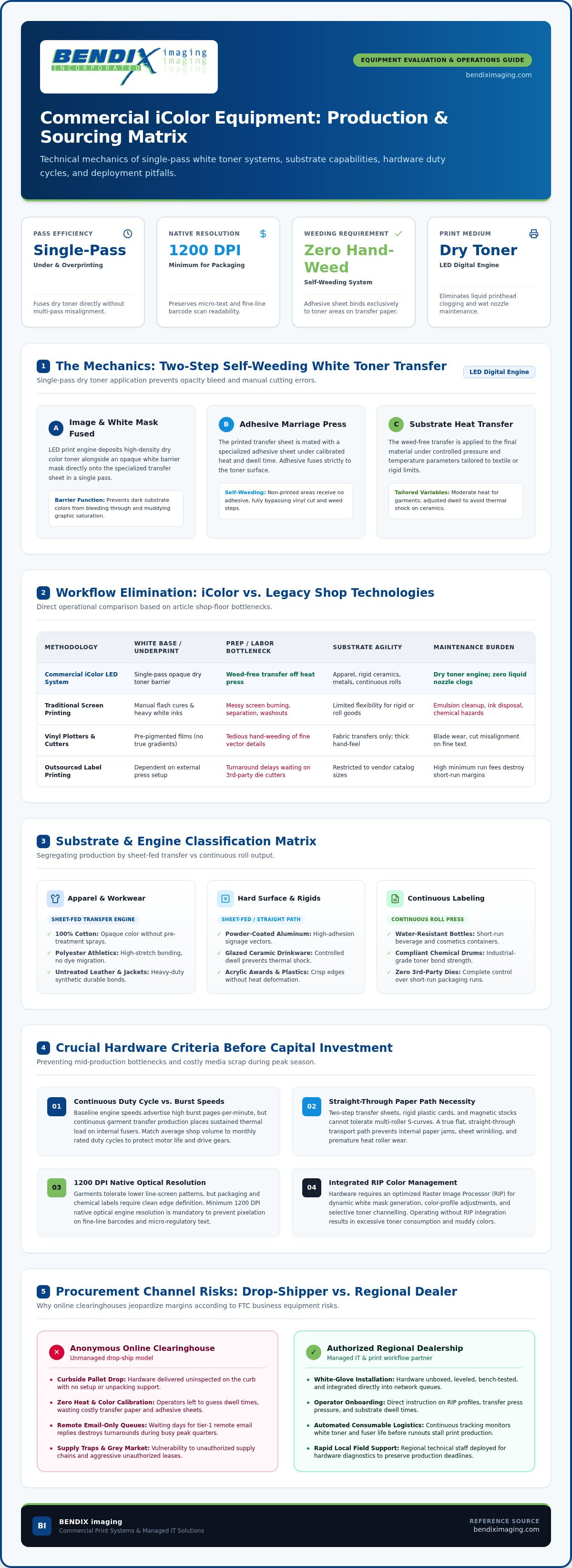
White toner serves as an opaque barrier. Without it, standard toners turn translucent and muddy when applied to dark fabrics or clear substrates. Operators pair this LED engine with two-step self-weeding transfer paper. The printer applies the image and white mask onto a transfer sheet, which is then heat-pressed against an adhesive sheet. The adhesive binds strictly to the toner, leaving non-printed areas bare. Temperature, dwell time, and pressure dynamics dictate durability. Cotton and synthetic textiles bond under moderate heat and firm pressure, whereas rigid ceramics or metals require tailored dwell times to prevent thermal shock and coating failure.
Key Business Applications: From Apparel to Industrial Labeling
Many shops make the mistake of treating all specialty printing the same. Understanding the mechanical division between transfer sheet engines and continuous roll presses is vital for scheduling production runs efficiently. While sheet-fed systems excel at custom personalization, roll systems protect your margins on bulk packaging.
- Apparel and Workwear: Print high-stretch, wash-durable graphics on 100% cotton, polyester athletic gear, untreated leather, and heavy synthetic work jackets without ink bleed.
- Product and Chemical Labeling: Run short-run, water-resistant bottle labels, cosmetics packaging, and compliant chemical containers on continuous digital rolls without waiting on third-party die cutters.
- Rigid Substrates: Transfer intricate vector designs onto powder-coated aluminum signage, glazed ceramic drinkware, and acrylic awards.
Securing the right configuration through verified iColor equipment sales ensures your shop gains this multi-substrate agility without running into daily maintenance traps.
Evaluating Commercial iColor Equipment: Key Criteria Before You Invest
Don't let an online storefront push you into hardware that stalls out during your busiest quarter. Vetting commercial iColor equipment sales requires separating inflated marketing claims from actual daily shop floor demands. A unit rated for high burst speeds won't help if its continuous duty cycle fails after an hour of heavy garment transfer sheets. Reviewing unauthorized supply traps and aggressive leasing tactics highlighted in FTC guidance on business equipment scams proves why sourcing hardware without clear performance validation is dangerous.
Duty Cycles, Resolution, and Media Versatility
Calculate your true output capacity instead of relying on baseline engine speeds. Heavy media such as two-step transfer sheets, rigid plastics, and magnetic stock require a straight-through paper path to prevent internal jams and heat roller wear. For sharp packaging labels and fine-line barcodes, demand at least 1200 dpi native resolution to keep micro-text legible. Garment transfers can tolerate broader screen patterns, but packaging runs require clean edge definition. Match your average daily run against the machine's monthly duty cycle to protect motor life and drive gears.
Software Integration, Color Profiles, and RIP Management
High-end hardware is worthless without capable raster image processor (RIP) software. Commercial production requires automated underprinting and overprinting controls, letting you swap white toner positioning without rebuilding complex vector artwork. Precise ICC profile management is equally critical; it ensures corporate client colors remain identical across cotton t-shirts, metal signs, and roll-fed packaging.
Before you commit, make sure your prospective system covers these core software capabilities:
- Per-Print Costing: Real-time calculators that project toner and media costs down to the penny before pressing print.
- White Choking Controls: Software sliders that automatically choke white underprint layers to prevent unsightly white borders on dark fabrics.
- Consumable Sourcing Logistics: Direct integration with local supply networks so you never run out of specialized toner during unexpected demand spikes.
If you aren't sure which engine class fits your shop's current volume, team up with BENDIX imaging to configure an equipment setup tailored to your exact production demands.
The Pitfalls of Online Drop-Shipping vs. Partnering with a Local Dealer
What happens to your delivery schedule when an 80-pound crate sits unopened on your loading dock because nobody knows how to initialize the print engine? Many business owners researching commercial iColor equipment sales get lured in by slick online storefronts. These national clearinghouses take your money, dispatch a third-party freight truck, and leave you on the curb. When a freight drop damages internal optical components or leaves out essential accessories, you get stuck in a remote customer service loop with outsourced call center staff who have never operated a production transfer press.
The True Cost of Curbside Delivery and Zero Training
Unboxing complex specialty printing equipment without technical support carries massive hidden liabilities. Untrained operators routinely scratch delicate imaging drums or misalign transfer belts during self-installation. Without hands-on color profiling and heat press calibration, you quickly waste hundreds of dollars in transfer sheets and specialty toner trying to fix blurred prints. Worse yet, when things break, web distributors won't dispatch help; they force you to crate up an 80-pound engine and ship it across state lines for depot repair, bringing your customer fulfillment to a dead stop.
Securing Local Deployment Across Eastern South Dakota
Working with a dedicated regional dealer eliminates the risk of expensive hardware sitting idle. Sourcing print machinery should accelerate your revenue, particularly when taking advantage of capital write-offs outlined in IRS Section 179 property depreciation guidelines to offset acquisition expenses. Having a regional partner handle the physical delivery and room-of-choice placement ensures your equipment is verified, leveled, and running test batches before the technician leaves your shop floor.
Commercial print operations in Watertown, Sioux Falls, Brookings, and Huron benefit directly from localized field onboarding:
- Hardware Calibration: Technicians inspect mechanics, lock in transfer temperatures, and configure RIP software presets for your specific media.
- Network Security Hardening: Technicians integrate the print system securely into your local IT infrastructure, ensuring print drivers and data flows don't introduce vulnerabilities.
- Operator Onboarding: Your team receives direct training on preventive cleaning routines, proper cartridge rotation, and safe paper-jam clearance to extend machine life.
Investing in reliable iColor equipment sales backed by local accountability shields your business from costly downtime and keeps your shop producing at full capacity.
Integrating iColor Systems into a Managed Print and IT Workflow
Why treat a specialty production printer as an isolated island when your other office hardware runs within a tightly managed network? Many print operators invest in commercial iColor equipment sales, plug the hardware into an unmonitored wall jack, and operate in total isolation. That mistake leaves you blind to consumable levels, vulnerable to network breaches, and susceptible to sudden production freezes. Treating transfer engines as connected enterprise endpoints ensures your production lines run without interruption.
Automated Toner Replenishment and Supply Control
Running out of white toner in the middle of a rush apparel contract destroys your delivery promises. Proactive telemetry monitoring tracks CMYK and specialized white toner levels across your network in real time. Instead of relying on panic orders when cartridges run dry, an integrated managed print workflow triggers replenishments before tanks drop below critical thresholds. Consolidating your specialized transfer media and toner procurement alongside standard business printing supplies provides predictable cost-per-page tracking, keeping customer quotes accurate and profitable.
Network Stability, Device Security, and Centralized Backups
Specialty printers process high-resolution vector artwork, proprietary corporate branding files, and sensitive client graphics. Leaving these print queues unsecured exposes your business network to unauthorized access and data exfiltration. Commercial print engines require active security oversight just like any other production asset.
Securing your production environment requires three essential network safeguards:
- Access-Controlled Print Queues: Restrict engine operation through authenticated user credentials to stop unauthorized internal use and wasted supplies.
- Centralized Asset Backups: Store proprietary vector artwork, custom RIP profiles, and substrate layout templates in automated cloud-backed archives to prevent permanent file loss.
- Firmware Maintenance: Keep network print interfaces and internal print spoolers updated with current patches to protect against known network vulnerabilities.
Don't let unmanaged equipment create costly production bottlenecks or expose your network. Connect with integrate your printing setup with BENDIX imaging to pair your production machinery with complete IT and managed print security.
Maximizing ROI: Next Steps for Securing Your iColor Printing Solution
How much capital is your shop bleeding each month by sending specialty transfer jobs to third-party wholesale printers? Investing in commercial iColor equipment sales isn't just about buying new hardware; it's an exercise in margin recovery and production independence. When you control the equipment, you reclaim turnaround times, capture rush fees, and eliminate the markup middleman. Maximizing your return requires a sober look at your shop floor numbers before signing any purchase order.
Auditing Production Demands and Financial Feasibility
Start by auditing your past six months of print expenditures. Tally every outsourced invoice for custom apparel, full-color drinkware, short-run packaging labels, and promotional signage. Compare that total against the predictable monthly amortization of dedicated hardware paired with your anticipated consumable costs. Next, factor in your hidden labor expenses. Weeding heat-transfer vinyl and cleaning liquid screen-printing emulsion burns expensive staff hours. Digital dry toner transfer eliminates weeding entirely, slashing production labor down to simple press-and-peel cycles.
To establish a realistic deployment timeline before peak seasonal volume hits, review these core audit checkpoints:
- Target Product Margins: Quantify gross profit targets across custom dark apparel, industrial labeling, and rigid promotional goods to set competitive retail pricing.
- Scrap Rate Benchmarking: Establish an acceptable test-to-production ratio to prevent operators from running up unnecessary transfer media waste during initial setups.
- Production Scheduling: Order and calibrate machinery at least six weeks ahead of seasonal demand spikes to ensure thorough operator training and profile setup.
Partnering with BENDIX imaging for Complete Support
Do not trust your production schedule to an e-commerce shopping cart that treats heavy commercial machinery like consumer parcel freight. Sourcing commercial iColor equipment sales through a committed regional partner protects your capital investment from unboxing errors and software confusion.
BENDIX imaging delivers dedicated equipment sales, specialized white toner supplies, and on-site technical onboarding throughout Eastern South Dakota, including Watertown, Brookings, Sioux Falls, Huron, and Montevideo. Our team works side by side with your operators to dial in heat press profiles, connect device drivers, and integrate hardware into your broader managed print environment. Take control of your print margins and eliminate unmanaged downtime by contacting BENDIX imaging today.
Secure Your Printing Margins and Hardware Support
Commercial printing profitability comes down to reliability and technical execution. Don't risk your turnaround times, media inventory, or customer relationships on distant online clearinghouses that abandon hardware at your curb. True operational efficiency happens when you integrate robust white toner machinery directly into a managed print and IT infrastructure, tracking consumables automatically and safeguarding your proprietary design files from day one.
Headquartered in Watertown, SD, BENDIX imaging provides commercial print shops across Eastern South Dakota with trusted commercial iColor equipment sales, specialized production media, and hands-on regional technician onboarding. With decades of regional business technology expertise, our team ensures your hardware is leveled, properly calibrated, and connected to prevent unmanaged bottlenecks. Take the guesswork out of expanding your shop's capabilities. Upgrade your production line with iColor equipment from BENDIX imaging and print with total confidence.
Frequently Asked Questions
What makes iColor white toner printing different from standard digital printing?
Standard office printers only deposit CMYK dry toner onto white media, leaving clear or dark sheets looking washed out. Commercial iColor systems utilize a specialized five-station LED engine that prints opaque white toner in a single pass. This provides either an underprint base for full-color saturation on dark items or an overprint protective layer for transparent films, without requiring messy liquid screens or multiple production runs.
Can commercial iColor equipment print durable transfers onto dark garments?
Yes, commercial iColor equipment produces long-lasting, wash-tested transfers on dark textiles using a two-step self-weeding paper process. The opaque white toner forms a solid background that bonds with the heat-activated adhesive. It creates vibrant graphics that withstand regular laundering on 100% black cotton, synthetic athletic apparel, nylon jackets, and dark blends without the peeling or color fading typical of cheap vinyl.
What maintenance is required to keep commercial iColor printers operating reliably?
Unlike liquid DTG or DTF printers that suffer from clogged printheads and require daily fluid flushes, dry toner LED systems require minimal daily intervention. Routine upkeep centers on wiping LED array bars, checking waste toner boxes, and replacing consumables like transfer belts and drum units on scheduled intervals. Keeping the internal paper path free of paper dust ensures continuous feeding without risking expensive transfer sheet jams.
How does buying through a local equipment dealer compare to ordering online?
Navigating commercial iColor equipment sales through a regional dealer protects your shop from curbside pallet drops and non-existent technical onboarding. Web clearinghouses leave you to unpack, level, and calibrate complex machinery alone. A regional partner provides hands-on unboxing, RIP software configuration, and operator training, ensuring your hardware works correctly out of the box and preventing costly scrap waste during initial production jobs.
What types of substrates and media can professional iColor systems handle?
Professional units process far more than basic apparel transfers. Beyond cotton, polyester, and performance blends, they handle heavy cardstock, metallic foils, clear window films, and continuous packaging label rolls. Using specialized hard-surface transfer media, operators can decorate ceramic mugs, powder-coated metals, leather patches, wood plaques, and acrylic awards, making the hardware a multi-purpose profit center across commercial and promotional product lines.
Can our business integrate iColor printing into our managed print program?
Yes, you can connect specialized transfer printers directly into an existing managed print environment. Networked SNMP monitoring tracks CMYK and white toner levels alongside your regular office fleet, automating supply replenishment before tanks run empty. Integrating these devices into centralized tracking establishes exact cost-per-print figures, ensures secured print queues for confidential customer artwork, and prevents unexpected downtime during major production runs.
How quickly can our team get operational support and supplies in Eastern South Dakota?
Commercial print shops across Eastern South Dakota, including Watertown, Brookings, Sioux Falls, Huron, and Montevideo, receive direct regional backing from BENDIX imaging. Investing in regional iColor equipment sales connects your facility with dedicated technicians and localized consumable warehouses. You avoid cross-country shipping delays on transfer paper or toner cartridges, securing reliable technical assistance and steady supply fulfillment right within your local operational territory.
{"@context":"https://schema.org","@type":"FAQPage","mainEntity":[{"@type":"Question","name":"What makes iColor white toner printing different from standard digital printing?","acceptedAnswer":{"@type":"Answer","text":"Standard office printers only deposit CMYK dry toner onto white media, leaving clear or dark sheets looking washed out. Commercial iColor systems utilize a specialized five-station LED engine that prints opaque white toner in a single pass. This provides either an underprint base for full-color saturation on dark items or an overprint protective layer for transparent films, without requiring messy liquid screens or multiple production runs."}},{"@type":"Question","name":"Can commercial iColor equipment print durable transfers onto dark garments?","acceptedAnswer":{"@type":"Answer","text":"Yes, commercial iColor equipment produces long-lasting, wash-tested transfers on dark textiles using a two-step self-weeding paper process. The opaque white toner forms a solid background that bonds with the heat-activated adhesive. It creates vibrant graphics that withstand regular laundering on 100% black cotton, synthetic athletic apparel, nylon jackets, and dark blends without the peeling or color fading typical of cheap vinyl."}},{"@type":"Question","name":"What maintenance is required to keep commercial iColor printers operating reliably?","acceptedAnswer":{"@type":"Answer","text":"Unlike liquid DTG or DTF printers that suffer from clogged printheads and require daily fluid flushes, dry toner LED systems require minimal daily intervention. Routine upkeep centers on wiping LED array bars, checking waste toner boxes, and replacing consumables like transfer belts and drum units on scheduled intervals. Keeping the internal paper path free of paper dust ensures continuous feeding without risking expensive transfer sheet jams."}},{"@type":"Question","name":"How does buying through a local equipment dealer compare to ordering online?","acceptedAnswer":{"@type":"Answer","text":"Navigating commercial iColor equipment sales through a regional dealer protects your shop from curbside pallet drops and non-existent technical onboarding. Web clearinghouses leave you to unpack, level, and calibrate complex machinery alone. A regional partner provides hands-on unboxing, RIP software configuration, and operator training, ensuring your hardware works correctly out of the box and preventing costly scrap waste during initial production jobs."}},{"@type":"Question","name":"What types of substrates and media can professional iColor systems handle?","acceptedAnswer":{"@type":"Answer","text":"Professional units process far more than basic apparel transfers. Beyond cotton, polyester, and performance blends, they handle heavy cardstock, metallic foils, clear window films, and continuous packaging label rolls. Using specialized hard-surface transfer media, operators can decorate ceramic mugs, powder-coated metals, leather patches, wood plaques, and acrylic awards, making the hardware a multi-purpose profit center across commercial and promotional product lines."}},{"@type":"Question","name":"Can our business integrate iColor printing into our managed print program?","acceptedAnswer":{"@type":"Answer","text":"Yes, you can connect specialized transfer printers directly into an existing managed print environment. Networked SNMP monitoring tracks CMYK and white toner levels alongside your regular office fleet, automating supply replenishment before tanks run empty. Integrating these devices into centralized tracking establishes exact cost-per-print figures, ensures secured print queues for confidential customer artwork, and prevents unexpected downtime during major production runs."}},{"@type":"Question","name":"How quickly can our team get operational support and supplies in Eastern South Dakota?","acceptedAnswer":{"@type":"Answer","text":"Commercial print shops across Eastern South Dakota, including Watertown, Brookings, Sioux Falls, Huron, and Montevideo, receive direct regional backing from BENDIX imaging. Investing in regional iColor equipment sales connects your facility with dedicated technicians and localized consumable warehouses. You avoid cross-country shipping delays on transfer paper or toner cartridges, securing reliable technical assistance and steady supply fulfillment right within your local operational territory."}}]}


