

What if the break-fix tech model you rely on is actually engineered to profit from your operational failure? You already know the sheer frustration of unannounced system crashes, sluggish networks, and unpredictable repair bills that arrive right when productivity stalls. Finding dependable technical talent across regional markets isn't easy, and waiting for equipment to fail before calling for help exposes your entire enterprise to catastrophic interruptions. Securing proactive managed IT support South Dakota organizations trust shifts your technology from an endless series of emergencies into a dependable foundation for business stability.
You shouldn't have to carry the daily anxiety of looming ransomware attacks, regulatory audits, or volatile hourly contractor expenses. In this guide, you'll discover how regional managed IT support eliminates operational downtime, shields business infrastructure, and drives sustainable growth across South Dakota. We'll examine what comprehensive technology oversight really covers and show you how to transition from chaotic, reactive troubleshooting to strategic, predictable operations.
Key Takeaways
- Understand the vital difference between reactive, costly break-fix models and comprehensive managed IT support South Dakota businesses rely on to prevent downtime.
- Discover how unifying network security, automated data backup, and managed print closes critical vulnerabilities across your operational infrastructure.
- Compare the hidden organizational costs of maintaining internal tech staff against the predictable financial structure of an outsourced provider.
- Learn a rigorous vetting framework to spot vague service agreements, surprise equipment fees, and subpar contractor standards before signing.
- Explore how strategic technological oversight and local executive guidance, such as vCSO consulting, shield your enterprise from evolving compliance risks.
What Is Managed IT Support for South Dakota Businesses?
Managed IT support is not a remote help desk you dial only after a server crashes. It is a comprehensive framework of operational governance, continuous surveillance, and strategic risk management. Rather than treating technical problems as isolated repair tickets, partnering with a professional Managed Service Provider (MSP) places your entire digital environment under active, round-the-clock defense. This operational shift transforms technology expenses from volatile capital leaks into a stable, predictable monthly operating cost. Commercial organizations running high-stakes operations across the state require executive-level accountability and dedicated oversight. Modern managed IT support South Dakota enterprises invest in delivers exactly that, defending vital digital assets while aligning day-to-day computing directly with long-term revenue targets.
The Fatal Flaws of Reactive Break-Fix IT
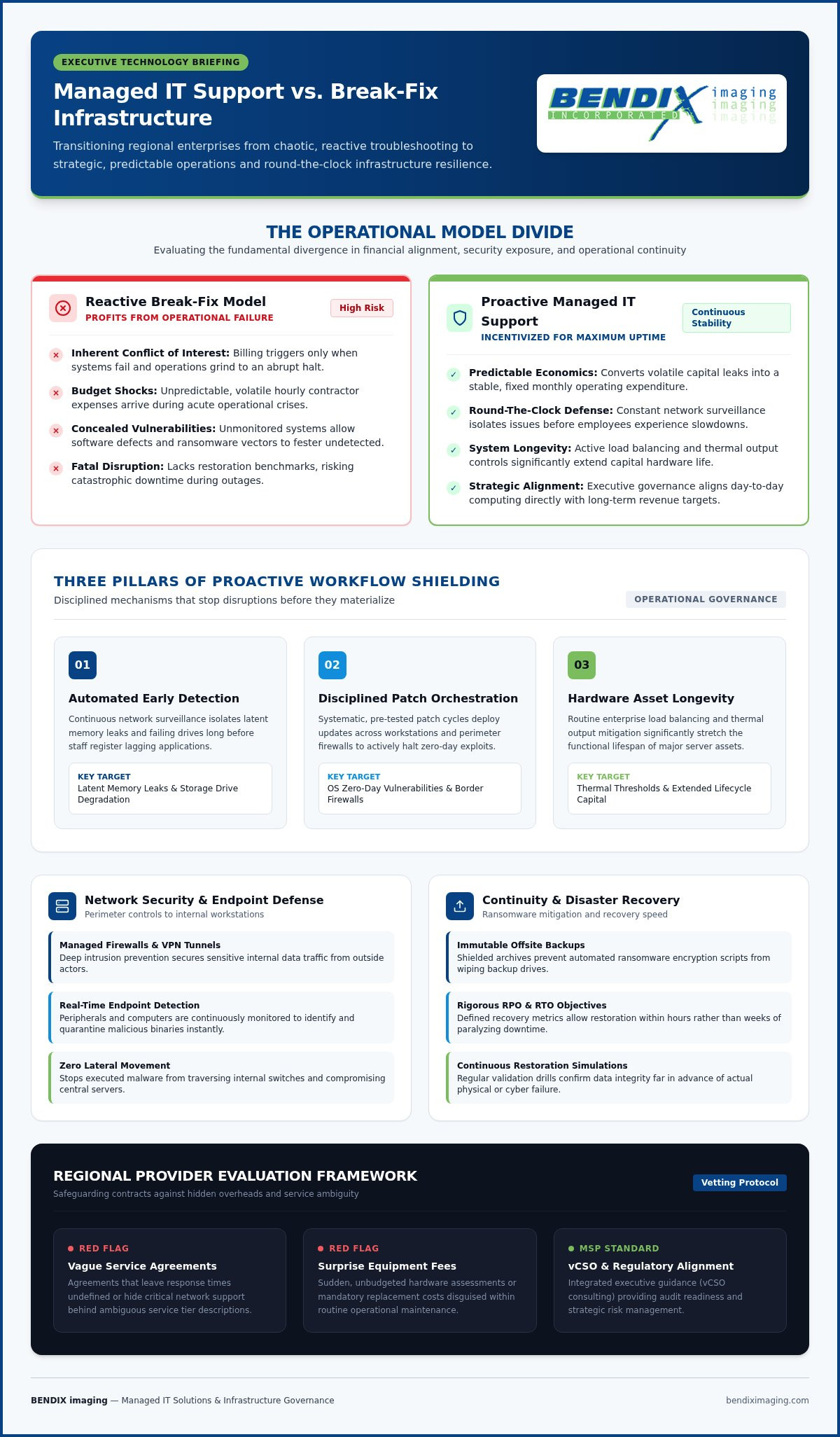
The traditional break-fix model is built on an inherent conflict of interest. An outside technician makes money only when your systems grind to an abrupt halt. When your network is stable, they don't bill; when your company experiences a catastrophic failure, their billing clock accelerates. This creates sudden, volatile budget shocks, forcing financial officers to pay premium hourly rates during acute operational panics. Worse, unmonitored infrastructure conceals latent vulnerabilities, allowing ransomware actors and software defects to fester undetected until business operations hit a wall.
How Proactive Management Shields Daily Workflows
Proactive administration inverts this broken model entirely by establishing rigorous, ongoing defense mechanisms across your network. Instead of waiting for disasters, dedicated management focuses on prevention:
- Automated early detection: Continuous network monitoring isolates latent memory leaks and failing drives before employees ever perceive slow application performance.
- Disciplined patch orchestration: Scheduled update cycles test and deploy operating system patches, actively shutting down zero-day exploits across workstations and border firewalls.
- Hardware asset longevity: Routine enterprise maintenance balances server loads, manages thermal output, and dramatically extends the functional lifecycle of expensive capital infrastructure.
Adopting strategic managed IT support South Dakota businesses need means you no longer surrender productivity to chance. Your core network, digital communications, and endpoints receive vigilant, disciplined stewardship, ensuring regional disruption never dictates your bottom line.
Core Components of Modern Managed IT Infrastructure
A resilient technology environment requires far more than basic connectivity; it demands an interconnected shield of operational safeguards. Modern business infrastructure unites defensive engineering, high-integrity data pipelines, and ongoing executive strategy. Understanding what an MSP can do means recognizing that true managed IT support South Dakota businesses depend on integrates every layer of daily computing into an impenetrable, synchronized workflow.
Network Security and Vigilant Endpoint Defense
Modern defense begins at the boundary and extends to every peripheral workstation. Managed firewall administration, deep intrusion prevention, and encrypted VPN tunnels ensure sensitive internal traffic stays locked away from hostile actors. Meanwhile, endpoint detection monitors processes in real time, instantly quarantining malicious binaries before they execute lateral movement across your server environment. If your current protections stop at standard desktop antivirus, review our comprehensive guide to cybersecurity Eastern South Dakota to address dangerous perimeter gaps.
Data Backup, Disaster Recovery, and Business Continuity
Data resilience is not an archive problem; it is an active business survival requirement. Immutable offsite backups keep your proprietary records safe from automated ransomware encryption scripts that target accessible internal drives. By establishing tight Recovery Point Objectives (RPOs) and Recovery Time Objectives (RTOs), an MSP enables your organization to restore critical databases within hours rather than suffering weeks of fatal business paralysis. Rigorous restoration simulations run continuously behind the scenes, validating data integrity long before a real-world catastrophe strikes.
Strategic Advisory: vCSO and Compliance Leadership
Deploying powerful hardware is pointless without executive steering. Virtual Chief Security Officers (vCSO) bring board-level governance to your operation, translating complex legal mandates like South Dakota's 60-day data breach notification requirements into clear internal policies. They build lifecycle replacement roadmaps that keep capital expenditures predictable and aligned with revenue growth. If your organization is modernizing workflows, review our AI consulting guide for South Dakota small businesses to deploy automated tools securely.
Managing operational risk requires constant vigilance across networks, endpoints, and data assets. Commercial leaders seeking to harden their infrastructure against catastrophic downtime can consult with the specialists at BENDIX imaging to audit existing technical gaps.
In-House Staff vs. Managed Service Provider: Cost and Capability
Every growing enterprise eventually faces an operational crossroads: hire an internal technician or retain an outside provider? While having an employee sitting down the hall provides an illusion of control, the true organizational investment tells a different story. Aligning internal operations with CISA's cyber guidance demands cross-functional expertise that single generalists simply cannot maintain alone. To achieve lasting resilience, commercial organizations require an objective assessment of overhead, tooling, and labor constraints.
The True Overhead of Internal IT Departments
Direct payroll represents only the baseline expenditure of internal hiring. Employer-sponsored healthcare, payroll taxes, paid leave, and retirement contributions compound base compensation significantly. Advanced certifications in firewall routing, cloud virtualization, and compliance audit preparation require thousands of dollars in continuous professional education. Relying on an isolated administrator introduces crippling structural vulnerability: who monitors the network when your sole technician takes vacation, falls ill, or suddenly resigns?
Comprehensive Comparison: In-House vs. MSP vs. Co-Managed
Evaluating your support structure requires looking beyond basic ticket counts to analyze toolsets and coverage:
| Operational Metric | In-House Employee | Break-Fix Contractor | Managed Service Provider |
|---|---|---|---|
| Depth of Expertise | Single generalist knowledge | Variable tactical repair skill | Multidisciplinary engineering bench |
| Coverage Reliability | Halted by PTO and sick leave | Delayed until technician availability | Continuous operational monitoring |
| Tooling & Infrastructure | Purchased at high individual cost | Basic third-party utilities | Enterprise-grade stacks included |
| Budget Predictability | Fixed salary plus emergency overtime | Chaotic, unpredictable invoices | Stable monthly operational baseline |
For organizations with existing technical personnel, a hybrid co-managed framework provides relief. An external partner offloads tedious routine patching and network hygiene, freeing internal staff to focus on critical revenue-generating projects.
Solving Regional Talent Shortages in Eastern South Dakota
Commercial hubs like Watertown, Brookings, and Huron face intense regional competition for certified cyber analysts. Small to mid-sized firms frequently lose recruiting battles to distant tech conglomerates offering remote software salaries. Partnering with established managed IT support South Dakota providers bypasses regional hiring bottlenecks instantly, delivering deep technical resources without recruiting friction. Forward-thinking executives assess their vulnerabilities before disaster hits by reviewing tailored infrastructure strategies directly with BENDIX imaging.
Evaluating Managed IT Support Providers in South Dakota
Selecting an IT partner is an operational risk decision, not a simple utility purchase. Too many commercial executives sign rigid long-term contracts only to discover hidden hardware surcharges, offshore call centers, and vague service agreements that excuse hours of crippling network outages. Evaluating managed IT support South Dakota providers requires a structured vetting framework to separate genuine operational partners from passive ticket routers.
Step 1 & 2: Proximity, Response SLAs, and Industry Experience
Distant national vendors often treat regional hubs as low-priority outposts. When evaluating an MSP, ensure they maintain an established operational base within Eastern South Dakota to deliver true accountability for complex technical consultations. Next, look past marketing claims and inspect their legally binding Service Level Agreements (SLAs). Your contract must specify guaranteed response intervals for critical network emergencies rather than vague promises to try their best. Finally, verify demonstrable experience navigating regional industries like precision manufacturing, regional banking, and healthcare networks governed by strict federal compliance rules.
Step 3 & 4: Security Posture and Transparent Agreements
An outside technology firm holds the keys to your entire digital kingdom, making their internal defenses your primary vulnerability. Audit their practices rigorously before granting network credentials:
- Internal security controls: Require the provider to prove their own staff adheres to mandatory multi-factor authentication, routine internal penetration testing, and clean SOC compliance standards.
- Billing transparency: Demand flat-rate contract language that explicitly outlines which items trigger additional fees, eliminating nickel-and-dime charges for routine patching or remote user setup.
- Sovereign data ownership: Ensure your agreement unequivocally confirms your company retains 100% ownership of all network configurations, administrative passwords, and data stores with zero lock-in barriers during offboarding.
Step 5: Technology Alignment and Quarterly Reviews
Vigilant governance demands continuous executive engagement. Top-tier providers run structured Quarterly Business Reviews (QBRs) to audit hardware lifecycles, retire obsolete endpoints, and adjust bandwidth before physical infrastructure causes downtime. This proactive rhythm prevents unexpected capital expenditures and ensures your computing capacity scales smoothly alongside regional business growth.
Don't settle for distant vendors with evasive service standards. Protect your commercial infrastructure today by scheduling a comprehensive systems evaluation with the regional experts at bendiximaging.com.
Securing Your Competitive Edge with BENDIX Imaging Managed Solutions
Fragmented office technology creates costly operational blind spots. When your network slows down, your phone system drops calls, or your document workflows fail, disparate vendors instinctively blame each other. You get stuck in the middle, footing the bill for lost productivity while nobody takes ownership. Modernizing your business means eliminating this friction entirely. By consolidating your infrastructure under a single, vigilant partner, you replace disconnected vendors with an integrated defense system built for stability and growth.
A Unified Technology Ecosystem: IT, Print, and Communications
True operational efficiency happens when your digital tools communicate seamlessly under one unified architecture. BENDIX imaging converges core managed IT support South Dakota organizations rely on with commercial VoIP communications and automated managed print systems. Instead of juggling separate invoices for telephony, hardware supplies, network security, and server patching, you gain a transparent, single-source operational partnership. When desktop workflows, high-speed VoIP lines, and secure office print systems operate under unified management, administrative overhead plummets and accountability becomes absolute.
The Local Advantage Across Eastern South Dakota
Corporate conglomerates run remote help desks staffed by rotating operators who don't understand our regional economy. BENDIX imaging operates with direct, no-nonsense leadership rooted right here in Eastern South Dakota. Headquartered in Watertown and actively defending enterprises across Brookings, Sioux Falls, and Huron, our team understands regional business realities. Whether supporting precision manufacturing, agricultural logistics, or community financial services, our engineers maintain an uncompromising commitment to keeping regional businesses fully operational, strictly compliant, and shielded against modern digital threats.
Taking the First Step Toward Proactive Operations
Tolerating sluggish systems, unexpected repair bills, and lurking cyber vulnerabilities is a choice you don't have to make. Every hour lost to network downtime drains revenue, weakens client trust, and demoralizes your workforce. You deserve an assertive local watchdog dedicated to keeping your systems running at peak performance.
Take control of your infrastructure before an avoidable failure forces your hand. Uncover latent security vulnerabilities, optimize your workflows, and discover the power of strategic managed IT support South Dakota enterprises trust. Request your IT assessment with BENDIX imaging today and secure the dedicated technological oversight your business demands.
Transform Your Technology into a Predictable Growth Engine
Relying on antiquated break-fix contractors is an expensive gamble your enterprise cannot afford. Moving to proactive managed IT support South Dakota businesses depend on eliminates volatile emergency invoices, shields vital records with immutable backups, and unifies communications, hardware, and cybersecurity under one accountable standard. When your operational foundation is actively defended, technology stops being an unpredictable liability and becomes your greatest competitive advantage.
Anchored in Watertown and actively serving enterprises throughout Brookings, Sioux Falls, and Huron, BENDIX imaging stands as your vigilant regional watchdog. By integrating managed IT services, executive vCSO governance, VoIP systems, and managed print, our team ensures your operations stay compliant, secure, and continuously moving forward. Don't wait for the next system crash to disrupt your business momentum. Protect your business with dedicated managed IT support from BENDIX imaging and build the resilient future your organization deserves.
Frequently Asked Questions
What is typically included in a managed IT support contract in South Dakota?
A comprehensive managed IT support contract delivers end-to-end network administration, automated patching, cybersecurity defenses, and regular data backups. Beyond standard workstation maintenance, top-tier agreements incorporate strategic elements such as Virtual Chief Security Officer (vCSO) guidance, regulatory compliance oversight, and unified communications like business VoIP. It replaces piecemeal software licenses with an integrated management ecosystem, giving leadership total visibility and predictable operating costs without unexpected billing surprises.
How does managed IT support differ from a standard break-fix computer repair service?
Break-fix services operate on a purely reactive model where technicians bill hourly rates only after systems crash or hardware breaks down. In contrast, managed IT support South Dakota enterprises rely on is continuous and preventative. An MSP deploys automated monitoring to isolate and correct vulnerabilities before they interrupt employee workflows. Break-fix contractors profit from your operational downtime, whereas a managed partner aligns their success directly with maintaining complete network uptime.
Can managed IT support work alongside our existing in-house IT staff?
Yes, this collaborative approach is known as co-managed IT. It allows growing companies to augment their internal staff with an external team rather than replacing them. The MSP absorbs routine maintenance burdens like software patching, firewall log audits, and endpoint monitoring. This operational shift relieves daily pressure on your in-house administrator, freeing them to concentrate on company-specific projects, enterprise resource planning, and internal user support.
How quickly should a regional managed service provider respond to technical issues?
Contracted response times depend on the specific severity level defined in your Service Level Agreement (SLA). Critical network outages affecting core business operations should mandate a technical response within 15 to 30 minutes. Minor user queries or routine administrative requests generally fall within standard multi-hour windows. Always demand clear, legally binding contractual response thresholds rather than accepting vague verbal assurances that leave your team stranded during outages.
Why should a small business invest in managed IT if they have never experienced a cyberattack?
Waiting for an attack before investing in security is the fastest way to suffer catastrophic operational paralysis. Automated ransomware scripts scan the internet indiscriminately for unpatched firewalls and weak credentials, targeting organizations regardless of company size. Proactive managed IT support South Dakota providers implement establishes defensive endpoint controls, multi-factor authentication, and immutable data backups before threats strike. Precautionary protection costs a fraction of the regulatory fines, legal liabilities, and downtime of a breach.
Does managed IT support include regulatory compliance management for healthcare or finance?
Specialized providers incorporate regulatory compliance management directly into their technical oversight. For healthcare clinics under HIPAA or financial institutions governed by GLBA, an MSP configures required encryption protocols, audits access controls, and enforces strict data retention rules. They also ensure alignment with South Dakota's 60-day breach notification statute. Having executive compliance oversight ensures your systems withstand formal regulatory audits while safeguarding protected client records from accidental exposure.
What geographic areas throughout South Dakota does a regional MSP typically cover?
A dedicated regional provider focuses their operational footprint where they can maintain direct, accountable client relationships. For example, BENDIX imaging is headquartered in Watertown and actively supports commercial enterprises throughout Eastern South Dakota, including Brookings, Sioux Falls, and Huron, alongside regional hubs like Montevideo. This focused regional footprint ensures your leadership works with engineers who understand local commercial dynamics rather than navigating an anonymous, distant corporate ticketing queue.
{"@context":"https://schema.org","@type":"FAQPage","mainEntity":[{"@type":"Question","name":"What is typically included in a managed IT support contract in South Dakota?","acceptedAnswer":{"@type":"Answer","text":"A comprehensive managed IT support contract delivers end-to-end network administration, automated patching, cybersecurity defenses, and regular data backups. Beyond standard workstation maintenance, top-tier agreements incorporate strategic elements such as Virtual Chief Security Officer (vCSO) guidance, regulatory compliance oversight, and unified communications like business VoIP. It replaces piecemeal software licenses with an integrated management ecosystem, giving leadership total visibility and predictable operating costs without unexpected billing surprises."}},{"@type":"Question","name":"How does managed IT support differ from a standard break-fix computer repair service?","acceptedAnswer":{"@type":"Answer","text":"Break-fix services operate on a purely reactive model where technicians bill hourly rates only after systems crash or hardware breaks down. In contrast, managed IT support South Dakota enterprises rely on is continuous and preventative. An MSP deploys automated monitoring to isolate and correct vulnerabilities before they interrupt employee workflows. Break-fix contractors profit from your operational downtime, whereas a managed partner aligns their success directly with maintaining complete network uptime."}},{"@type":"Question","name":"Can managed IT support work alongside our existing in-house IT staff?","acceptedAnswer":{"@type":"Answer","text":"Yes, this collaborative approach is known as co-managed IT. It allows growing companies to augment their internal staff with an external team rather than replacing them. The MSP absorbs routine maintenance burdens like software patching, firewall log audits, and endpoint monitoring. This operational shift relieves daily pressure on your in-house administrator, freeing them to concentrate on company-specific projects, enterprise resource planning, and internal user support."}},{"@type":"Question","name":"How quickly should a regional managed service provider respond to technical issues?","acceptedAnswer":{"@type":"Answer","text":"Contracted response times depend on the specific severity level defined in your Service Level Agreement (SLA). Critical network outages affecting core business operations should mandate a technical response within 15 to 30 minutes. Minor user queries or routine administrative requests generally fall within standard multi-hour windows. Always demand clear, legally binding contractual response thresholds rather than accepting vague verbal assurances that leave your team stranded during outages."}},{"@type":"Question","name":"Why should a small business invest in managed IT if they have never experienced a cyberattack?","acceptedAnswer":{"@type":"Answer","text":"Waiting for an attack before investing in security is the fastest way to suffer catastrophic operational paralysis. Automated ransomware scripts scan the internet indiscriminately for unpatched firewalls and weak credentials, targeting organizations regardless of company size. Proactive managed IT support South Dakota providers implement establishes defensive endpoint controls, multi-factor authentication, and immutable data backups before threats strike. Precautionary protection costs a fraction of the regulatory fines, legal liabilities, and downtime of a breach."}},{"@type":"Question","name":"Does managed IT support include regulatory compliance management for healthcare or finance?","acceptedAnswer":{"@type":"Answer","text":"Specialized providers incorporate regulatory compliance management directly into their technical oversight. For healthcare clinics under HIPAA or financial institutions governed by GLBA, an MSP configures required encryption protocols, audits access controls, and enforces strict data retention rules. They also ensure alignment with South Dakota's 60-day breach notification statute. Having executive compliance oversight ensures your systems withstand formal regulatory audits while safeguarding protected client records from accidental exposure."}},{"@type":"Question","name":"What geographic areas throughout South Dakota does a regional MSP typically cover?","acceptedAnswer":{"@type":"Answer","text":"A dedicated regional provider focuses their operational footprint where they can maintain direct, accountable client relationships. For example, BENDIX imaging is headquartered in Watertown and actively supports commercial enterprises throughout Eastern South Dakota, including Brookings, Sioux Falls, and Huron, alongside regional hubs like Montevideo. This focused regional footprint ensures your leadership works with engineers who understand local commercial dynamics rather than navigating an anonymous, distant corporate ticketing queue."}}]}


