

What if your business has strong security tools but still misses a compliance obligation? Regulatory compliance for businesses starts with identifying which rules apply, not with buying technology or copying another company’s checklist. The answer can depend on your industry, locations, customers, and the information you handle.
If you’re unsure where your responsibilities begin, you’re not alone. Requirements can be difficult to translate into reliable day-to-day practices, and a policy on paper won’t protect your organization if staff and systems don’t follow it. Ask qualified legal or industry professionals to confirm your obligations. Then document what needs attention and prioritize the risks.
This guide explains what business compliance involves, how to identify and verify relevant requirements, and how to build a practical program with clear owners, records, and review processes. You’ll also see where IT security, managed IT, and vCSO expertise can help put technology controls into operation and support ongoing coordination. These resources can strengthen your process, but they don’t replace legal counsel or guarantee compliance. The goal is a clear, workable approach that helps protect your organization and gives your team a dependable place to start.
Key Takeaways
- Regulatory compliance for businesses depends on the rules tied to your industry, locations, customers, data, and activities.
- Map your operations and information systems to see which obligations may need review.
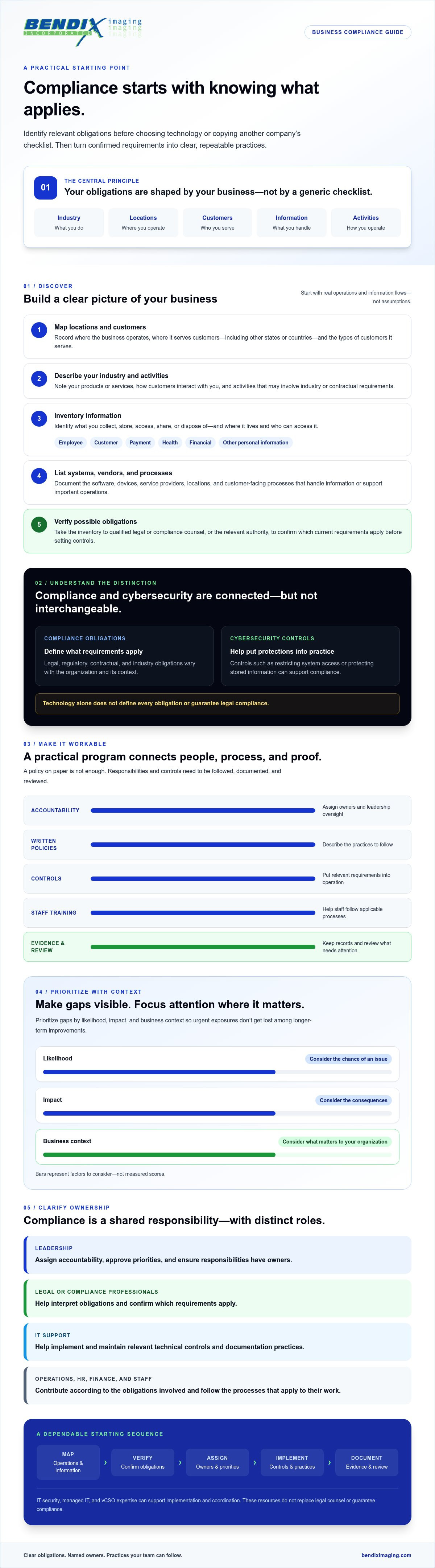
- A practical compliance program connects assigned owners, written policies, controls, staff training, and evidence.
- Prioritize gaps by likelihood, impact, and business context so urgent exposures don’t get lost among longer-term improvements.
- Use legal counsel to confirm requirements and IT support to put relevant security and documentation controls into practice.
What Regulatory Compliance for Businesses Means, and Why It Matters
Regulatory compliance means meeting the legal, regulatory, contractual, and industry obligations that apply to an organization. The specific requirements aren’t the same for every company. They can depend on your industry, the information you handle, where you operate, who your customers are, and the activities you perform. Regulatory compliance varies across industries and jurisdictions, so assumptions based on another business can leave important gaps.
For a small business, compliance might involve handling employee records responsibly, meeting customer or vendor contract terms, or following requirements tied to a particular service. A business that processes payment information may face different obligations from one that doesn’t. Rather than copying a checklist, first establish which requirements apply, then turn them into repeatable practices.
The stakes go beyond avoiding penalties. A clear, well-managed approach can help protect people and information, support dependable operations, and show that leadership is exercising responsible oversight. When responsibilities are unclear, important tasks may be missed or handled inconsistently. Regulatory compliance for businesses is therefore both an obligation and a practical part of managing risk.
How regulatory compliance differs from cybersecurity
Cybersecurity controls, such as restricting system access or protecting stored information, can help support compliance. But cybersecurity doesn’t define every legal, contractual, or industry obligation. Requirements often describe an outcome, while a business chooses suitable technical and administrative methods to meet it. The right approach depends on the obligation and the organization. A technology vendor can support implementation, but technology alone cannot guarantee legal compliance.
Who should take ownership of compliance?
Leadership must assign accountability, approve priorities, and make sure responsibilities have owners. Compliance isn’t solely an IT task: operations, HR, and finance may each contribute, depending on the obligations involved. IT can help implement and maintain relevant technical controls, while staff follow the processes that apply to their work. If you’re uncertain whether a rule applies or how to interpret it, consult qualified legal or compliance professionals.
Set a clear boundary between advice and execution. Legal counsel can help interpret obligations; an IT partner can support the technology and operational controls used to address them. Start by identifying what applies, naming who is accountable, and building processes that can be followed and reviewed.
How to Identify Which Business Compliance Requirements Apply
Start with your actual operations, not a generic checklist. A useful discovery process helps you spot where obligations may arise, then gives qualified counsel or the relevant authority the context needed to confirm them. For regulatory compliance for businesses, the details matter: where you operate, what you do, and what information your business handles can all affect the review.
- Map locations and customers. Record where your business operates and where it serves customers. Include locations in other states or countries, as well as the types of customers you serve.
- Describe your industry and activities. Note the products or services you provide, how customers interact with you, and any activities that may be subject to industry or contractual requirements.
- Inventory information. Identify employee, customer, payment, health, financial, and other personal information your business collects, stores, accesses, shares, or disposes of. Note where it lives and who can access it.
- List systems, vendors, and processes. Document the software, devices, service providers, business locations, and customer-facing processes that handle information or support important operations.
- Verify possible obligations. Take the resulting inventory to qualified legal or compliance counsel, or the relevant authority, to confirm which current requirements apply before setting controls.
Map your data, operations, and third parties
Trace information through its lifecycle, from collection to disposal. For example, a small business might receive customer details through a website, store them in business software, and share selected records with an outside provider. Record each step, the systems involved, and each party’s role. Flag payment, health, financial, and personal information for careful review; their presence alone doesn’t establish which rules apply.
Separate laws, standards, contracts, and guidance
Don’t treat every checklist or framework as a law. Statutes and regulations create legal requirements; contracts can impose obligations between parties; industry standards may apply through customer, payment, or other business relationships. Guidance and voluntary frameworks can help structure risk management without creating a universal legal mandate. For example, the NIST Cybersecurity Framework is a risk-management framework, not a rule that automatically applies to every business.
HIPAA, the FTC Safeguards Rule, and PCI DSS are examples to investigate, not requirements to assume. Applicability depends on the organization’s circumstances and the relevant rule or relationship. If requirements appear to overlap, or operations cross jurisdictions, ask qualified counsel to clarify what applies and how conflicts should be handled. Then use that confirmed scope to guide technical and administrative controls.
Once the obligations are confirmed, an IT partner can help connect them to documented technology practices. Eastern South Dakota businesses can learn more about BENDIX imaging’s compliance support when considering that operational side of the work.
What a Business Compliance Program Should Cover
A useful program turns confirmed obligations into work people can carry out and leadership can oversee. It connects clear accountability with written policies, practical controls, staff training, and records that show how processes operate. The goal isn’t to collect policies and assume the job is done. It’s to make responsibilities visible and keep the program aligned with the organization’s actual obligations and risks.
Prioritize obligations that apply and risks that could seriously affect people, information, or operations. Depending on the business and its confirmed requirements, controls may include:
- Managing access to systems and information, including reviewing who still needs access.
- Maintaining secure system configurations and documenting relevant changes.
- Protecting backups and checking that recovery processes support business needs.
- Establishing incident response steps, roles, and documentation practices.
- Reviewing vendors that handle sensitive information or access business systems.
These are possible components, not a universal checklist. A control that helps one organization may not meet another organization’s obligations. Confirm the requirements before deciding what’s necessary, and document why each control is in place.
Turn requirements into policies, controls, and evidence
For each confirmed obligation, identify a responsible owner, the process that addresses it, and the supporting control. Keep appropriate records, such as dated policies, training completion, access reviews, and incident documentation. Define how exceptions are reported, approved, corrected, and reviewed. This creates a traceable connection between the requirement and the work your team performs, rather than leaving compliance dependent on memory or informal habits.
Account for employees, vendors, and changing risks
Give employees training suited to their roles and a clear way to raise concerns. Assess vendors according to the sensitivity of the information they handle and their access to your systems; record the review and follow-up actions. Revisit the program when laws, operations, technology, threats, or vendor relationships change. A control that once fit may need adjustment as the business or its exposure evolves.
Make the program usable. Assign owners who can maintain records and raise gaps, while leadership reviews priorities and approves decisions that affect risk. IT and security support can help implement and maintain relevant technical controls, such as access management, backups, and secure configurations. But a technology checklist alone doesn’t establish that every legal or contractual obligation is met. Keep the program grounded in confirmed requirements, then check whether the documented process is being followed and still addresses the risks that matter.
How to Build a Practical Compliance Roadmap Without Guesswork
A roadmap turns confirmed obligations and known gaps into assigned work. Keep it in one maintained plan so leaders can see what needs attention, who owns each action, and what evidence will show progress. For regulatory compliance for businesses, a clear sequence helps prevent urgent exposures from getting buried under routine improvements.
- Confirm obligations. Record the requirements qualified advisers or relevant authorities have confirmed apply to your organization.
- Assess gaps. Compare those requirements with current practices. Note missing controls, incomplete records, and areas where evidence is unclear.
- Assign owners. Give each action a responsible person, a realistic due date, and an escalation path for delays or decisions beyond their authority.
- Prioritize work. Weigh likelihood, potential impact, and business context. Address credible, high-impact exposures first, then schedule longer-term process improvements.
- Document and review. Track decisions, owners, due dates, evidence, and status in the same plan. Set a review cadence that reflects your risks and obligations.
Make priorities explicit. A gap that could expose sensitive information or disrupt a critical business process may call for faster action than a documentation improvement with limited immediate impact. Don’t rely on urgency alone: record why an item is prioritized, who approved the approach, and when the decision should be revisited.
Prioritize gaps and assign accountable owners
For each corrective action, describe the gap, the evidence supporting it, the planned response, and the person responsible. Set a deadline that accounts for the work required and its dependencies. Escalate questions about legal interpretation to qualified advisers, and bring material risk decisions to leadership. If a control can’t be implemented as planned, document the reason, interim steps, and approval rather than letting the issue disappear from view.
Review the program as the business changes
Use a review schedule suited to your risk and obligations, then trigger an additional review after meaningful changes. New systems, vendors, acquisitions, incidents, or data practices can alter the organization’s exposure. Recheck whether owners, evidence, and corrective actions remain current. For focused security planning, see the Eastern South Dakota cybersecurity guide and this small-business cybersecurity audit guide.
Need help coordinating the technology side of your roadmap? Discuss compliance and IT support needs with BENDIX imaging. Technology support can help put relevant controls into practice, while legal counsel remains the resource for determining legal obligations.
How IT and Compliance Support Fit Together for South Dakota Businesses
Compliance plans depend on people and technology working together. An IT partner can help implement and maintain relevant security, access, backup, and documentation controls. That work supports the organization’s compliance processes, but it doesn’t determine which laws apply or how they should be interpreted. Legal counsel advises on legal obligations; IT providers support technical execution.
For businesses in Eastern South Dakota, BENDIX imaging offers managed IT, cybersecurity, network security, data backup and recovery, regulatory compliance support, and vCSO expertise. These services may help connect technology operations with a documented compliance effort. Confirm the specific scope before work begins. To explore operational support, see managed IT support in South Dakota.
When outside compliance and IT support may help
Consider outside support when internal expertise is limited, systems are complex, or it’s unclear who owns a control. A vCSO may help with strategic coordination, but confirm the current service scope and responsibilities rather than assuming specific deliverables. Before engaging a provider, agree on what work is included, who approves decisions, how concerns are escalated, and how often progress is reviewed.
Keep roles clear. Leadership remains accountable for assigning responsibility and approving priorities. Qualified legal or compliance advisers can help determine and interpret obligations. IT professionals can support relevant technical work, such as maintaining access controls, backups, and records. Coordination matters, but it doesn’t make those roles interchangeable.
Choose support that strengthens accountability
Ask prospective providers practical questions: How will work and risks be documented? What evidence can they help your team collect? How will they report gaps or changes? Clarify who owns legal interpretation, policy approval, technical changes, and ongoing reviews. Put those expectations in writing so important tasks don’t fall between teams.
For a stronger working relationship, share the obligations counsel has confirmed and the controls your business needs to support. Then agree on communication and escalation paths before issues arise. BENDIX imaging supports businesses in Eastern South Dakota, including Watertown, Brookings, Sioux Falls, Huron, and Montevideo. Contact BENDIX imaging to discuss your local business technology and compliance-support needs. Technical support can strengthen your processes, but it can’t guarantee legal compliance or replace qualified counsel.
Make Compliance a Clear, Ongoing Business Priority
Strong compliance starts with confirming which obligations apply to your business, then assigning clear owners and building documented processes around them. Prioritize gaps according to their likelihood and impact, and revisit controls as your operations, systems, and vendors change. This makes regulatory compliance for businesses part of ongoing risk management, not a one-time checklist.
Keep responsibilities distinct: qualified legal counsel can advise on legal interpretation, while IT support can help implement and maintain relevant technical controls. BENDIX imaging supports organizations across Eastern South Dakota, including Watertown, Brookings, Sioux Falls, Huron, and Montevideo, with managed IT, cybersecurity, backup, compliance support, and vCSO expertise.
Ready to clarify the technology support your compliance processes may need? Discuss your business technology and compliance-support needs with BENDIX imaging. With the right advice, accountable owners, and practical support in place, your organization can take its next steps with greater clarity and confidence.
Frequently Asked Questions
What is regulatory compliance for businesses?
Regulatory compliance for businesses means meeting the legal, regulatory, contractual, and industry obligations that apply to an organization. Which requirements matter depends on the company’s activities, location, sector, customers, and the information it handles. A compliance program is the set of responsibilities, policies, controls, training, and review processes used to address applicable obligations. It isn’t a software product. Qualified legal counsel can help determine which obligations apply.
How do I know which regulations apply to my business?
Start by mapping where you operate, your industry, the customers you serve, and the information you collect or handle. Include relevant systems, vendors, and business activities in that inventory. Then compare it with potential legal, contractual, and industry requirements, and confirm applicability with qualified counsel or relevant authorities. Don’t assume a rule applies or doesn’t apply based only on company size or a vendor checklist; your specific circumstances matter.
Does every business need to comply with HIPAA?
No, HIPAA doesn’t automatically apply to every business that handles health-related information. It applies to covered entities and business associates under defined circumstances, so a company’s role, relationships, and data practices matter. A business should review how it receives, uses, stores, or shares health information and seek qualified legal counsel to assess whether HIPAA applies. This general FAQ can’t determine a particular organization’s legal obligations.
Is cybersecurity the same as regulatory compliance?
No. Cybersecurity involves practices and controls that can support some compliance obligations, such as protecting systems and limiting access to information. Compliance may also involve privacy, training, records, contracts, and operational processes. Strong security alone doesn’t prove that every applicable obligation is being met. Assess legal and contractual requirements separately, then identify which security controls and other processes can help address them.
Can a managed IT provider make my business compliant?
A managed IT provider can help implement and maintain technical controls, document relevant work, and support security processes. That support can be useful, but it doesn’t automatically establish that every legal obligation is met or replace legal advice. Agree on responsibilities and deliverables, including who handles technical changes and who interprets legal requirements. BENDIX imaging supports businesses in Watertown, Brookings, Sioux Falls, Huron, and Montevideo with managed IT and related services.
What should a small-business compliance program include?
A practical program typically connects confirmed obligations with assigned owners, written policies, appropriate controls, employee training, vendor oversight, and records that show how processes are followed. It should also address incident handling and include periodic reviews. The right scope depends on the organization’s obligations, operations, and risks. A generic checklist can help start a discussion, but it isn’t proof that the business meets its specific requirements.
How often should a business review its compliance program?
Set a review cadence based on your risks and applicable obligations, rather than assuming one interval fits every business. Reassess sooner after meaningful changes, such as adding systems, vendors, or locations, experiencing an incident, or changing data practices. Record review dates, findings, decisions, and corrective actions so the process is traceable. Ask qualified advisers whether specific obligations require particular reviews or documentation for your circumstances.
{"@context":"https://schema.org","@type":"FAQPage","mainEntity":[{"@type":"Question","name":"Who should take ownership of compliance?","acceptedAnswer":{"@type":"Answer","text":"Leadership must assign accountability, approve priorities, and make sure responsibilities have owners. Compliance isn’t solely an IT task: operations, HR, and finance may each contribute, depending on the obligations involved. IT can help implement and maintain relevant technical controls, while staff follow the processes that apply to their work. If you’re uncertain whether a rule applies or how to interpret it, consult qualified legal or compliance professionals. Set a clear boundary between advice and execution. Legal counsel can help interpret obligations; an IT partner can support the technology and operational controls used to address them. Start by identifying what applies, naming who is accountable, and building processes that can be followed and reviewed. Start with your actual operations, not a generic checklist. A useful discovery process helps you spot where obligations may arise, then gives qualified counsel or the relevant authority the context needed to confirm them. For regulatory compliance for businesses, the details matter: where you operate, what you do, and what information your business handles can all affect the review."}},{"@type":"Question","name":"What is regulatory compliance for businesses?","acceptedAnswer":{"@type":"Answer","text":"Regulatory compliance for businesses means meeting the legal, regulatory, contractual, and industry obligations that apply to an organization. Which requirements matter depends on the company’s activities, location, sector, customers, and the information it handles. A compliance program is the set of responsibilities, policies, controls, training, and review processes used to address applicable obligations. It isn’t a software product. Qualified legal counsel can help determine which obligations apply."}},{"@type":"Question","name":"How do I know which regulations apply to my business?","acceptedAnswer":{"@type":"Answer","text":"Start by mapping where you operate, your industry, the customers you serve, and the information you collect or handle. Include relevant systems, vendors, and business activities in that inventory. Then compare it with potential legal, contractual, and industry requirements, and confirm applicability with qualified counsel or relevant authorities. Don’t assume a rule applies or doesn’t apply based only on company size or a vendor checklist; your specific circumstances matter."}},{"@type":"Question","name":"Does every business need to comply with HIPAA?","acceptedAnswer":{"@type":"Answer","text":"No, HIPAA doesn’t automatically apply to every business that handles health-related information. It applies to covered entities and business associates under defined circumstances, so a company’s role, relationships, and data practices matter. A business should review how it receives, uses, stores, or shares health information and seek qualified legal counsel to assess whether HIPAA applies. This general FAQ can’t determine a particular organization’s legal obligations."}},{"@type":"Question","name":"Is cybersecurity the same as regulatory compliance?","acceptedAnswer":{"@type":"Answer","text":"No. Cybersecurity involves practices and controls that can support some compliance obligations, such as protecting systems and limiting access to information. Compliance may also involve privacy, training, records, contracts, and operational processes. Strong security alone doesn’t prove that every applicable obligation is being met. Assess legal and contractual requirements separately, then identify which security controls and other processes can help address them."}},{"@type":"Question","name":"Can a managed IT provider make my business compliant?","acceptedAnswer":{"@type":"Answer","text":"A managed IT provider can help implement and maintain technical controls, document relevant work, and support security processes. That support can be useful, but it doesn’t automatically establish that every legal obligation is met or replace legal advice. Agree on responsibilities and deliverables, including who handles technical changes and who interprets legal requirements. BENDIX imaging supports businesses in Watertown, Brookings, Sioux Falls, Huron, and Montevideo with managed IT and related services."}},{"@type":"Question","name":"What should a small-business compliance program include?","acceptedAnswer":{"@type":"Answer","text":"A practical program typically connects confirmed obligations with assigned owners, written policies, appropriate controls, employee training, vendor oversight, and records that show how processes are followed. It should also address incident handling and include periodic reviews. The right scope depends on the organization’s obligations, operations, and risks. A generic checklist can help start a discussion, but it isn’t proof that the business meets its specific requirements."}},{"@type":"Question","name":"How often should a business review its compliance program?","acceptedAnswer":{"@type":"Answer","text":"Set a review cadence based on your risks and applicable obligations, rather than assuming one interval fits every business. Reassess sooner after meaningful changes, such as adding systems, vendors, or locations, experiencing an incident, or changing data practices. Record review dates, findings, decisions, and corrective actions so the process is traceable. Ask qualified advisers whether specific obligations require particular reviews or documentation for your circumstances."}}]}


