

Could your business fall under the FTC Safeguards Rule even if it isn’t a bank? The rule’s definition of a financial institution can include businesses such as tax preparers, mortgage brokers, and auto dealers that arrange financing. Assuming your business is outside the rule based only on its industry label can leave important questions unanswered. If you’re searching for “ftc safeguards rule financial institutions customer information official” guidance, start by checking your activities and regulator against the rule’s scope.
Turning the requirements into day-to-day security steps can be challenging. Covered institutions need a documented information security program, but the work also involves assessing risks, assigning oversight, protecting customer information, and managing service providers. The rule doesn’t apply to every financial institution, and specific requirements or exceptions may depend on your circumstances.
This guide explains how to assess potential coverage and outlines the rule’s key safeguards, documentation, vendor oversight, and reporting responsibilities. It also identifies practical records and processes to review with qualified legal and technical advisers, and points you toward current FTC guidance. Start with scope, then connect each applicable duty to a documented security process.
Key Takeaways
- Check what your business does and whether it falls within the FTC’s jurisdiction before deciding the Safeguards Rule applies.
- Understand how the rule’s written, risk-based security program connects assigned oversight with safeguards for customer information.
- Recognize that individual security tools, such as backups, don’t by themselves establish that an institution meets its obligations.
- Use a structured readiness review to map customer-information locations, access, vendors, safeguards, and supporting records.
- Use this ftc safeguards rule financial institutions customer information official guide to identify questions for current FTC guidance and qualified legal and technical advisers.
What Is the FTC Safeguards Rule, and Which Financial Institutions Does It Cover?
The FTC Safeguards Rule requires certain financial institutions under the Federal Trade Commission’s jurisdiction to maintain safeguards for customer information. It is part of the broader framework established by the Gramm-Leach-Bliley Act, which addresses the protection of certain consumer financial information.
The FTC Safeguards Rule is a federal information-security regulation, not a general cybersecurity certification. Having security tools or a vendor’s certification doesn’t, by itself, establish that the rule applies to your business or that you’ve met its requirements. Coverage depends on the financial activities a business conducts and which regulator has jurisdiction, not simply its company name or size.
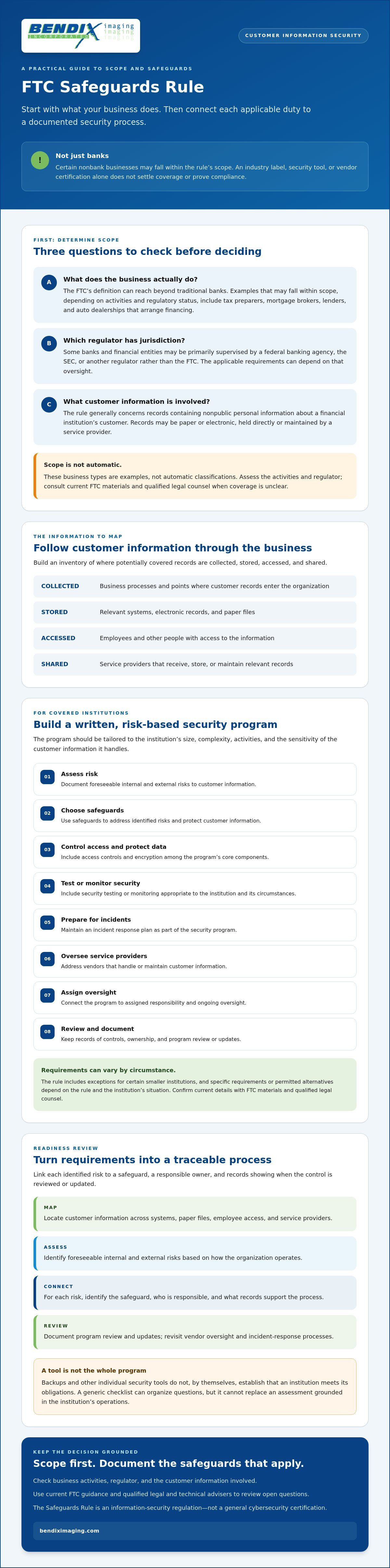
What does the FTC mean by a financial institution?
The FTC’s definition reaches beyond traditional banks. Depending on their activities and regulatory status, certain mortgage brokers, tax preparers, lenders, and auto dealerships that arrange financing may fall within the rule’s scope. These are examples, not automatic classifications. Assess what the business actually does rather than assuming its industry label settles the question.
Regulatory oversight matters, too. Banks and other financial entities may be supervised primarily by a federal banking agency, the SEC, or another regulator, rather than the FTC. That distinction can affect which information-security requirements apply. Don’t assume every financial institution is covered by the FTC Safeguards Rule. If your activities or regulator are unclear, check current FTC materials and consult qualified legal counsel.
Searchers looking for “ftc safeguards rule financial institutions customer information official” guidance should start with the FTC’s current scope materials, then verify how those definitions apply to their organization.
What counts as customer information?
In the rule’s context, customer information generally means records containing nonpublic personal information about a customer of a financial institution. Records may be on paper or electronic, and the institution may hold them directly or use a service provider to maintain them. The rule’s definitions are specific, so don’t treat every company record as covered information or assume a record is outside scope without checking how it relates to a customer and the institution’s activities.
Map where potentially covered information is collected, stored, accessed, and shared. Include relevant systems, paper files, employee access, and service providers. This inventory gives leadership, counsel, and IT staff a practical starting point for determining what information needs protection and which obligations may apply.
What the FTC Safeguards Rule Requires of Institutions
For institutions under FTC jurisdiction, the Safeguards Rule calls for a written information security program tailored to the institution’s size, complexity, activities, and the sensitivity of the customer information it handles. It’s a risk-based program, not a one-size-fits-all checklist. Some requirements have exceptions for certain smaller institutions, so use current FTC materials and qualified legal counsel to confirm which provisions apply.
Core program components include a written risk assessment, safeguards to control identified risks, access controls, encryption, security testing or monitoring, an incident response plan, service-provider oversight, and documented program review. The exact requirements and permitted alternatives depend on the rule’s wording and the institution’s circumstances. The FTC Safeguards Rule official guide is a useful starting point for checking current details.
How should a written information security program work?
Start with the risks. The institution’s written assessment should identify foreseeable internal and external risks to customer information and help determine which safeguards are appropriate. Connect each risk to a control, a responsible owner, and records showing when the control is reviewed or updated. A generic checklist can help organize questions, but it can’t replace an assessment grounded in the institution’s operations; organizations looking to identify broader vulnerabilities can discover FaultLine Cyber & Security Ltd for exposure assessments that pinpoint hidden operational and cyber risks.
Safeguards may include limiting access to people with a business need, encrypting customer information at rest and in transit, and using multi-factor authentication. The rule allows specific alternatives in certain circumstances, subject to its conditions. For monitoring, institutions generally need continuous monitoring or a combination of annual penetration testing and vulnerability assessments at least every six months. Check the current rule for the applicable requirements and exceptions.
Who oversees the program and its service providers?
The institution must designate a qualified individual to oversee and implement its information security program. That person can be an employee or a service provider, but outsourcing the work doesn’t automatically transfer the institution’s responsibilities. The qualified individual coordinates the program and, under the rule, reports in writing to the board or equivalent governing body at least annually.
Vendor oversight is part of protecting information beyond the institution’s own systems. Assess service providers’ security practices, set appropriate protections in contracts, and monitor providers in line with the institution’s risk and the rule’s requirements. Keep records of decisions and follow-up. A signed contract alone doesn’t demonstrate ongoing oversight.
If you’re searching for “ftc safeguards rule financial institutions customer information official” guidance, verify each duty against the current FTC rule before treating it as applicable to your organization. Technical and governance support, such as managed IT and vCSO expertise, may help organize controls and review processes alongside advice from qualified legal counsel.
How Does the Safeguards Rule Differ from a General Cybersecurity Checklist?
A security checklist can help organize work, but the FTC Safeguards Rule is a legal requirement for covered institutions under FTC jurisdiction. It calls for a tailored program and evidence of how the institution identifies and addresses risks. A tool such as backup software or endpoint protection can support that effort, but installing it alone doesn’t establish that the institution meets the rule.
Use this distinction to keep legal obligations and supporting practices clear:
| Area | FTC Safeguards Rule | General security practice or framework |
|---|---|---|
| Legal scope | Applies to covered financial institutions under FTC jurisdiction, subject to the rule’s terms and exceptions. | Guidance such as the NIST Cybersecurity Framework can inform security planning but doesn’t determine whether the FTC rule applies. |
| Program elements | Requires applicable institutions to maintain a written, risk-based information security program and meet specified safeguards. | May offer practices for managing risks, but doesn’t replace requirements in the rule. |
| Evidence | Institutions should retain program documents and records that show how responsibilities, risks, safeguards, and reviews are handled. | Security tools can generate useful logs or reports, but those records don’t by themselves demonstrate that all applicable duties are met. |
| Supporting practices | Controls must be selected and maintained in line with applicable rule requirements and the institution’s risks. | Access management, patching, backups, and monitoring may support protection when they address identified risks. |
For the current regulatory baseline, consult the FTC Safeguards Rule official guide. Treat other frameworks as useful references, not substitutes for checking the rule itself.
Which security practices support the rule without replacing it?
Connect each technical measure to a documented risk. For example, access controls may help limit who can view customer information, while patching and monitoring may help address risks identified in the assessment. Backups can support recovery planning. These are practical examples, not a universal checklist of legal mandates. The rule’s specific duties and alternatives depend on applicability. Policies, named owners, and review records matter alongside technology because they show how the program is managed over time.
Are small financial institutions exempt?
Some limited exemptions apply to specified provisions, not necessarily to the rule as a whole. Under the current FTC rule, an institution that maintains customer information concerning fewer than 5,000 consumers is exempt from certain requirements, including the written risk assessment, written incident response plan, and annual report. Don’t assume that small staff size or a modest business footprint qualifies. Verify the current threshold, definitions, and covered provisions in FTC materials, then seek qualified legal review if your status is uncertain.
How Can a Business Assess Its FTC Safeguards Rule Readiness?
A readiness review is a documented process, not a one-time tool purchase. It helps leadership see what information needs protection, who is responsible, and which questions require qualified legal, compliance, or security advice. Use this sequence to organize the review, not as a guarantee of compliance:
- Confirm scope. Check the institution’s activities, FTC jurisdiction, and any applicable exceptions against current FTC guidance and qualified legal advice.
- Assign ownership. Identify who oversees the program and how leadership receives updates.
- Assess risks. Review how customer information is collected, stored, accessed, shared, and handled by service providers.
- Inspect safeguards. Compare current practices with the identified risks and the requirements that apply.
- Document follow-up. Record gaps, decisions, responsible owners, and review plans.
Keep the information inventory practical: include relevant systems, paper records, user access, vendors, and existing security documentation. This gives advisers a clearer view of how information moves through the organization and where controls may need attention.
What records should an institution review?
Gather the written security program, risk assessments, relevant employee training records, service-provider contracts and reviews, access-review records, incident procedures, and evidence of management oversight. The exact records depend on the institution’s circumstances and applicable requirements. Don’t assume a particular retention period applies without verifying it with current authority and qualified advisers.
Use the review to identify unanswered questions, not to declare the business compliant. For broader context, consult current FTC materials and appropriate regulatory compliance advisers.
How should a business handle a potential security event?
Follow the organization’s incident response plan: escalate promptly to designated decision-makers and technical contacts, take appropriate steps to contain the event, preserve relevant records, and document what is known and when it was discovered. Involve qualified legal and security professionals to assess the facts and determine the required response.
FTC guidance says covered financial institutions must notify the FTC as soon as possible, and no later than 30 days after discovery, of a notification event involving the unencrypted information of 500 or more consumers. Verify the current rule for the precise trigger, scope, and reporting process before acting. Other legal or contractual duties may also need review.
For “ftc safeguards rule financial institutions customer information official” guidance, rely on current FTC materials and qualified advisers to confirm your organization’s obligations. BENDIX imaging’s cybersecurity, managed IT, and regulatory compliance support may help businesses organize technical and governance reviews. Explore cybersecurity and compliance support.
Next Steps to Protect Customer Information
Turn your review into an ongoing process. Start by verifying whether the rule applies to your activities and regulator, then consult current FTC guidance for the requirements and exceptions that fit your circumstances. Assign an owner, coordinate next steps across leadership, counsel, compliance staff, and IT, and document decisions, unresolved questions, and follow-up responsibilities.
A clear record makes the work easier to manage. Note which safeguards need attention, who will address each gap, and when the responsible people will review progress. Treat the review as a working process, not a box to check after buying a security tool.
When should a business involve legal or compliance counsel?
Bring in qualified counsel when coverage, FTC jurisdiction, an exemption, or the interpretation of a current obligation is uncertain. This article is educational and isn’t legal advice. Ask advisers to help clarify the organization’s position, then record the reasoning and assign follow-up actions to specific owners. That keeps legal interpretation connected to the business’s security work instead of leaving it in a separate file.
Leadership, compliance, and IT each have a role. Counsel can address legal interpretation; compliance staff can help organize responsibilities and records; IT personnel can explain systems, access, and technical safeguards. Agree on who will resolve open questions and how decisions will be reviewed.
How can local IT support contribute?
Managed IT or vCSO support may help an organization assess and coordinate technical work, such as reviewing security controls, backup practices, documentation, and service-provider relationships. Use that support as an operational resource, not as a substitute for legal advice or a guarantee of compliance. For broader context, businesses can also consult a managed IT services guide for Watertown businesses and review which technical responsibilities need an owner.
Businesses in Watertown, Brookings, Sioux Falls, Huron, and Montevideo can discuss IT and security needs with BENDIX imaging. The right support should help clarify responsibilities and organize practical next steps while qualified advisers determine the legal requirements. Keep decisions documented and revisit them as your operations, risks, or applicable guidance change.
Make Customer Information Security an Ongoing Priority
Start by confirming whether your business and its activities fall under the FTC Safeguards Rule. Coverage depends on regulatory jurisdiction, so verify your position with current FTC guidance and qualified counsel. If the rule applies, connect its requirements to a documented security program with clear ownership, risk review, safeguards, and follow-up.
A tool or checklist alone can’t show how your organization manages its responsibilities. Keep leadership, legal and compliance advisers, and IT personnel aligned, and document decisions as your systems, risks, or obligations change. Use the ftc safeguards rule financial institutions customer information official resources as a starting point, not a substitute for advice specific to your organization.
BENDIX imaging provides managed IT, cybersecurity, and network security services, along with vCSO expertise and regulatory compliance support for businesses across Eastern South Dakota. These services can help organize technical and governance work, but they don’t replace legal advice or guarantee compliance.
Talk with BENDIX imaging about your business IT and security needs. With clear responsibilities and steady review, your organization can take practical steps to protect customer information with greater confidence.
Frequently Asked Questions
What is the FTC Safeguards Rule?
The FTC Safeguards Rule requires certain financial institutions under Federal Trade Commission jurisdiction to maintain a written information security program that protects customer information. It’s part of the Gramm-Leach-Bliley Act framework. The program should address the institution’s risks and applicable requirements, rather than rely on a generic cybersecurity checklist. Whether the rule applies depends on the institution’s activities and regulatory oversight, so verify your situation with current FTC guidance and qualified counsel.
Which financial institutions are covered by the FTC Safeguards Rule?
Certain financial institutions under FTC jurisdiction are covered, and the definition extends beyond banks. Depending on their activities and regulatory status, examples can include mortgage brokers, tax preparers, lenders, and auto dealerships that arrange financing. These examples aren’t automatic classifications. Banks and other financial entities may have a different primary regulator, such as a federal banking agency or the SEC. Check current FTC guidance and seek legal advice if coverage is uncertain.
Does the FTC Safeguards Rule apply to small businesses?
It can apply to a small business if the business conducts covered financial activities and falls under FTC jurisdiction. Some provisions have limited exemptions. For example, institutions maintaining customer information concerning fewer than 5,000 consumers are exempt from certain requirements, including the written risk assessment, incident response plan, and annual report. That doesn’t necessarily exempt them from the entire rule. Confirm current definitions and applicable provisions with FTC materials and qualified legal counsel.
What information does the FTC Safeguards Rule protect?
The rule addresses customer information, including records containing nonpublic personal information about a customer of a financial institution. Information may be held electronically or on paper, and a service provider may maintain it for the institution. To understand what needs protection, identify where relevant information is collected, stored, accessed, and shared. Don’t assume every business record is covered or that a record is outside scope without checking the rule’s definitions and your circumstances.
What are the main requirements of the FTC Safeguards Rule?
Covered institutions generally need a written, risk-based information security program overseen by a designated qualified individual. Depending on applicability, requirements address risk assessment, access controls, encryption, security testing or monitoring, incident response, service-provider oversight, and program reporting. The rule includes specific conditions and exceptions, so this list isn’t a substitute for reviewing the current requirements. For readers seeking ftc safeguards rule financial institutions customer information official guidance, start with FTC materials and confirm obligations with qualified advisers.
Does the FTC Safeguards Rule require reporting a data breach?
Yes, certain security events must be reported to the FTC. The notification requirement covers an event involving unauthorized acquisition of unencrypted customer information about at least 500 consumers. The institution must notify the FTC as soon as possible and no later than 30 days after discovering the event. Not every incident triggers this requirement. Check current FTC materials for the precise trigger and reporting process, and consult legal and security professionals promptly about a suspected event.
How can a business prepare for the FTC Safeguards Rule?
First, verify coverage and identify the regulator responsible for your business. Then assign an owner, map customer-information locations and access, review service providers and security records, and document gaps, decisions, and follow-up. Coordinate leadership, counsel, compliance staff, and IT rather than treating readiness as a one-time software purchase. Businesses in Watertown, Brookings, Sioux Falls, Huron, and Montevideo can also consider local managed IT or cybersecurity support for technical planning, alongside qualified legal advice.
{"@context":"https://schema.org","@type":"FAQPage","mainEntity":[{"@type":"Question","name":"What does the FTC mean by a financial institution?","acceptedAnswer":{"@type":"Answer","text":"The FTC’s definition reaches beyond traditional banks. Depending on their activities and regulatory status, certain mortgage brokers, tax preparers, lenders, and auto dealerships that arrange financing may fall within the rule’s scope. These are examples, not automatic classifications. Assess what the business actually does rather than assuming its industry label settles the question. Regulatory oversight matters, too. Banks and other financial entities may be supervised primarily by a federal banking agency, the SEC, or another regulator, rather than the FTC. That distinction can affect which information-security requirements apply. Don’t assume every financial institution is covered by the FTC Safeguards Rule. If your activities or regulator are unclear, check current FTC materials and consult qualified legal counsel. Searchers looking for “ftc safeguards rule financial institutions customer information official” guidance should start with the FTC’s current scope materials, then verify how those definitions apply to their organization."}},{"@type":"Question","name":"What counts as customer information?","acceptedAnswer":{"@type":"Answer","text":"In the rule’s context, customer information generally means records containing nonpublic personal information about a customer of a financial institution. Records may be on paper or electronic, and the institution may hold them directly or use a service provider to maintain them. The rule’s definitions are specific, so don’t treat every company record as covered information or assume a record is outside scope without checking how it relates to a customer and the institution’s activities. Map where potentially covered information is collected, stored, accessed, and shared. Include relevant systems, paper files, employee access, and service providers. This inventory gives leadership, counsel, and IT staff a practical starting point for determining what information needs protection and which obligations may apply. For institutions under FTC jurisdiction, the Safeguards Rule calls for a written information security program tailored to the institution’s size, complexity, activities, and the sensitivity of the customer information it handles. It’s a risk-based program, not a one-size-fits-all checklist. Some requirements have exceptions for certain smaller institutions, so use current FTC materials and qualified legal counsel to confirm which provisions apply. Core program components include a written risk assessment, safeguards to control identified risks, access controls, encryption, security testing or monitoring, an incident response plan, service-provider oversight, and documented program review. The exact requirements and permitted alternatives depend on the rule’s wording and the institution’s circumstances. The FTC Safeguards Rule official guide is a useful starting point for checking current details."}},{"@type":"Question","name":"How should a written information security program work?","acceptedAnswer":{"@type":"Answer","text":"Start with the risks. The institution’s written assessment should identify foreseeable internal and external risks to customer information and help determine which safeguards are appropriate. Connect each risk to a control, a responsible owner, and records showing when the control is reviewed or updated. A generic checklist can help organize questions, but it can’t replace an assessment grounded in the institution’s operations. Safeguards may include limiting access to people with a business need, encrypting customer information at rest and in transit, and using multi-factor authentication. The rule allows specific alternatives in certain circumstances, subject to its conditions. For monitoring, institutions generally need continuous monitoring or a combination of annual penetration testing and vulnerability assessments at least every six months. Check the current rule for the applicable requirements and exceptions."}},{"@type":"Question","name":"Who oversees the program and its service providers?","acceptedAnswer":{"@type":"Answer","text":"The institution must designate a qualified individual to oversee and implement its information security program. That person can be an employee or a service provider, but outsourcing the work doesn’t automatically transfer the institution’s responsibilities. The qualified individual coordinates the program and, under the rule, reports in writing to the board or equivalent governing body at least annually. Vendor oversight is part of protecting information beyond the institution’s own systems. Assess service providers’ security practices, set appropriate protections in contracts, and monitor providers in line with the institution’s risk and the rule’s requirements. Keep records of decisions and follow-up. A signed contract alone doesn’t demonstrate ongoing oversight. If you’re searching for “ftc safeguards rule financial institutions customer information official” guidance, verify each duty against the current FTC rule before treating it as applicable to your organization. Technical and governance support, such as managed IT and vCSO expertise, may help organize controls and review processes alongside advice from qualified legal counsel. A security checklist can help organize work, but the FTC Safeguards Rule is a legal requirement for covered institutions under FTC jurisdiction. It calls for a tailored program and evidence of how the institution identifies and addresses risks. A tool such as backup software or endpoint protection can support that effort, but installing it alone doesn’t establish that the institution meets the rule. Use this distinction to keep legal obligations and supporting practices clear: For the current regulatory baseline, consult the FTC Safeguards Rule official guide. Treat other frameworks as useful references, not substitutes for checking the rule itself."}},{"@type":"Question","name":"Which security practices support the rule without replacing it?","acceptedAnswer":{"@type":"Answer","text":"Connect each technical measure to a documented risk. For example, access controls may help limit who can view customer information, while patching and monitoring may help address risks identified in the assessment. Backups can support recovery planning. These are practical examples, not a universal checklist of legal mandates. The rule’s specific duties and alternatives depend on applicability. Policies, named owners, and review records matter alongside technology because they show how the program is managed over time."}},{"@type":"Question","name":"Are small financial institutions exempt?","acceptedAnswer":{"@type":"Answer","text":"Some limited exemptions apply to specified provisions, not necessarily to the rule as a whole. Under the current FTC rule, an institution that maintains customer information concerning fewer than 5,000 consumers is exempt from certain requirements, including the written risk assessment, written incident response plan, and annual report. Don’t assume that small staff size or a modest business footprint qualifies. Verify the current threshold, definitions, and covered provisions in FTC materials, then seek qualified legal review if your status is uncertain. A readiness review is a documented process, not a one-time tool purchase. It helps leadership see what information needs protection, who is responsible, and which questions require qualified legal, compliance, or security advice. Use this sequence to organize the review, not as a guarantee of compliance: Keep the information inventory practical: include relevant systems, paper records, user access, vendors, and existing security documentation. This gives advisers a clearer view of how information moves through the organization and where controls may need attention."}},{"@type":"Question","name":"What records should an institution review?","acceptedAnswer":{"@type":"Answer","text":"Gather the written security program, risk assessments, relevant employee training records, service-provider contracts and reviews, access-review records, incident procedures, and evidence of management oversight. The exact records depend on the institution’s circumstances and applicable requirements. Don’t assume a particular retention period applies without verifying it with current authority and qualified advisers. Use the review to identify unanswered questions, not to declare the business compliant. For broader context, consult current FTC materials and appropriate regulatory compliance advisers."}},{"@type":"Question","name":"How should a business handle a potential security event?","acceptedAnswer":{"@type":"Answer","text":"Follow the organization’s incident response plan: escalate promptly to designated decision-makers and technical contacts, take appropriate steps to contain the event, preserve relevant records, and document what is known and when it was discovered. Involve qualified legal and security professionals to assess the facts and determine the required response. FTC guidance says covered financial institutions must notify the FTC as soon as possible, and no later than 30 days after discovery, of a notification event involving the unencrypted information of 500 or more consumers. Verify the current rule for the precise trigger, scope, and reporting process before acting. Other legal or contractual duties may also need review. For “ftc safeguards rule financial institutions customer information official” guidance, rely on current FTC materials and qualified advisers to confirm your organization’s obligations. BENDIX imaging’s cybersecurity, managed IT, and regulatory compliance support may help businesses organize technical and governance reviews. Explore cybersecurity and compliance support. Turn your review into an ongoing process. Start by verifying whether the rule applies to your activities and regulator, then consult current FTC guidance for the requirements and exceptions that fit your circumstances. Assign an owner, coordinate next steps across leadership, counsel, compliance staff, and IT, and document decisions, unresolved questions, and follow-up responsibilities. A clear record makes the work easier to manage. Note which safeguards need attention, who will address each gap, and when the responsible people will review progress. Treat the review as a working process, not a box to check after buying a security tool."}},{"@type":"Question","name":"When should a business involve legal or compliance counsel?","acceptedAnswer":{"@type":"Answer","text":"Bring in qualified counsel when coverage, FTC jurisdiction, an exemption, or the interpretation of a current obligation is uncertain. This article is educational and isn’t legal advice. Ask advisers to help clarify the organization’s position, then record the reasoning and assign follow-up actions to specific owners. That keeps legal interpretation connected to the business’s security work instead of leaving it in a separate file. Leadership, compliance, and IT each have a role. Counsel can address legal interpretation; compliance staff can help organize responsibilities and records; IT personnel can explain systems, access, and technical safeguards. Agree on who will resolve open questions and how decisions will be reviewed."}},{"@type":"Question","name":"How can local IT support contribute?","acceptedAnswer":{"@type":"Answer","text":"Managed IT or vCSO support may help an organization assess and coordinate technical work, such as reviewing security controls, backup practices, documentation, and service-provider relationships. Use that support as an operational resource, not as a substitute for legal advice or a guarantee of compliance. For broader context, businesses can also consult a managed IT services guide for Watertown businesses and review which technical responsibilities need an owner. Businesses in Watertown, Brookings, Sioux Falls, Huron, and Montevideo can discuss IT and security needs with BENDIX imaging. The right support should help clarify responsibilities and organize practical next steps while qualified advisers determine the legal requirements. Keep decisions documented and revisit them as your operations, risks, or applicable guidance change. Start by confirming whether your business and its activities fall under the FTC Safeguards Rule. Coverage depends on regulatory jurisdiction, so verify your position with current FTC guidance and qualified counsel. If the rule applies, connect its requirements to a documented security program with clear ownership, risk review, safeguards, and follow-up. A tool or checklist alone can’t show how your organization manages its responsibilities. Keep leadership, legal and compliance advisers, and IT personnel aligned, and document decisions as your systems, risks, or obligations change. Use the ftc safeguards rule financial institutions customer information official resources as a starting point, not a substitute for advice specific to your organization. BENDIX imaging provides managed IT, cybersecurity, and network security services, along with vCSO expertise and regulatory compliance support for businesses across Eastern South Dakota. These services can help organize technical and governance work, but they don’t replace legal advice or guarantee compliance. Talk with BENDIX imaging about your business IT and security needs. With clear responsibilities and steady review, your organization can take practical steps to protect customer information with greater confidence."}},{"@type":"Question","name":"What is the FTC Safeguards Rule?","acceptedAnswer":{"@type":"Answer","text":"The FTC Safeguards Rule requires certain financial institutions under Federal Trade Commission jurisdiction to maintain a written information security program that protects customer information. It’s part of the Gramm-Leach-Bliley Act framework. The program should address the institution’s risks and applicable requirements, rather than rely on a generic cybersecurity checklist. Whether the rule applies depends on the institution’s activities and regulatory oversight, so verify your situation with current FTC guidance and qualified counsel."}},{"@type":"Question","name":"Which financial institutions are covered by the FTC Safeguards Rule?","acceptedAnswer":{"@type":"Answer","text":"Certain financial institutions under FTC jurisdiction are covered, and the definition extends beyond banks. Depending on their activities and regulatory status, examples can include mortgage brokers, tax preparers, lenders, and auto dealerships that arrange financing. These examples aren’t automatic classifications. Banks and other financial entities may have a different primary regulator, such as a federal banking agency or the SEC. Check current FTC guidance and seek legal advice if coverage is uncertain."}},{"@type":"Question","name":"Does the FTC Safeguards Rule apply to small businesses?","acceptedAnswer":{"@type":"Answer","text":"It can apply to a small business if the business conducts covered financial activities and falls under FTC jurisdiction. Some provisions have limited exemptions. For example, institutions maintaining customer information concerning fewer than 5,000 consumers are exempt from certain requirements, including the written risk assessment, incident response plan, and annual report. That doesn’t necessarily exempt them from the entire rule. Confirm current definitions and applicable provisions with FTC materials and qualified legal counsel."}},{"@type":"Question","name":"What information does the FTC Safeguards Rule protect?","acceptedAnswer":{"@type":"Answer","text":"The rule addresses customer information, including records containing nonpublic personal information about a customer of a financial institution. Information may be held electronically or on paper, and a service provider may maintain it for the institution. To understand what needs protection, identify where relevant information is collected, stored, accessed, and shared. Don’t assume every business record is covered or that a record is outside scope without checking the rule’s definitions and your circumstances."}},{"@type":"Question","name":"What are the main requirements of the FTC Safeguards Rule?","acceptedAnswer":{"@type":"Answer","text":"Covered institutions generally need a written, risk-based information security program overseen by a designated qualified individual. Depending on applicability, requirements address risk assessment, access controls, encryption, security testing or monitoring, incident response, service-provider oversight, and program reporting. The rule includes specific conditions and exceptions, so this list isn’t a substitute for reviewing the current requirements. For readers seeking ftc safeguards rule financial institutions customer information official guidance, start with FTC materials and confirm obligations with qualified advisers."}},{"@type":"Question","name":"Does the FTC Safeguards Rule require reporting a data breach?","acceptedAnswer":{"@type":"Answer","text":"Yes, certain security events must be reported to the FTC. The notification requirement covers an event involving unauthorized acquisition of unencrypted customer information about at least 500 consumers. The institution must notify the FTC as soon as possible and no later than 30 days after discovering the event. Not every incident triggers this requirement. Check current FTC materials for the precise trigger and reporting process, and consult legal and security professionals promptly about a suspected event."}},{"@type":"Question","name":"How can a business prepare for the FTC Safeguards Rule?","acceptedAnswer":{"@type":"Answer","text":"First, verify coverage and identify the regulator responsible for your business. Then assign an owner, map customer-information locations and access, review service providers and security records, and document gaps, decisions, and follow-up. Coordinate leadership, counsel, compliance staff, and IT rather than treating readiness as a one-time software purchase. Businesses in Watertown, Brookings, Sioux Falls, Huron, and Montevideo can also consider local managed IT or cybersecurity support for technical planning, alongside qualified legal advice."}}]}


