

What if audit readiness were part of everyday security work instead of a scramble before a deadline? When policies, control records, and evidence are scattered, it can be difficult to confirm what applies, who owns each response, or whether documentation is consistent. A vCSO for regulatory audits can bring strategic security leadership to the process and help coordinate preparation with your IT and business stakeholders.
An audit is likely to require clear evidence and timely answers, which can be challenging when your in-house team has limited capacity. The right support can help organize responsibilities, identify gaps, and establish a more disciplined approach to evidence. A vCSO doesn’t replace an independent auditor or guarantee compliance. Confirm the exact scope of support in advance.
This article explains what a vCSO may contribute before, during, and after an audit, what evidence and ownership practices to assess, and what to clarify when choosing a provider. It also covers why the provider’s responsibilities during auditor fieldwork need to be explicit. For organizations in Brookings, Watertown, Sioux Falls, Huron, and Montevideo, BENDIX imaging offers vCSO expertise and regulatory compliance support to discuss alongside your specific obligations and internal capacity.
Key Takeaways
- Clarify what a vCSO can coordinate and which audit responsibilities remain with your organization, auditor, or other stakeholders.
- Use a vCSO for regulatory audits to organize scope, ownership, evidence, remediation, and follow-up around your specific engagement.
- Evaluate providers by their defined scope, deliverables, communication practices, client responsibilities, and exclusions.
- Build a readiness checklist that assigns an owner to every relevant policy, control record, and open issue.
- Businesses in Brookings and other Eastern South Dakota communities can assess how local vCSO, regulatory compliance, cybersecurity, and managed IT support may fit their audit needs.
What a vCSO for regulatory audits does, and what it does not do
A vCSO, or virtual Chief Security Officer, provides strategic security leadership on a fractional or part-time basis. The role helps set security priorities and connect security decisions with business risk. For background on the executive function, see this overview of the Chief Information Security Officer (CISO) role. A vCSO for regulatory audits applies that leadership to preparation, but does not take over the auditor’s independent role.
In brief: A vCSO helps lead and coordinate your organization’s security readiness. An independent auditor evaluates evidence and reaches their own conclusions.
An audit’s scope depends on the requirements that apply to your organization, relevant contracts, and the auditor’s direction. Before preparation begins, confirm what is being assessed and which requirements are in scope. Otherwise, your team may spend time collecting records that don’t answer the actual request or miss responsibilities that do.
What does a vCSO contribute to audit readiness?
A vCSO can bring structure to preparation by coordinating security priorities, identifying control owners, and organizing policies and supporting evidence. If a review surfaces a gap, the vCSO can help assign a responsible owner and track remediation before fieldwork. For example, a control record should have an accountable person who can explain the process and locate the relevant documentation.
Confirm the specific work products. Put in writing which frameworks, evidence activities, and deliverables the engagement covers, and what your staff must provide. Don’t assume evidence collection, remediation, or support during auditor fieldwork is included unless the agreement says so.
Can a vCSO guarantee regulatory compliance or an audit pass?
No. An advisor can help your organization prepare, but can’t guarantee an auditor’s findings or a regulatory outcome. Auditors remain independent and determine the evidence and testing procedures they will use. A vCSO may coordinate responses, but agree on the exact role during fieldwork in advance.
A vCSO also isn’t a substitute for legal advice or an independent audit. Consult counsel or a qualified compliance specialist to interpret legal obligations and determine how they apply to your organization. Keep the boundaries clear: security leadership supports preparation, the auditor provides independent evaluation, and qualified counsel or specialists address legal interpretation.
How a vCSO supports each stage of a regulatory audit
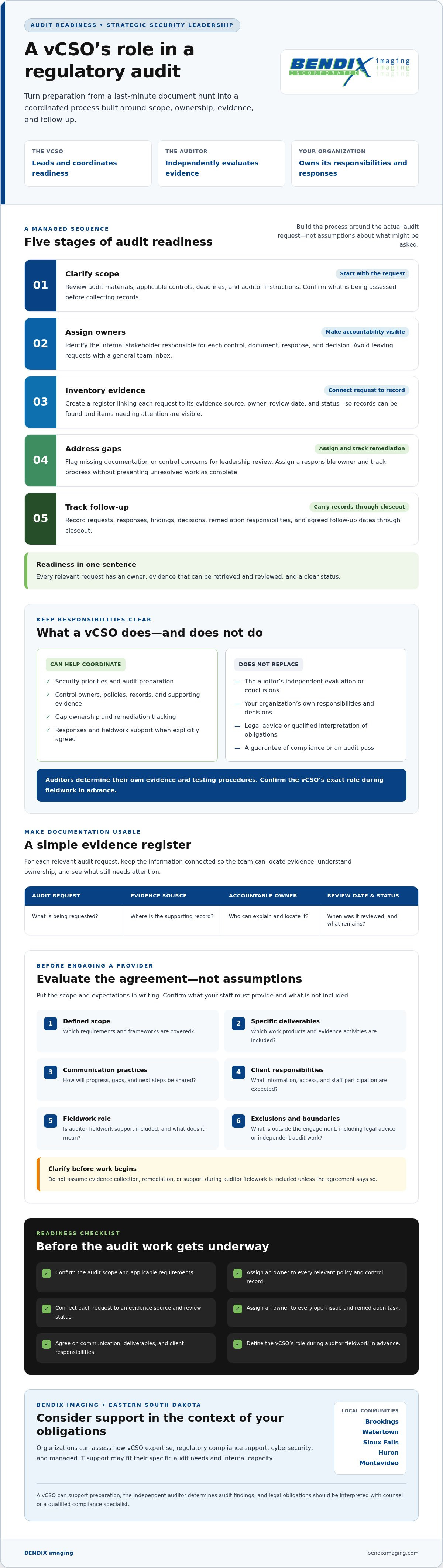
Audit preparation works best as a managed sequence, not a last-minute document hunt. A vCSO can coordinate work across security, IT, and business teams, while keeping leadership informed about what’s complete, what’s missing, and who owns the next step. Base the process on the actual audit request, not assumptions about what an auditor might ask.
Audit readiness means clear ownership and evidence that can be retrieved, reviewed, and linked to the right request.
A comprehensive security audit can involve assessing controls and supporting records against defined requirements. A vCSO helps organize your organization’s preparation around those requirements. The steps depend on the framework, auditor requests, organization size, and written engagement agreement.
- Clarify scope. Review the audit request, applicable control set, deadlines, and auditor instructions. Confirm what is being assessed before gathering evidence.
- Assign owners. Identify the internal stakeholders responsible for each control, document, response, and decision. Make accountability visible instead of leaving requests with a general team inbox.
- Inventory evidence. Create a register that connects each request to its evidence source, owner, review date, and status. This makes records easier to locate and highlights items that need attention.
- Address gaps. Flag missing documentation or control concerns for leadership review. Assign remediation owners and track progress without describing unresolved work as complete.
- Track follow-up. Record requests, responses, findings, decisions, remediation responsibilities, and agreed follow-up dates through closeout.
Before fieldwork: scope, owners, and evidence
Start with the audit materials and a clear list of internal contacts. An evidence register might show that a requested policy has an assigned owner and a known source, while a related record still needs review. That distinction gives leaders a more useful picture than a simple “ready” label. A vCSO may help surface gaps and coordinate remediation, but confirm which evidence activities and deliverables are included in the engagement.
During and after the auditor’s review
During fieldwork, the vCSO may route questions to the right subject-matter owners and keep requests and submitted evidence organized, if those tasks are within the agreed scope. The auditor remains responsible for their review and conclusions. After the report, track each finding, decision, remediation owner, and agreed follow-up date so responsibilities don’t disappear when the review ends.
Concise status reports help executives act without overstating readiness. Separate completed items from open gaps, blocked work, and decisions awaiting approval. Organizations in Brookings and nearby communities can review BENDIX imaging’s vCSO and compliance support and clarify how the proposed scope fits their audit needs.
How to evaluate a vCSO for regulatory audit support
Choose support based on the work your audit requires, not a broad promise of “compliance help.” A vCSO for regulatory audits should have a clearly defined role and deliverables that fit your requirements and your team’s capacity. Ask to see sample evidence-tracking and status-reporting formats to understand how work and open items would be presented. Treat samples as examples of process, not proof of client-specific results.
Questions to ask before signing a vCSO agreement
Ask which audit types and frameworks the provider has supported, then verify the relevant experience and scope. A familiar framework name doesn’t automatically mean your needs are covered. Clarify who owns each task, including policies, evidence collection, technical remediation, and communications with the auditor. Confirm the meeting cadence, reporting format, escalation path, and how scope changes or unplanned requests will be handled.
Before signing, define the framework, owners, deliverables, exclusions, and escalation path in writing.
| Compare | What to clarify |
|---|---|
| Scope | Which audit types, frameworks, and preparation activities are included? |
| Named deliverables | Will you receive specific items such as an evidence register, action log, or status report? |
| Client responsibilities | What must your staff provide, review, approve, or remediate? |
| Communication | Who reports progress, how often, and through what format? |
| Exclusions | Are independent auditing, legal interpretation, technical work, or fieldwork support outside the engagement? |
How to compare vCSO, managed IT, and independent audit roles
These roles address different needs. A vCSO provides strategic security leadership, helping align priorities, risks, and accountability. Managed IT focuses on operating and supporting technology under its own agreed scope. An independent auditor evaluates evidence and provides assurance based on the auditor’s procedures. One provider may coordinate with another, but independence and conflict requirements still need to be respected.
Don’t assume one service replaces another. Ask how the vCSO will work with internal IT, business leaders, counsel, and the independent auditor, and who has authority to approve decisions or responses. Put those boundaries in the agreement. In particular, confirm whether the vCSO will organize auditor requests or participate during fieldwork. Don’t assume either task is included unless it’s expressly defined. Clear roles reduce duplicate effort and keep accountability with the right people.
How to prepare your business for a regulatory audit with a vCSO
Start with the actual audit request and applicable requirements, not a universal checklist. A vCSO for regulatory audits can help translate the scope into work your team can manage, but each item needs a named owner. Assign responsibility for maintaining the record, confirming its accuracy, and responding to questions. An item without an owner is easy to overlook, even when the document exists.
Use this checklist as a starting point, then keep only the areas relevant to your audit:
- Policies and procedures: Name the owner who reviews each applicable policy and can explain how it is used.
- Access reviews: Identify who can provide relevant records and explain the review process, if access controls are in scope.
- Change records: Assign an owner to locate applicable records and clarify how changes are documented.
- Backup evidence: Where relevant, identify who can provide records that support the organization’s backup practices.
- Training records: Confirm who maintains applicable training documentation and can answer questions about it.
- Incident procedures: Identify the owner of relevant procedures and records, if incident response is part of the assessment.
- Vendor records: If third-party controls are in scope, assign responsibility for locating relevant vendor documentation.
For every item, record its source, review date, status, and accountable owner. Documentation matters, but a policy or record alone doesn’t prove a control operated as intended. Don’t backdate records or make paperwork appear complete after the fact. If evidence is missing or a process wasn’t followed, document the gap honestly, assign an owner, and track the response.
Which records and control areas should teams review?
Let the audit request determine what belongs in the evidence set. Access, change management, data protection, backups, incident response, and vendor records may be relevant, but they aren’t required for every audit. Use your existing regulatory compliance guide and framework-specific resources to check the context. Healthcare organizations may need to consult applicable HIPAA guidance; financial organizations should review relevant FTC Safeguards Rule guidance. Confirm applicability with qualified compliance support or counsel.
How do you keep audit readiness from becoming a last-minute project?
Schedule periodic evidence reviews and document how records should be updated when systems, responsibilities, or procedures change. Maintain an exception and remediation log with each issue’s status, accountable owner, decision, and next review point. Give leadership concise updates on open gaps and decisions needed, rather than an unsupported “ready” label. Set the review cadence to match applicable obligations and your organization’s risk profile.
Organizations in Brookings and nearby communities can discuss audit-readiness support with BENDIX imaging, including how vCSO and regulatory compliance services may fit their needs.
Choosing local vCSO support for regulatory audits in Brookings
Brookings organizations need to know whether a provider understands the audit-readiness work they actually need and can coordinate with the people already responsible for security and IT. BENDIX imaging serves businesses in Brookings, Watertown, Sioux Falls, Huron, and Montevideo, with vCSO expertise alongside regulatory compliance, cybersecurity, and managed IT services.
That combination may be worth exploring if your organization needs strategic security leadership while working through compliance and technology responsibilities. It doesn’t mean every service or audit task is automatically included. Confirm which frameworks and activities the proposed engagement covers, and keep the independent auditor’s role separate.
What should a Brookings-area business clarify in an initial conversation?
Bring the materials that define the work so the conversation can focus on your actual needs rather than assumptions. Useful starting points include:
- The audit request and any framework reference or other stated requirements.
- Known deadlines, open findings, and unresolved evidence requests.
- A list of internal owners for security, IT, compliance, and business decisions.
Then ask how vCSO support would coordinate with your existing IT provider and company leadership. Clarify who prepares or reviews evidence, who handles technical remediation, and whether auditor communications or fieldwork support are included. These responsibilities should be explicit, not inferred from a service label.
Request a written scope that names deliverables, client responsibilities, exclusions, and the communication and escalation process. If you expect recurring evidence reviews or progress reporting, ask whether they are part of the proposed engagement and how they will be documented. A clear agreement helps everyone understand what the provider will do and what remains with your team.
When is BENDIX imaging’s vCSO support worth exploring?
Consider a conversation if your organization lacks dedicated security leadership to coordinate audit preparation, or if compliance work needs closer alignment with existing IT and cybersecurity responsibilities. BENDIX imaging offers vCSO, regulatory compliance, cybersecurity, and managed IT services. How those services fit together for your audit depends on the scope you discuss and confirm.
Approach the conversation as a scope assessment, not a promise of an audit pass or a particular finding. Share your timeline and requirements, then evaluate whether the proposed responsibilities match your obligations and internal capacity. Businesses in Brookings and surrounding Eastern South Dakota communities can discuss vCSO and regulatory compliance support with BENDIX imaging and clarify what preparation assistance may fit their needs.
Build audit readiness before the deadline
Audit preparation is stronger when it’s an ongoing, evidence-led process, not a last-minute effort to collect records. A vCSO for regulatory audits can help coordinate security priorities, ownership, evidence, and follow-up, while your independent auditor retains responsibility for its assessment. Confirm in writing which frameworks, deliverables, and responsibilities are included before work begins.
Keep accountability visible. Assign an owner to each relevant control, document, and open issue, and give leadership an honest view of progress and gaps. This structure helps your team prepare deliberately without treating documentation as a guarantee of compliance or an audit result.
BENDIX imaging offers vCSO expertise and regulatory compliance support to businesses in Brookings, Watertown, Sioux Falls, Huron, and Montevideo. If your organization is weighing its audit timeline and internal capacity, discuss vCSO and audit-readiness support with BENDIX imaging. Start with a clear picture of your needs and build a practical path forward with the right responsibilities in place.
Frequently Asked Questions
Can a vCSO help a business prepare for a regulatory audit?
Yes. A vCSO for regulatory audits can provide strategic security leadership to coordinate preparation, clarify responsibilities, organize evidence, and track open issues. Begin with the actual audit request and applicable requirements, not a generic checklist. Confirm which frameworks, preparation activities, and deliverables are included in the written engagement. A vCSO can support readiness, but can’t guarantee an auditor’s findings or a regulatory outcome.
What does a vCSO do during an audit?
A vCSO may coordinate internal responses, route auditor questions to accountable staff, and keep requests and submitted evidence organized, if those tasks are included in the engagement. Your organization’s subject-matter owners should provide accurate information about their areas. The independent auditor determines its own evidence requests, testing procedures, and conclusions. Clarify the vCSO’s responsibilities in writing before fieldwork so no one assumes support that hasn’t been agreed.
Is a vCSO the same as an auditor or compliance consultant?
No. A vCSO provides strategic security leadership, while an independent auditor evaluates evidence and forms conclusions under its own procedures. A compliance consultant may guide compliance work, but the exact role depends on the provider and engagement. A vCSO doesn’t automatically provide legal advice, conduct an independent audit, or certify compliance. Ask providers to define their scope and involve qualified counsel to interpret legal obligations.
What information should we have ready before hiring a vCSO for an audit?
Gather the audit request, any framework reference, known deadlines, open findings, and a list of internal owners across security, IT, compliance, and business leadership. Note where evidence is stored and which requests remain unresolved. These details help a prospective provider understand your needs and internal capacity. Ask for a written scope that identifies deliverables, exclusions, client responsibilities, communication practices, and any support expected during auditor fieldwork.
Can a vCSO help with HIPAA or the FTC Safeguards Rule?
A vCSO may help coordinate security preparation related to HIPAA or the FTC Safeguards Rule, but don’t assume a provider covers either framework without confirmation. Ask about relevant experience, which requirements and evidence activities the engagement addresses, and what remains your responsibility. Confirm applicability and legal interpretation with qualified compliance specialists or counsel. Keep the specific scope in writing, including exclusions and the provider’s role during an assessment.
How do we know whether we need a vCSO or managed IT support?
Consider a vCSO if you need strategic security leadership to set priorities, coordinate risk and compliance work, and align internal owners. Managed IT support focuses on technology operations and support under its own agreed scope. Some organizations need one, the other, or both. Businesses in Brookings, Watertown, Sioux Falls, Huron, and Montevideo can assess which responsibilities are missing and whether proposed services complement existing staff or providers.
{"@context":"https://schema.org","@type":"FAQPage","mainEntity":[{"@type":"Question","name":"What does a vCSO contribute to audit readiness?","acceptedAnswer":{"@type":"Answer","text":"A vCSO can bring structure to preparation by coordinating security priorities, identifying control owners, and organizing policies and supporting evidence. If a review surfaces a gap, the vCSO can help assign a responsible owner and track remediation before fieldwork. For example, a control record should have an accountable person who can explain the process and locate the relevant documentation. Confirm the specific work products. Put in writing which frameworks, evidence activities, and deliverables the engagement covers, and what your staff must provide. Don’t assume evidence collection, remediation, or support during auditor fieldwork is included unless the agreement says so."}},{"@type":"Question","name":"Can a vCSO guarantee regulatory compliance or an audit pass?","acceptedAnswer":{"@type":"Answer","text":"No. An advisor can help your organization prepare, but can’t guarantee an auditor’s findings or a regulatory outcome. Auditors remain independent and determine the evidence and testing procedures they will use. A vCSO may coordinate responses, but agree on the exact role during fieldwork in advance. A vCSO also isn’t a substitute for legal advice or an independent audit. Consult counsel or a qualified compliance specialist to interpret legal obligations and determine how they apply to your organization. Keep the boundaries clear: security leadership supports preparation, the auditor provides independent evaluation, and qualified counsel or specialists address legal interpretation. Audit preparation works best as a managed sequence, not a last-minute document hunt. A vCSO can coordinate work across security, IT, and business teams, while keeping leadership informed about what’s complete, what’s missing, and who owns the next step. Base the process on the actual audit request, not assumptions about what an auditor might ask. Audit readiness means clear ownership and evidence that can be retrieved, reviewed, and linked to the right request. A comprehensive security audit can involve assessing controls and supporting records against defined requirements. A vCSO helps organize your organization’s preparation around those requirements. The steps depend on the framework, auditor requests, organization size, and written engagement agreement."}},{"@type":"Question","name":"Which records and control areas should teams review?","acceptedAnswer":{"@type":"Answer","text":"Let the audit request determine what belongs in the evidence set. Access, change management, data protection, backups, incident response, and vendor records may be relevant, but they aren’t required for every audit. Use your existing regulatory compliance guide and framework-specific resources to check the context. Healthcare organizations may need to consult applicable HIPAA guidance; financial organizations should review relevant FTC Safeguards Rule guidance. Confirm applicability with qualified compliance support or counsel."}},{"@type":"Question","name":"How do you keep audit readiness from becoming a last-minute project?","acceptedAnswer":{"@type":"Answer","text":"Schedule periodic evidence reviews and document how records should be updated when systems, responsibilities, or procedures change. Maintain an exception and remediation log with each issue’s status, accountable owner, decision, and next review point. Give leadership concise updates on open gaps and decisions needed, rather than an unsupported “ready” label. Set the review cadence to match applicable obligations and your organization’s risk profile. Organizations in Brookings and nearby communities can discuss audit-readiness support with BENDIX imaging, including how vCSO and regulatory compliance services may fit their needs. Brookings organizations need to know whether a provider understands the audit-readiness work they actually need and can coordinate with the people already responsible for security and IT. BENDIX imaging serves businesses in Brookings, Watertown, Sioux Falls, Huron, and Montevideo, with vCSO expertise alongside regulatory compliance, cybersecurity, and managed IT services. That combination may be worth exploring if your organization needs strategic security leadership while working through compliance and technology responsibilities. It doesn’t mean every service or audit task is automatically included. Confirm which frameworks and activities the proposed engagement covers, and keep the independent auditor’s role separate."}},{"@type":"Question","name":"What should a Brookings-area business clarify in an initial conversation?","acceptedAnswer":{"@type":"Answer","text":"Bring the materials that define the work so the conversation can focus on your actual needs rather than assumptions. Useful starting points include: Then ask how vCSO support would coordinate with your existing IT provider and company leadership. Clarify who prepares or reviews evidence, who handles technical remediation, and whether auditor communications or fieldwork support are included. These responsibilities should be explicit, not inferred from a service label. Request a written scope that names deliverables, client responsibilities, exclusions, and the communication and escalation process. If you expect recurring evidence reviews or progress reporting, ask whether they are part of the proposed engagement and how they will be documented. A clear agreement helps everyone understand what the provider will do and what remains with your team."}},{"@type":"Question","name":"When is BENDIX imaging’s vCSO support worth exploring?","acceptedAnswer":{"@type":"Answer","text":"Consider a conversation if your organization lacks dedicated security leadership to coordinate audit preparation, or if compliance work needs closer alignment with existing IT and cybersecurity responsibilities. BENDIX imaging offers vCSO, regulatory compliance, cybersecurity, and managed IT services. How those services fit together for your audit depends on the scope you discuss and confirm. Approach the conversation as a scope assessment, not a promise of an audit pass or a particular finding. Share your timeline and requirements, then evaluate whether the proposed responsibilities match your obligations and internal capacity. Businesses in Brookings and surrounding Eastern South Dakota communities can discuss vCSO and regulatory compliance support with BENDIX imaging and clarify what preparation assistance may fit their needs. Audit preparation is stronger when it’s an ongoing, evidence-led process, not a last-minute effort to collect records. A vCSO for regulatory audits can help coordinate security priorities, ownership, evidence, and follow-up, while your independent auditor retains responsibility for its assessment. Confirm in writing which frameworks, deliverables, and responsibilities are included before work begins. Keep accountability visible. Assign an owner to each relevant control, document, and open issue, and give leadership an honest view of progress and gaps. This structure helps your team prepare deliberately without treating documentation as a guarantee of compliance or an audit result. BENDIX imaging offers vCSO expertise and regulatory compliance support to businesses in Brookings, Watertown, Sioux Falls, Huron, and Montevideo. If your organization is weighing its audit timeline and internal capacity, discuss vCSO and audit-readiness support with BENDIX imaging. Start with a clear picture of your needs and build a practical path forward with the right responsibilities in place."}},{"@type":"Question","name":"Can a vCSO help a business prepare for a regulatory audit?","acceptedAnswer":{"@type":"Answer","text":"Yes. A vCSO for regulatory audits can provide strategic security leadership to coordinate preparation, clarify responsibilities, organize evidence, and track open issues. Begin with the actual audit request and applicable requirements, not a generic checklist. Confirm which frameworks, preparation activities, and deliverables are included in the written engagement. A vCSO can support readiness, but can’t guarantee an auditor’s findings or a regulatory outcome."}},{"@type":"Question","name":"What does a vCSO do during an audit?","acceptedAnswer":{"@type":"Answer","text":"A vCSO may coordinate internal responses, route auditor questions to accountable staff, and keep requests and submitted evidence organized, if those tasks are included in the engagement. Your organization’s subject-matter owners should provide accurate information about their areas. The independent auditor determines its own evidence requests, testing procedures, and conclusions. Clarify the vCSO’s responsibilities in writing before fieldwork so no one assumes support that hasn’t been agreed."}},{"@type":"Question","name":"Is a vCSO the same as an auditor or compliance consultant?","acceptedAnswer":{"@type":"Answer","text":"No. A vCSO provides strategic security leadership, while an independent auditor evaluates evidence and forms conclusions under its own procedures. A compliance consultant may guide compliance work, but the exact role depends on the provider and engagement. A vCSO doesn’t automatically provide legal advice, conduct an independent audit, or certify compliance. Ask providers to define their scope and involve qualified counsel to interpret legal obligations."}},{"@type":"Question","name":"What information should we have ready before hiring a vCSO for an audit?","acceptedAnswer":{"@type":"Answer","text":"Gather the audit request, any framework reference, known deadlines, open findings, and a list of internal owners across security, IT, compliance, and business leadership. Note where evidence is stored and which requests remain unresolved. These details help a prospective provider understand your needs and internal capacity. Ask for a written scope that identifies deliverables, exclusions, client responsibilities, communication practices, and any support expected during auditor fieldwork."}},{"@type":"Question","name":"Can a vCSO help with HIPAA or the FTC Safeguards Rule?","acceptedAnswer":{"@type":"Answer","text":"A vCSO may help coordinate security preparation related to HIPAA or the FTC Safeguards Rule, but don’t assume a provider covers either framework without confirmation. Ask about relevant experience, which requirements and evidence activities the engagement addresses, and what remains your responsibility. Confirm applicability and legal interpretation with qualified compliance specialists or counsel. Keep the specific scope in writing, including exclusions and the provider’s role during an assessment."}},{"@type":"Question","name":"How do we know whether we need a vCSO or managed IT support?","acceptedAnswer":{"@type":"Answer","text":"Consider a vCSO if you need strategic security leadership to set priorities, coordinate risk and compliance work, and align internal owners. Managed IT support focuses on technology operations and support under its own agreed scope. Some organizations need one, the other, or both. Businesses in Brookings, Watertown, Sioux Falls, Huron, and Montevideo can assess which responsibilities are missing and whether proposed services complement existing staff or providers."}}]}


