

The bigger IT provider isn’t automatically the better fit. In the Marco managed IT services vs local MSP South Dakota decision, what matters most is who takes ownership when a technology problem disrupts your work and whether the support model fits your business.
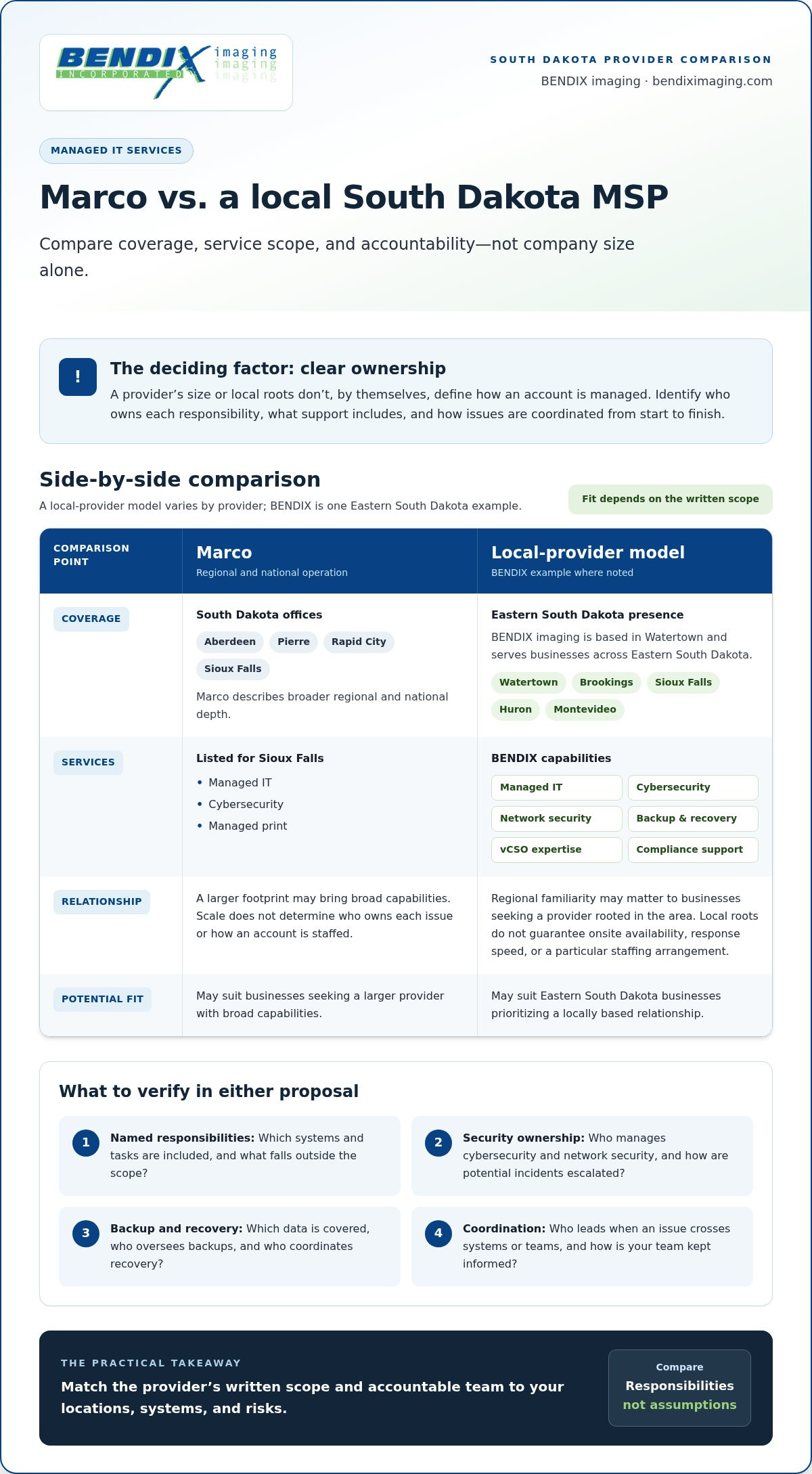
It’s reasonable to weigh Marco’s regional scale against the accountability of a local partner. Marco has South Dakota offices in Aberdeen, Pierre, Rapid City, and Sioux Falls. BENDIX imaging is based in Watertown and serves businesses across Eastern South Dakota, including Watertown, Brookings, Sioux Falls, Huron, and Montevideo. Its services include managed IT, cybersecurity, backup and recovery, vCSO, and compliance support. Both provider models can support business technology, but the details of coverage, expertise, and coordination determine which fits your team.
This comparison breaks down local coverage, service scope, security and backup needs, and the questions that reveal who owns an issue from start to finish. Use it to match provider capabilities to your locations, business size, and risks, then bring the right information to a managed IT planning conversation.
Key Takeaways
- Compare the responsibilities included in each managed IT proposal, not just the broad service labels.
- Assess cybersecurity, network security, backups, recovery, and compliance as distinct needs with clear ownership.
- For Marco managed IT services vs local MSP South Dakota, weigh the support model and assigned resources, not company size alone.
- Use a practical checklist to map your locations, risks, responsibilities, and essential versus optional services.
- See how BENDIX imaging’s Eastern South Dakota presence and technology services fit your business’s needs.
Marco Managed IT Services vs. a Local South Dakota MSP: What Is the Real Difference?
A managed service provider (MSP) is an outside partner that manages technology operations a business has agreed to hand over. That may include day-to-day IT support, security, or other defined services. The Managed Services Overview offers background on the model. When choosing an MSP, focus on what the provider will own in your business and how clearly those responsibilities are defined.
For the Marco managed IT services vs local MSP South Dakota comparison, look beyond the company name. Marco combines a Sioux Falls presence with a larger regional and national operation. A local-provider model may offer a closer connection to the communities and business conditions it serves. Neither size nor proximity alone tells you how an account is managed, what support includes, or whether the arrangement fits your needs.
What Marco’s South Dakota presence means for local businesses
Marco’s Sioux Falls location page presents the company as offering local expertise backed by national depth. It lists managed IT, cybersecurity, and managed print for Sioux Falls businesses. That combination may appeal to organizations seeking a provider with a broad footprint and several technology capabilities. The practical test is how the proposed services and account responsibilities map to your operation.
What a local MSP model can mean in Eastern South Dakota
A provider based in Eastern South Dakota may be familiar with business communities such as Watertown, Brookings, Sioux Falls, Huron, and Montevideo. That regional focus can matter if you value an ongoing relationship with a provider rooted in the area. But local roots don’t establish onsite availability, response speed, or which staff will handle your account. Those details should be clear in the service arrangement.
BENDIX imaging is a privately owned local provider based in Watertown and serving businesses across Eastern South Dakota. Its services include managed IT, cybersecurity, network security, backup and recovery, vCSO expertise, and regulatory compliance support. For businesses comparing local providers, these capabilities offer a concrete basis for evaluating scope rather than assuming a smaller provider has limited reach.
| Comparison point | Marco | Local-provider model |
|---|---|---|
| Coverage | Sioux Falls presence, with broader regional and national depth described in Marco’s messaging. | May focus on nearby communities across a defined regional footprint. |
| Relationship model | Scale does not determine who owns each issue; responsibilities should be clear. | Local roots may support regional familiarity, but don’t guarantee a particular staffing arrangement. |
| Service breadth | Sioux Falls page lists managed IT, cybersecurity, and managed print. | Scope varies; BENDIX offers IT, security, backup and recovery, vCSO, and compliance services. |
| Potential fit | May suit businesses seeking a larger provider and broad capabilities. | May suit Eastern South Dakota businesses prioritizing a locally based relationship. |
Use the comparison as a starting point, not a verdict. For each provider, identify the team accountable for every part of your technology environment, how the proposed scope covers your locations, and where support responsibilities begin and end. These specifics reveal more about fit than provider size alone.
Compare Managed IT Services, Security, and Support Before You Choose
A proposal can say “managed IT” or “cybersecurity” without showing exactly what the provider will do. Compare the written scope, not just the service labels. Look for named responsibilities, what’s included in ongoing management, what falls outside the scope, and how work is coordinated when an issue crosses systems or teams. Clear ownership helps prevent critical tasks from being assumed but left undone.
Review each proposal against your actual operations. If your business relies on a cloud accounting platform, on-site network equipment, and shared file storage, identify which systems are covered and who handles each one. The Marco managed IT services vs local MSP South Dakota decision should turn on those practical details, not on a long list of service categories.
- Cybersecurity: Identify the protections and monitoring responsibilities included, and how potential incidents are escalated.
- Network security: Clarify which network components are covered and who manages their security.
- Backup and recovery: Establish which data is backed up, who oversees the process, and what recovery responsibilities are defined.
- Compliance support: Separate technical support from guidance, documentation, or other compliance-related responsibilities.
Match cybersecurity and continuity support to business risk
Start with what your business can’t afford to lose. List critical systems, sensitive data, and the operational consequences of downtime. Then compare how each proposal assigns security, backup, and recovery work. A backup service label alone doesn’t explain what data is covered or who coordinates recovery. For a closer look at risk-focused protections, explore BENDIX’s cybersecurity support.
Make ownership explicit. If an incident affects both network access and backed-up data, the proposal should show who leads coordination and how your team is kept informed. Routine support, incident handling, and vendor communication may involve different tasks, but your business needs a clear path for getting each issue to the right owner.
Check strategic and compliance support, not just help desk coverage
A help desk addresses user issues, but it doesn’t necessarily set security priorities. vCSO guidance can help a business organize security and compliance work into a clearer plan. Compare what each proposal commits to in planning, reporting, and accountability. Look for defined deliverables and decision-making responsibilities rather than assuming a broad “strategy” label includes them.
Separate ongoing managed services from work that’s scoped independently. A proposal may define recurring support while treating a project, system change, or additional compliance task separately. That isn’t a flaw, but it should be clear before you decide. Review BENDIX’s vCSO services to see how strategic security guidance can complement managed IT.
Before comparing proposals, mark each responsibility as included, separately scoped, or assigned to your own team. This simple review exposes gaps and overlap. For managed IT alongside cybersecurity, backup, compliance, or vCSO needs, BENDIX’s managed IT services provide an Eastern South Dakota option.
Does a Local MSP Have Enough Reach? Addressing the Scale Concern
Does choosing a local MSP mean settling for limited resources? Not necessarily. A national provider isn’t automatically distant or impersonal, either. A company’s size describes its overall scale, not the specific people, processes, or services assigned to your account. For the Marco managed IT services vs local MSP South Dakota decision, judge the working model: who coordinates your support, how issues move between specialists, and what responsibilities are documented.
Separate general capability from account-level delivery. A provider may offer a broad range of services, but the useful question is which are part of your arrangement and how they connect. Likewise, a regional provider’s local focus doesn’t establish staffing depth or onsite availability by itself. Look for a service structure that suits your operations, not assumptions based on a company’s size or address.
When regional familiarity can support day-to-day operations
A provider serving Eastern South Dakota may understand the geography and business communities around Watertown, Brookings, Sioux Falls, Huron, and Montevideo. That familiarity can make conversations more grounded in how your organization operates across the region. A locally rooted relationship may also give your team a consistent point of connection. It doesn’t, on its own, guarantee onsite support or a particular response time.
Consider whether continuity matters to your business. If your staff work in one town or across nearby communities, a relationship built around the region may be a practical fit. Focus on how communication is handled, who understands your environment, and how the provider tracks your needs over time. Proximity is relevant, but it isn’t a substitute for defined ownership.
When broader provider resources may matter more
A broader provider footprint may suit organizations operating across multiple locations or managing complex technology environments. Those businesses may value access to a wider range of capabilities or a consistent approach across sites. But scale alone doesn’t prove that a particular specialist, tool, or outcome will be part of your account. The proposal and assigned service model make that clear.
For multi-location operations, consistency is key. Ask how support is coordinated across offices, how shared systems and security policies are managed, and how local differences are handled without creating gaps. A business with a main office in Sioux Falls and another site in Watertown, for example, needs clear responsibility across both locations, regardless of which provider model it chooses.
- People: Identify the roles responsible for routine support, security, and complex issues.
- Process: Understand how requests are routed, escalated, and tracked across locations.
- Scope: Compare which systems, sites, and responsibilities are covered in writing.
- Consistency: Look for a defined approach to shared access, security practices, and communication across your organization.
BENDIX imaging serves businesses across Eastern South Dakota from its Watertown base, including Watertown, Brookings, Sioux Falls, Huron, and Montevideo. For a regional business, that local focus is one factor to weigh alongside the documented team, processes, and scope proposed for the work. Evaluate the operating model, not the label.
How to Decide Between Marco and a Local MSP: A South Dakota Fit Checklist
Make the decision against your business requirements, not a general impression of provider size or proximity. The Marco managed IT services vs local MSP South Dakota comparison becomes clearer when you put your needs in writing and check whether each proposal assigns responsibility for them. Use this five-step review to spot gaps, separate must-haves from optional services, and compare what each provider is proposing.
Build a requirements list for your South Dakota business
Start with a concise inventory: employee count, business locations, critical applications, and the IT work your internal staff can manage. Then rank cybersecurity, backups, compliance, and network needs by the impact of a failure or interruption. Note which systems employees need to serve customers and which data would be difficult to restore. This list gives each proposal the same practical starting point.
- Map your needs. Record essential technology, recurring support needs, and specialized security or compliance priorities.
- List your locations. Include every office or work site, who uses its systems, and where consistent support matters.
- Prioritize your risks. Identify sensitive data, business-critical systems, and the consequences of downtime.
- Assign responsibilities. Note what your internal IT staff, business leaders, and outside provider should own.
- Review proposal scope. Compare included services, exclusions, deliverables, communication paths, and escalation language against your list.
Compare proposals on scope and accountability
Read each proposal for specifics, not just reassuring labels. Check how routine requests, incidents, reporting, and planning are handled, and whether the provider’s responsibilities match your priorities. A clearly defined exclusion is easier to plan around than a task everyone assumes someone else will handle. Keep pricing comparisons qualitative unless you have current proposals with comparable scope, inclusions, and terms.
Use this decision matrix to guide discussion. It doesn’t assign scores; it helps reveal where a proposal fits or needs clarification.
- Strong fit: Essential systems and locations are addressed, responsibilities are explicit, and communication and reporting match your needs.
- Needs clarification: A service is named, but ownership, deliverables, exclusions, or escalation steps are vague.
- Optional: The service may be useful, but it doesn’t address a current priority or identified business risk.
Apply the same test to both providers. If your priorities include cybersecurity, backup and recovery, or compliance, check whether each proposal connects those services to your operations and identifies who coordinates related work. BENDIX imaging’s managed IT services for South Dakota businesses serve Eastern South Dakota businesses.
Before making a choice, make sure the proposal reflects the business you described, not a generic package. A well-matched plan makes essential coverage and accountability clear, while distinguishing optional services from core requirements.
Why Eastern South Dakota Businesses Consider BENDIX for Managed IT
Choosing between Marco and a local provider is ultimately about which service model fits your business. For companies weighing Marco managed IT services vs local MSP South Dakota, BENDIX imaging offers an Eastern South Dakota option. It is a privately owned local provider based in Watertown and serving businesses across the region, including Brookings, Sioux Falls, Huron, and Montevideo.
Local reach is useful when it supports practical coordination and a relationship grounded in the communities your business operates in. It doesn’t automatically mean a particular onsite arrangement or response time. Consider whether the provider’s services and communication model align with your locations, technology priorities, and internal capacity.
A local partner with connected business technology services
BENDIX’s managed IT services connect with cybersecurity, network security, data backup and recovery, vCSO expertise, and regulatory compliance support. This range lets businesses consider day-to-day technology management alongside security and continuity needs. The value lies in how responsibilities fit together for your organization, not simply how many services appear in a list.
Technology operations can also involve print and communications. BENDIX offers managed print and VoIP systems, which can be considered alongside your IT environment. For example, a team reviewing office technology management can include printers and business phone systems in the discussion rather than treating them as unrelated concerns. The right scope depends on your operations.
Take the next step with a clear view of your needs
Before discussing a managed IT plan, bring a short summary of your business: locations, the systems employees rely on, recurring technology challenges, and the security or compliance priorities that matter most. Include areas where internal staff need support. This gives the conversation a practical starting point and connects services to real business needs.
Be direct about what you need to protect and where unclear ownership creates concern. Whether your focus is cybersecurity, backup and recovery, network security, compliance, or broader IT coordination, a clear priority list makes it easier to define a suitable scope.
- Locations: Note where teams work and which systems they depend on.
- Priorities: Separate essential protections and support from optional improvements.
- Challenges: Identify recurring disruptions, security concerns, or responsibilities that feel unclear.
Ready to discuss managed IT and cybersecurity for your Eastern South Dakota business? Bring your priorities and start a conversation with BENDIX imaging about the support your organization needs.
Turn Your IT Priorities Into a Clear Next Step
The best choice is the provider model that makes ownership clear and keeps your technology priorities connected to the way your business operates. Before you decide, turn open questions into a short working brief: what must stay available, which risks need attention, and where you need a partner to take responsibility. That gives the conversation a practical focus and helps prevent important needs from getting lost in broad service descriptions.
The Marco managed IT services vs local MSP South Dakota decision doesn’t need to come down to company size or a single feature. It should reflect the support structure your team can rely on and the responsibilities your business needs covered. If you’re ready to explore how those priorities could translate into a managed IT plan, start a conversation with BENDIX.
Talk with BENDIX about managed IT for your business. A clear starting point can help you move toward technology support that fits your goals.
Frequently Asked Questions
Is Marco a local managed IT provider in South Dakota?
Yes. Marco has a published Sioux Falls presence, and its Sioux Falls page lists managed IT, cybersecurity, and managed print. That establishes a local office and stated service offerings, but it doesn’t by itself describe the full geographic reach or how each account is supported across South Dakota. Distinguish Marco’s local positioning from the coverage and responsibilities defined for the services in your proposal.
What is the difference between Marco and a local MSP?
The difference is often the provider’s operating model and geographic footprint, not a fixed difference in service quality. Marco combines a South Dakota presence with a broader company structure, while a local MSP may focus on a regional customer base. In the Marco managed IT services vs local MSP South Dakota comparison, look at who owns your account, how specialists are involved, and how support is coordinated. Practices vary by provider.
Can a local MSP support a business with multiple South Dakota locations?
Yes, a local MSP can support a business with multiple locations when its documented coverage and service scope fit the organization. A company with offices in Watertown and Sioux Falls, for example, should look for clear ownership of shared systems as well as location-specific needs. The number of sites alone doesn’t determine fit. Compare how requests, account communication, and consistent technology practices are coordinated across locations.
How much do managed IT services cost in South Dakota?
There isn’t one reliable price that applies to every South Dakota business. Proposals depend on the environment and the services being scoped, such as the systems supported, security needs, backup responsibilities, and compliance priorities. To compare proposals fairly, give each provider the same business requirements and review what is included or separately scoped. Avoid comparing headline totals without understanding the work each covers.
What should a business compare in managed IT service proposals?
Compare the actual scope, including which devices or systems are supported and what cybersecurity and backup responsibilities are defined. Review how routine requests are handled, who coordinates incidents, and what reporting or planning deliverables are described. Pay attention to exclusions and communication commitments, too. For example, make sure it’s clear who coordinates with a software vendor if an application problem affects employees but the underlying system belongs to that vendor.
Does a business need both managed IT and cybersecurity services?
Not necessarily as separate arrangements. Cybersecurity can be part of an IT management plan or scoped as a distinct area of work, depending on the business’s needs and current resources. Assess the sensitivity of the information you handle, the systems employees rely on, and which security tasks your team can manage internally. The key is to make security ownership explicit rather than assume general IT support covers every protection need.
Can an MSP help with compliance and data backup?
Yes, an MSP may provide compliance support and backup or recovery services, but the responsibilities should be defined separately. Compliance guidance can help organize technology-related priorities; it isn’t a substitute for legal advice or a determination that your business meets every requirement. For backup, identify what information is covered and who manages recovery tasks. BENDIX imaging provides regulatory compliance support and data backup and recovery for businesses in Eastern South Dakota.
{"@context":"https://schema.org","@type":"FAQPage","mainEntity":[{"@type":"Question","name":"Is Marco a local managed IT provider in South Dakota?","acceptedAnswer":{"@type":"Answer","text":"Yes. Marco has a published Sioux Falls presence, and its Sioux Falls page lists managed IT, cybersecurity, and managed print. That establishes a local office and stated service offerings, but it doesn’t by itself describe the full geographic reach or how each account is supported across South Dakota. Distinguish Marco’s local positioning from the coverage and responsibilities defined for the services in your proposal."}},{"@type":"Question","name":"What is the difference between Marco and a local MSP?","acceptedAnswer":{"@type":"Answer","text":"The difference is often the provider’s operating model and geographic footprint, not a fixed difference in service quality. Marco combines a South Dakota presence with a broader company structure, while a local MSP may focus on a regional customer base. In the Marco managed IT services vs local MSP South Dakota comparison, look at who owns your account, how specialists are involved, and how support is coordinated. Practices vary by provider."}},{"@type":"Question","name":"Can a local MSP support a business with multiple South Dakota locations?","acceptedAnswer":{"@type":"Answer","text":"Yes, a local MSP can support a business with multiple locations when its documented coverage and service scope fit the organization. A company with offices in Watertown and Sioux Falls, for example, should look for clear ownership of shared systems as well as location-specific needs. The number of sites alone doesn’t determine fit. Compare how requests, account communication, and consistent technology practices are coordinated across locations."}},{"@type":"Question","name":"How much do managed IT services cost in South Dakota?","acceptedAnswer":{"@type":"Answer","text":"There isn’t one reliable price that applies to every South Dakota business. Proposals depend on the environment and the services being scoped, such as the systems supported, security needs, backup responsibilities, and compliance priorities. To compare proposals fairly, give each provider the same business requirements and review what is included or separately scoped. Avoid comparing headline totals without understanding the work each covers."}},{"@type":"Question","name":"What should a business compare in managed IT service proposals?","acceptedAnswer":{"@type":"Answer","text":"Compare the actual scope, including which devices or systems are supported and what cybersecurity and backup responsibilities are defined. Review how routine requests are handled, who coordinates incidents, and what reporting or planning deliverables are described. Pay attention to exclusions and communication commitments, too. For example, make sure it’s clear who coordinates with a software vendor if an application problem affects employees but the underlying system belongs to that vendor."}},{"@type":"Question","name":"Does a business need both managed IT and cybersecurity services?","acceptedAnswer":{"@type":"Answer","text":"Not necessarily as separate arrangements. Cybersecurity can be part of an IT management plan or scoped as a distinct area of work, depending on the business’s needs and current resources. Assess the sensitivity of the information you handle, the systems employees rely on, and which security tasks your team can manage internally. The key is to make security ownership explicit rather than assume general IT support covers every protection need."}},{"@type":"Question","name":"Can an MSP help with compliance and data backup?","acceptedAnswer":{"@type":"Answer","text":"Yes, an MSP may provide compliance support and backup or recovery services, but the responsibilities should be defined separately. Compliance guidance can help organize technology-related priorities; it isn’t a substitute for legal advice or a determination that your business meets every requirement. For backup, identify what information is covered and who manages recovery tasks. BENDIX imaging provides regulatory compliance support and data backup and recovery for businesses in Eastern South Dakota."}}]}


