

Regulatory compliance means meeting the laws, regulations, and industry standards that apply to your business, data, and customers. HIPAA sets privacy and security requirements for healthcare data, PCI DSS protects cardholder data, and SOX governs financial reporting and corporate record-keeping for publicly traded companies. Regulatory compliance IT support helps align your systems, security controls, and records with the obligations relevant to your operations.
Compliance is more than paperwork. It affects how your business protects information and earns customer confidence. Gaps in access controls, updates, backups, or documentation can create exposure. A well-managed program helps demonstrate that your organization takes its responsibilities seriously.
This article explains what regulatory compliance covers, how IT security supports it, and why the right controls matter beyond an audit. You’ll learn how requirements vary by industry and data, what noncompliance can put at risk, and how stronger compliance practices can support customer trust and market access.
Key Takeaways
- Regulatory obligations depend on your industry, the data you handle, where you operate, and the contracts you accept. Regularly reassess them as your business changes.
- Security controls such as access management, software updates, backups, and clear records help support compliance and make audit evidence easier to organize.
- Compliance gaps can expose a business to legal, financial, and reputational consequences. The European Union’s GDPR fine framework can impose a maximum fine of €20 million for severe violations.
- Consistent controls and clear evidence can help demonstrate that your organization takes data protection seriously, supporting customer confidence and access to business opportunities.
What is Regulatory Compliance?
Regulatory compliance means meeting the laws and standards that apply to an organization’s operations, data, and conduct. For IT, that means aligning cybersecurity policies and controls with applicable obligations, then keeping evidence that they work.
Managing Regulatory Change
Regulatory change management means identifying new or revised obligations and updating policies, controls, and evidence accordingly. Business operations and requirements can change, leaving existing safeguards out of date. IT support can track affected systems, document control changes, and update records. Regulatory compliance IT support can include this work alongside security configuration and evidence management.
Compliance, Corporate Governance, and Risk
Regulatory compliance addresses external legal or industry requirements; corporate compliance also covers internal policies and standards of conduct. Risk management identifies threats and weighs ways to reduce their effects, while governance assigns oversight and accountability. A GRC platform can centralize obligations and map them to controls and policies. When assessing support, consider how requirements are mapped, evidence is managed, gaps are reported, and incident response is supported.
Support costs depend on the systems, requirements, and work involved; pricing is provided after a quote request. Ask providers which compliance frameworks and certifications they support, how they document controls, and how they coordinate incident response.
Security Controls and Risk Management
Cybersecurity controls are safeguards that help meet obligations and reduce exposure, such as access permissions, password policies, supported software, and security patches. Their design should reflect the sensitivity of the data and the systems that handle it—including the end of the hardware lifecycle, where compliant e-waste recycling from providers like greenbox.com.au prevents retired assets from leaking protected information. IT compliance support can include maintaining controls, reviewing logs, and organizing audit evidence. To prepare for an audit, identify applicable requirements, assess gaps, address weaknesses, and assemble records such as access-control logs and policies.
Information Security Management
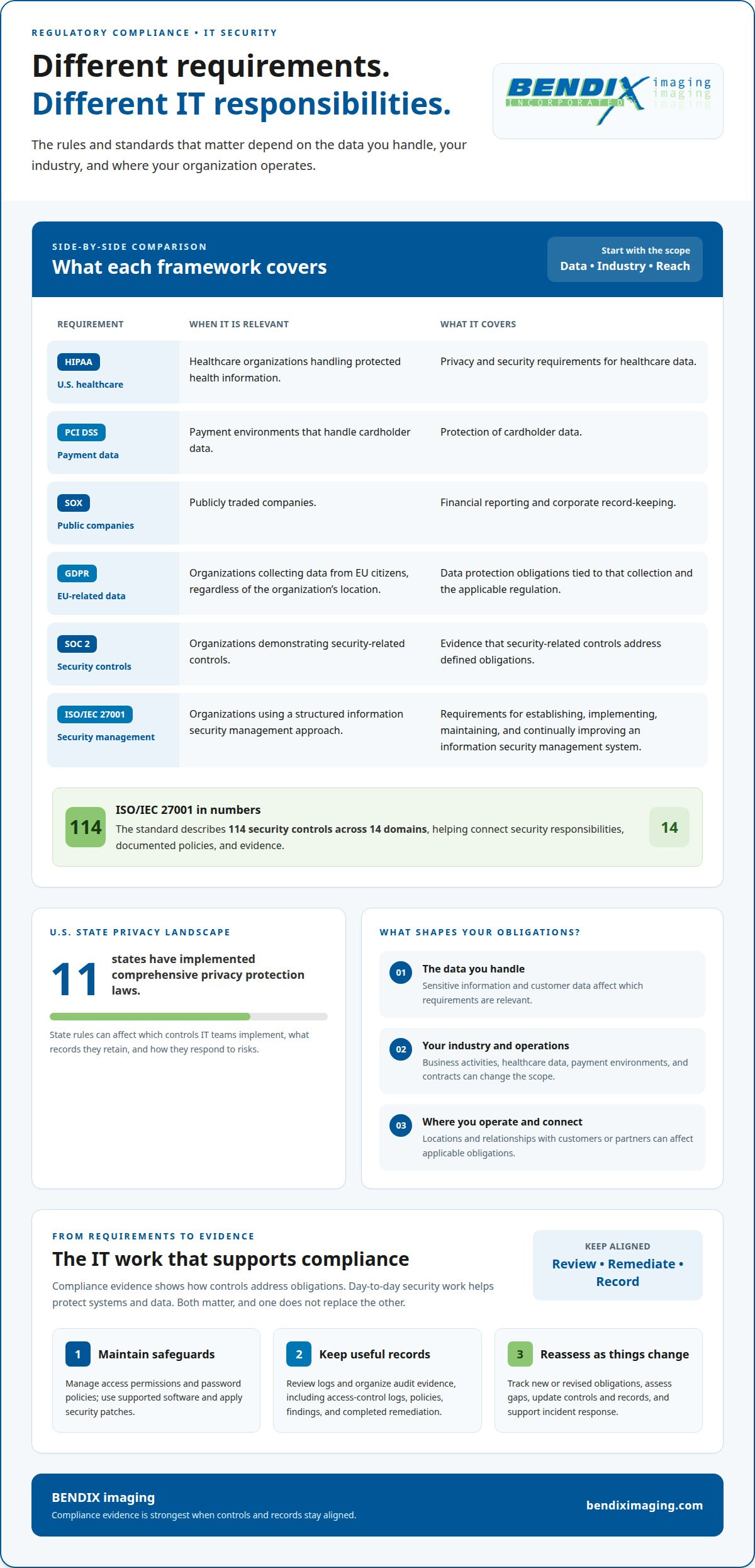
ISO/IEC 27001 specifies requirements for establishing, implementing, maintaining, and continually improving an information security management system. It describes 114 security controls across 14 domains. This structured approach helps organizations connect security responsibilities, documented policies, and evidence instead of treating each audit request as a separate task. A GRC platform can help maintain that central view, while regular reviews keep the program aligned with operational or regulatory changes.
Regulatory compliance and IT security requirements
IT requirements depend on the data an organization handles, its industry, and where it operates. Distinguish evidence required to demonstrate compliance from the security work that protects systems every day.
Industry and State Requirements
Compliance obligations vary with business activities, sensitive data, customer contracts, and the states where an organization operates. Healthcare organizations handling protected health information must consider HIPAA, while payment environments handling cardholder data must meet PCI DSS requirements. State privacy rules also matter: 11 states have implemented comprehensive privacy protection laws. These differences affect which controls IT teams implement, what records they retain, and how they respond to risks.
To assess a compliance-focused IT provider, compare its approach to your applicable requirements, security assessments, vulnerability remediation, evidence management, and incident response. Ask how it documents work and reports unresolved gaps.
Regulations Affecting IT Support
U.S. requirements may include HIPAA for protected health information, PCI DSS for cardholder data, and SOC 2 for demonstrating security-related controls. GDPR can also apply to organizations collecting data from EU citizens, regardless of the organization’s location. The relevant obligations depend on what data you process and how your operations connect to customers or partners. Identifying those factors helps focus IT support on applicable standards.
IT compliance shows whether policies and controls address defined obligations; IT security focuses on protecting systems and data from threats. They overlap, but neither replaces the other. For specialized safeguards such as threat detection and data protection, enterprise cybersecurity resources like oadtechnologies.com illustrate how active security operations complement compliance requirements. A vulnerability assessment can identify weaknesses, while remediation applies fixes such as security patches, access changes, or software updates. Keep records of findings and completed work to support internal reviews and audits.
International standards offer structured approaches to security management. ISO/IEC 27001 specifies requirements for establishing, implementing, maintaining, and continually improving an information security management system. NIST-aligned approaches can also structure compliance work. Employee training matters too: teach staff how to handle sensitive information, follow internal policies, and report suspicious activity, then reinforce those practices beyond a single annual session.
A documented security assessment approach can help connect identified weaknesses with practical remediation and supporting records.
Legal, financial, and reputational consequences
Compliance failures can lead to penalties, corrective work, and lost confidence. The effects depend on the applicable data protection regulation, the failure, and the organization’s response.
Financial Consequences
Financial consequences include regulatory fines and costs tied to investigating and correcting control failures. According to the European Union, the GDPR fine framework can impose a maximum fine of €20 million for severe violations. It can also impose a maximum fine of 4% of annual global turnover for severe violations. These limits show why organizations need clear accountability, reliable reporting, and continuous compliance management.
A breach can also divert staff from normal operations while an organization investigates, restores systems, and addresses control gaps. Develop a response process that assigns responsibilities, preserves relevant records, and tracks corrective actions. For example, a documented access-control review can show who approved permissions and what changes followed. Strong records support accountability, but they don’t replace effective safeguards.
Consequences of Compliance
Compliance means meeting applicable obligations through policies, controls, documentation, and oversight. Consistent compliance management helps organizations identify weaknesses before they become violations and gives leaders a clearer view of unresolved risks. Reporting findings and corrective actions also shows how responsibilities were handled. These practices matter because a missing record or unaddressed control gap can complicate an investigation and weaken confidence in the organization’s conduct.
Noncompliance can lead to regulatory scrutiny, required remediation, and reputational harm, especially when failures involve sensitive customer information. Customers may question whether an organization can protect their data; business partners may also reassess security expectations. Ongoing review connects changes in operations with updated controls and evidence. It can’t eliminate every threat, but it helps organizations make documented decisions instead of scrambling to reconstruct events after a failure.
Compliance also supports a more disciplined response when an incident occurs. Assigning clear owners, preserving incident records, and reporting decisions through established channels helps leaders explain what happened and what changed. Teams can trace findings to corrective actions, while management can see whether issues remain open. Treat compliance as ongoing management, not a one-time filing exercise.
Compliance benefits for customer trust and market access
Customers want evidence that organizations handle their information responsibly. A documented data protection program can show how access is controlled, sensitive records are handled, and security incidents are managed. Clear access policies and review records offer more than general assurance: they show how protections work in practice. Trust grows when an organization can explain its processes consistently.
Compliance can also support market access. A prospective customer may require security documentation before sharing data or approving a supplier. Organized policies, control records, and audit evidence help answer those requests without assembling information from scratch. Standards such as SOC 2 or ISO/IEC 27001 can provide a structured way to demonstrate security practices, while the applicable requirements depend on the customer and business relationship.
For organizations handling data connected to the European Union, the General Data Protection Regulation (GDPR) makes data protection responsibilities especially relevant. Clear ownership, documented processes, and ongoing monitoring help demonstrate that privacy risks receive attention. A customer assessing a supplier can review specific safeguards, such as how access is granted and changes are recorded, rather than relying only on broad statements.
Turn compliance into a working business process. Keep policies current, assign an accountable owner to each control, and maintain records showing how the control operates. Review findings, track remediation, and update procedures when operations or customer expectations change. These steps help teams respond to customer due diligence and internal reviews with consistent evidence. They also make gaps easier to identify and address before they disrupt a business relationship.
Build a compliance program that supports customer confidence and business readiness with regulatory compliance support.
BENDIX imaging: Regulatory Compliance
BENDIX imaging helps businesses connect compliance requirements with practical IT and security measures. Turn to its regulatory compliance support when your policies, controls, or audit evidence need to fit daily operations more clearly.
Through Managed IT Services, Cyber Security, and Network Security, BENDIX imaging supports the systems and safeguards that underpin compliance. This support can help address security gaps, maintain IT environments, and align technical practices with your compliance priorities. Artificial Intelligence (AI) Consulting can also help your business consider how AI fits its operations and risk management.
Start with the requirements affecting your organization, the systems that handle sensitive information, and the controls needing attention. BENDIX imaging can help turn those priorities into a practical support approach. Contact BENDIX imaging to discuss your regulatory compliance needs.
Make your next compliance decision count
Compliance works best when responsibilities are clear and security decisions reflect how your business operates. Identify the compliance issue creating the most uncertainty, then connect it to the systems and processes needing attention. The right regulatory compliance IT support can help turn that priority into a focused plan, with clear ownership and follow-through.
BENDIX imaging offers Managed IT Services and Cyber Security to support business technology and protection needs, alongside Artificial Intelligence (AI) Consulting. These services can help address IT and security priorities as your organization develops its compliance approach.
Bring your current concern, whether it involves security controls, operational processes, or planning for AI. A focused conversation can help clarify where technical support fits and what to address next. Contact BENDIX imaging to discuss your needs and take the next step with confidence.
Frequently Asked Questions
Consequences of Noncompliance?
Noncompliance can lead to regulatory scrutiny, corrective requirements, financial penalties, and reduced confidence from customers or business partners. The consequences depend on the applicable obligation, the type of failure, and how the organization responds. For example, a weak process for approving access could leave sensitive records exposed. Clear ownership and documented corrective actions help leadership address findings and explain decisions.
How Do You Implement a Compliance Plan?
Start by assigning an accountable owner and defining which business activities and information the plan covers. Translate applicable obligations into policies, assigned responsibilities, and controls that fit daily operations. For example, a company handling payment data can map who approves access to the relevant systems. Record decisions, train affected staff, and review the plan as operations or requirements change.
How to Measure the Effectiveness of a Compliance Program?
Measure whether controls operate consistently, not just whether policies exist. Track indicators such as overdue corrective actions, unresolved assessment findings, completed access reviews, and missing evidence. Repeated exceptions in access approvals, for example, may point to a process that needs redesign. Review trends with accountable leaders, document decisions, and use audit results to assess whether changes addressed the original gap.
What Are IT Compliance and Guidelines?
IT compliance is the alignment of technology practices with obligations that apply to an organization; IT guidelines explain how staff should follow those practices. A data-handling policy might set expectations for who can access records, while system permissions put that rule into effect. Keep guidance practical: name the responsible role, describe the expected action, and explain how staff should report an exception.
What happens if your organization is found to be out of compliance?
An organization may need to respond to an assessment or regulator, explain a gap, and address required corrective actions. The immediate response should establish what happened, which systems or records are involved, and who owns remediation. Preserve relevant evidence and document decisions as work proceeds. The steps and consequences depend on the specific requirement and circumstances surrounding the finding.
What is Compliance Reporting?
Compliance reporting communicates an organization’s status, risks, findings, and corrective actions to those responsible for oversight. Operational reports help compliance and risk teams monitor open issues, while board summaries focus on significant exposure and decisions needed. A practical report identifies the control or obligation, its status, accountable owner, evidence, and next action, giving leaders a clear basis for oversight.
{"@context":"https://schema.org","@type":"FAQPage","mainEntity":[{"@type":"Question","name":"Consequences of Noncompliance?","acceptedAnswer":{"@type":"Answer","text":"Noncompliance can lead to regulatory scrutiny, corrective requirements, financial penalties, and reduced confidence from customers or business partners. The consequences depend on the applicable obligation, the type of failure, and how the organization responds. For example, a weak process for approving access could leave sensitive records exposed. Clear ownership and documented corrective actions help leadership address findings and explain decisions."}},{"@type":"Question","name":"How Do You Implement a Compliance Plan?","acceptedAnswer":{"@type":"Answer","text":"Start by assigning an accountable owner and defining which business activities and information the plan covers. Translate applicable obligations into policies, assigned responsibilities, and controls that fit daily operations. For example, a company handling payment data can map who approves access to the relevant systems. Record decisions, train affected staff, and review the plan as operations or requirements change."}},{"@type":"Question","name":"How to Measure the Effectiveness of a Compliance Program?","acceptedAnswer":{"@type":"Answer","text":"Measure whether controls operate consistently, not just whether policies exist. Track indicators such as overdue corrective actions, unresolved assessment findings, completed access reviews, and missing evidence. Repeated exceptions in access approvals, for example, may point to a process that needs redesign. Review trends with accountable leaders, document decisions, and use audit results to assess whether changes addressed the original gap."}},{"@type":"Question","name":"What Are IT Compliance and Guidelines?","acceptedAnswer":{"@type":"Answer","text":"IT compliance is the alignment of technology practices with obligations that apply to an organization; IT guidelines explain how staff should follow those practices. A data-handling policy might set expectations for who can access records, while system permissions put that rule into effect. Keep guidance practical: name the responsible role, describe the expected action, and explain how staff should report an exception."}},{"@type":"Question","name":"What happens if your organization is found to be out of compliance?","acceptedAnswer":{"@type":"Answer","text":"An organization may need to respond to an assessment or regulator, explain a gap, and address required corrective actions. The immediate response should establish what happened, which systems or records are involved, and who owns remediation. Preserve relevant evidence and document decisions as work proceeds. The steps and consequences depend on the specific requirement and circumstances surrounding the finding."}},{"@type":"Question","name":"What is Compliance Reporting?","acceptedAnswer":{"@type":"Answer","text":"Compliance reporting communicates an organization’s status, risks, findings, and corrective actions to those responsible for oversight. Operational reports help compliance and risk teams monitor open issues, while board summaries focus on significant exposure and decisions needed. A practical report identifies the control or obligation, its status, accountable owner, evidence, and next action, giving leaders a clear basis for oversight."}}]}


