

A full-time CISO isn’t automatically the right security investment for a mid-sized company. A virtual CISO for a mid-sized business can provide strategic security guidance while an internal team continues handling day-to-day operations. The right fit depends on the leadership, communication, and incident-response support your organization needs.
Cybersecurity leadership matters, but that doesn’t mean every company needs a full-time executive. The challenge is understanding what a virtual CISO handles, how the role connects with leadership and IT teams, and what you gain or give up compared with an in-house hire.
This comparison covers provider responsibilities, executive communication, incident planning, hiring considerations, and cost factors alongside the full-time CISO option. You’ll find practical criteria for deciding which approach fits your company’s security needs and budget.
Key Takeaways
- Match vCISO support to your actual gaps, from compliance preparation and risk reviews to incident planning and executive guidance.
- Compare providers on industry knowledge, clear communication, measurable roadmaps, and how their engagement supports your internal team.
- Set expectations for leadership updates and operational coordination so security priorities stay visible to both executives and technical staff.
- Compare the full cost and coverage of a flexible engagement with the responsibilities and investment of a full-time CISO.
- Consider BENDIX imaging’s cybersecurity and IT services when you need support connecting security priorities with your technology operations.
What Is a Virtual CISO Company?
A virtual CISO provides cybersecurity leadership through a flexible engagement rather than a traditional full-time role. The work may include assessing risk, setting governance priorities, developing security policies, and preparing for audits. An internal IT team or an external provider like Torch Services can continue operating systems while the vCISO guides the security program.
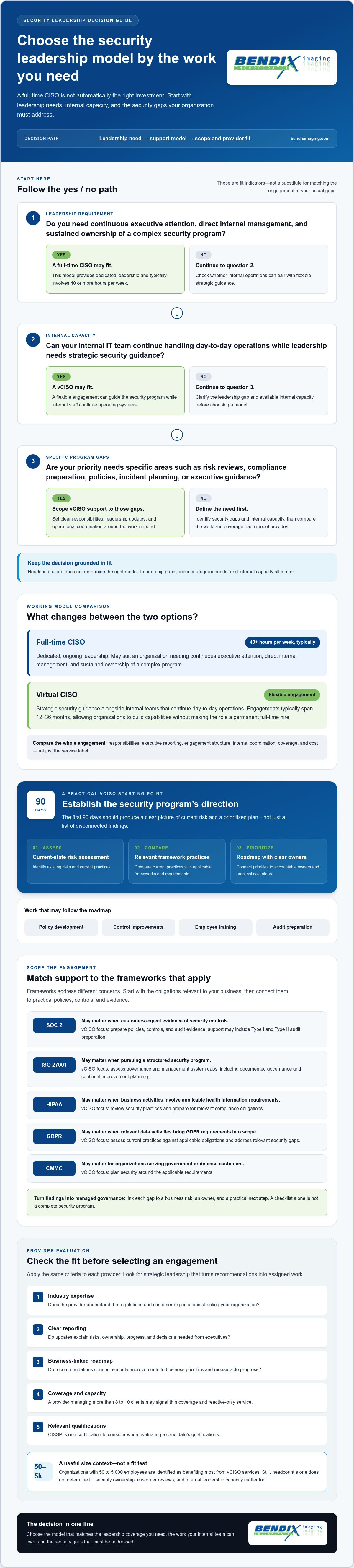
What should a virtual CISO engagement include in its first 90 days? It should establish a current-state risk assessment, compare practices against relevant frameworks, and deliver a prioritized roadmap with clear owners. The work can then move into policy development, control improvements, employee training, and audit preparation.
Start by identifying which obligations actually apply. A gap analysis compares current practices with relevant requirements and industry expectations. For example, a company pursuing SOC 2 can map existing access controls, incident procedures, and evidence collection against its audit needs. ISO 27001 planning may call for a broader information security management system, documented governance, and continual improvement.
Frameworks aren’t interchangeable. HIPAA, PCI DSS, and GDPR address different compliance concerns, while CMMC is a focus for providers serving government and defense organizations. The European Union identifies GDPR as a framework whose expanded enforcement increases organizations’ compliance requirements. A vCISO helps connect applicable frameworks to practical policies and controls, rather than treating a checklist as a complete security program.
For SOC 2, support can cover Type I and Type II audit preparation. For HIPAA or GDPR, the work may include assessing current practices, organizing policies, and addressing security gaps relevant to the organization’s obligations. The exact scope depends on the frameworks and business relationships involved.
| Framework or regulation | When it may matter | vCISO focus |
|---|---|---|
| SOC 2 | Customers expect evidence of security controls | Prepare policies, controls, and audit evidence |
| ISO 27001 | The organization is pursuing a structured security program | Assess governance and management-system gaps |
| HIPAA | Business activities involve applicable health information requirements | Review security practices and compliance preparation |
| GDPR | Relevant data activities bring GDPR requirements into scope | Assess practices against applicable obligations |
| CMMC | The organization serves government or defense customers | Focus security planning on applicable requirements |
Match the engagement’s assessment, policies, and audit support to the frameworks your organization needs to address.
Security maturity also shapes the work. A company with documented policies may need control testing and help coordinating evidence; a less mature program may first need clear accountability, foundational policies, and risk prioritization. Ask for a roadmap linking each gap to a business risk, an owner, and a practical next step. This turns scattered paperwork into managed governance.
Evaluating vCISO providers and hiring considerations
For small and mid-sized organizations, the right choice depends on leadership gaps, security program needs, and internal capacity. Compare the work delivered, executive reporting, engagement structure, and provider fit, not just the service label.
Service Components and Strategic Leadership
A vCISO combines strategic leadership with practical security program guidance. Work can include risk assessment, policy development, compliance planning, technology reviews, and executive reporting. Unlike a technical contractor focused on a defined task, a vCISO helps prioritize security across the organization. Ask how recommendations become assigned actions, who tracks progress, and how leaders see unresolved risks.
Apply the same evaluation steps to each provider:
- Match expertise to your industry. A provider should understand the regulations and customer expectations affecting your organization.
- Review reporting. Look for clear updates that explain risk, ownership, progress, and decisions needed from executives.
- Test the roadmap. Recommendations should connect security improvements to business priorities and measurable progress.
- Assess capacity. A vCISO managing more than 8 to 10 clients may signal thin coverage and reactive-only service.
- Consider credentials. CISSP is one certification to consider when evaluating a candidate’s qualifications.
Organizations with 50 to 5,000 employees are identified as benefiting most from vCISO services. Still, headcount alone doesn’t determine fit. A 150-person company with customer security reviews and limited internal leadership may need more guidance than a larger organization with mature security ownership.
Full-Time CISO and vCISO Engagements
A full-time CISO provides ongoing, dedicated leadership and typically works 40 or more hours per week. A vCISO brings strategic guidance through a flexible engagement, while internal staff can continue managing daily operations. Engagements typically span 12-36 months, giving organizations room to build capabilities without making the role a permanent full-time hire.
Compare the working model before choosing. A full-time leader may suit an organization that needs continuous executive attention, direct internal management, and sustained ownership of a complex security program. A vCISO may fit when the IT team handles security alongside other priorities, or leadership needs specialized guidance without a dedicated executive role. Define expected availability, decision rights, reporting cadence, and responsibility for implementation.
Provider headquarters and founding dates can add context, but they don’t prove service quality. Consider whether the provider understands your operating environment, communicates well with your teams, and has relevant experience for your security needs. Treat location as a practical coordination factor, not a substitute for clear scope and accountable reporting.
| Option | Leadership model | Best fit to assess |
|---|---|---|
| Solo vCISO consultant | Flexible, individual guidance | Defined strategic needs and direct access |
| vCISO firm | Structured service engagement | Broader program support and reporting |
| Full-time CISO | Dedicated internal leadership | Ongoing executive ownership and management |
Choose the model whose leadership coverage, reporting, and implementation responsibilities match your organization’s actual security workload.
Executive communication and security investment planning
Security leadership must turn technical risk into decisions executives can act on. Set a reporting rhythm, connect recommendations to business priorities, and tie each proposed investment to a risk or operational need.
Strategic Planning and Hands-On Guidance
A vCISO can set strategic direction while guiding practical work with IT and security teams. This differs from a role focused only on executive updates: the advisor can connect leadership decisions with implementation plans, risk owners, and progress measures. Use weekly operational check-ins to surface blockers, then translate technical issues into business impact, required decisions, and next steps.
Keep communication predictable. Monthly executive briefings can summarize security posture, open risks, and initiatives. Quarterly board reporting can show strategic progress, while annual planning sessions review the security program and set priorities for the next cycle. These distinct touchpoints give executives decision-ready information without burying them in technical detail.
Customized Strategy and Security Priorities
A customized strategy starts with business exposure, existing controls, and available resources. A vCISO can prioritize improvements around critical systems, customer commitments, compliance needs, and the organization’s tolerance for disruption. Unlike a generic checklist, each recommendation should identify the risk addressed, the owner, and the operational work required.
Ask for a completed risk assessment and prioritized roadmap within 30 to 60 days. The roadmap should separate urgent exposures from longer-term investments and explain dependencies, such as staff time or technology changes. Nearly 53% of organizations say their security budgets are underfunded, so executives need clear trade-offs and evidence behind each proposed spend.
Make the business case specific. For each investment, show the risk it reduces, the systems or teams affected, and how progress will be measured. Leaders weighing stronger access controls against broader employee training need a clear comparison of exposure, implementation effort, and security value. A vCISO should connect those choices to organizational goals, not simply present a list of tools.
Industry experience helps the advisor interpret those priorities. A provider familiar with your sector can recognize how customer expectations, operating models, and applicable frameworks shape security decisions. Certifications such as CISSP can inform candidate evaluation, but executives should also assess whether the advisor explains technical risk clearly and translates recommendations into a workable plan.
Clarify incident-response responsibilities before an event. The vCISO can help leadership understand decision points, escalation paths, and how incident response connects with business continuity. Managed security support may handle operational monitoring, while security leadership sets priorities and coordinates executive decisions. Define those roles in reporting and response plans so an incident does not expose gaps between technical teams and management.
For organizations affected by SEC cybersecurity disclosure rules, board-level security oversight is an important planning consideration. Use board reporting to explain material risks, program progress, and decisions requiring oversight. Tie each update to documented evidence and clear ownership, so executives can see what changed and what action remains.
Virtual CISO responsibilities and incident response
A vCISO connects risk management with security decisions, response planning, and recovery priorities. At a mid-sized company, key risks include compromised accounts, phishing, exposed sensitive data, and disruptions to critical systems.
Virtual CISO Services and Responsibilities
A virtual CISO provides fractional security leadership, helping set priorities while internal teams handle day-to-day operations. Responsibilities can include maintaining the risk register, coordinating governance and compliance work, and aligning security policies with business needs. Unlike an operational IT role, this leadership function focuses on accountability, risk decisions, and clear ownership of security work.
Make the division of responsibilities explicit. The vCISO can advise on controls and escalation procedures, while designated employees operate systems and carry out approved changes. Weekly operational check-ins with IT and security teams can surface issues such as overdue access reviews or unresolved software vulnerabilities. An empowered internal person should own cybersecurity accountability and coordinate decisions across teams.
Incident Response and Breach Recovery
Incident-response planning differs from routine risk management because it prepares people to act during a disruption. A vCISO can help develop response plans, define escalation paths, and connect technical actions with business continuity and disaster recovery. For example, a suspected compromised account should trigger clear steps for reporting, investigation, containment, and leadership updates.
Recovery needs its own tested procedures. Test how critical systems respond to disruption, how they can be restored, and whether employees know their roles. A tabletop exercise can walk leaders and technical staff through a ransomware scenario, identifying who makes decisions and how teams communicate. Testing exposes gaps before an actual incident puts operations under pressure.
What cybersecurity risks should a virtual CISO address at a mid-sized company? Prioritize threats that could expose sensitive information or interrupt essential operations, including phishing, weak access controls, unpatched systems, and inadequate recovery plans. Rank each risk by business impact, affected systems, existing controls, and the actions needed to reduce exposure.
During a breach, the vCISO can guide the response without replacing the internal incident owner or technical responders. The plan should identify who assesses the incident, coordinates containment, and communicates with executives. Document contact paths and responsibilities so staff don’t lose time deciding whom to notify.
After recovery, record what happened, which controls worked, and where the response stalled. Use those findings to update policies, training, and recovery procedures. A vCISO can turn incident lessons into assigned improvements, linking each corrective action to an owner and a risk-management priority.
Cost comparison with a full-time CISO
Compare the full commitment, not just the headline cost. A full-time CISO carries compensation and employment costs, while virtual CISO services vary with advisory hours, technical scope, compliance complexity, and implementation support. The deciding factor is how much leadership your security program needs and what work your internal team can own.
That figure frames the hiring commitment, but it doesn’t capture every practical consideration. A full-time executive can provide dedicated leadership and ongoing internal coordination. A vCISO offers flexible access to strategic expertise, with the engagement shaped around the organization’s security priorities.
| Cost consideration | Full-time CISO | Virtual CISO |
|---|---|---|
| Commitment | Ongoing executive employment | Flexible advisory engagement |
| Leadership coverage | Dedicated internal presence | Coverage defined by engagement scope |
| Implementation | May lead internal execution | Internal teams often carry out operational work |
| Best cost comparison | Total compensation and employment costs | Scope, hours, complexity, and support required |
Scope drives the vCISO comparison. An organization seeking executive advice and a security roadmap needs a different engagement from one requiring extensive compliance preparation and implementation coordination. A project-based engagement may suit a defined objective, while ongoing advisory support may fit a program that needs recurring leadership. Compare deliverables and responsibilities, not labels alone.
Separate advisory work from technical execution. A vCISO may prioritize access-control improvements and set accountability, while an internal team or a managed IT specialist like Proactive Networking configures systems and tracks completion. If implementation support is included, establish which tasks the provider handles and which remain with employees. Otherwise, the organization may have recommendations but insufficient capacity to carry them out.
Build a like-for-like estimate by listing expected hours, reporting, compliance requirements, incident planning, and implementation duties. Then identify internal staff time and any separate technology or operational needs. These factors shape the engagement’s total burden, even when they don’t appear in an advisory proposal. For a vCISO engagement, pricing depends on the case and is given after a quote request; scope, compliance complexity, hours, and implementation support affect the cost.
A full-time hire may make sense when the organization needs dedicated daily leadership and direct management of a substantial internal security function. A vCISO may fit when executives need strategic guidance and the internal team can manage routine operations. Weigh leadership coverage, scope, and execution capacity against total compensation.
Clarify decision rights before committing. Identify who approves security investments, who owns technical changes, and how progress reaches executives. For organizations balancing security priorities with broader IT operations, explore managed IT services as part of the planning conversation.
BENDIX imaging: Artificial Intelligence (AI) Consulting
BENDIX imaging helps businesses consider AI alongside cybersecurity and day-to-day technology needs. Its Artificial Intelligence (AI) Consulting can help you assess where AI may fit and how to approach adoption with security and operations in view.
Security decisions also depend on the systems supporting your organization. Cyber Security and Network Security address protection priorities, while Managed IT Services supports the broader technology environment. Bringing these needs into the same planning conversation can help leaders weigh AI opportunities against information security and operational requirements.
If your next step is to review AI or security priorities with a technology partner, contact BENDIX imaging or visit bendiximaging.com.
Make Security Leadership Part of the Next Business Decision
Choosing a virtual CISO for a mid-sized business is not only a staffing decision. It makes security leadership part of how your organization evaluates change, technology, and risk. As priorities shift, keep ownership clear and make security decisions alongside operational plans, not after them.
BENDIX imaging offers Artificial Intelligence (AI) Consulting, Cyber Security, and Managed IT Services. These services can support conversations about responsible AI adoption, security priorities, and the technology environment your teams rely on. Start with the business challenge that matters most, then outline the decisions and support needed to address it.
Ready to discuss a practical next step for your organization? Contact BENDIX imaging today. A clear conversation can help you move forward with greater focus and confidence.
Frequently Asked Questions
Bringing It All Together: Is a vCISO Right for Your Organization?
A vCISO can fit an organization that needs security leadership but not a dedicated executive managing the function full time. Consider this model if executives lack clear security visibility, internal IT handles security alongside other work, or customers expect documented answers about risk. It may be less suitable when the organization needs a leader continuously managing a large internal security team and daily decisions.
How quickly does a vCISO engagement produce results?
Virtual CISO onboarding typically takes 2-4 weeks, and services may begin delivering value in that period. Early progress can include clarified ownership, an initial view of priority risks, or a defined work plan. Compliance-related business outcomes typically follow within six months. Treat those as distinct milestones: organizing the engagement is not the same as completing compliance work or achieving an audit outcome.
What does a virtual CISO do for a mid-sized business?
A virtual CISO provides cybersecurity leadership without becoming a full-time internal executive. For example, an advisor can help leaders decide whether a customer security request needs a policy update, technical remediation, or documented evidence. The vCISO can coordinate priorities across executives and IT staff, while employees remain responsible for operating systems and carrying out assigned work.
How much does a virtual CISO cost in the United States?
Virtual CISO pricing depends on the engagement’s scope and is provided after a quote request. Costs are shaped by advisory hours, compliance complexity, implementation support, and the level of ongoing leadership required. A limited strategic review has different requirements from a broad security program engagement. Compare the defined deliverables and responsibilities rather than relying on a headline price alone.
What factors affect virtual CISO pricing and service levels?
Service levels and pricing depend on the organization’s security maturity, the work required, and the expertise involved. A program needing policy development, audit preparation, and implementation coordination calls for a different scope than one needing periodic executive advice. Clarify availability, reporting, incident-planning responsibilities, and which tasks remain with internal staff. Those details show whether the engagement matches operational needs.
How does a virtual CISO compare with hiring a full-time CISO?
A full-time CISO provides dedicated executive leadership and internal continuity, while a vCISO supplies strategic guidance through a flexible engagement. Compare the need for daily decision-making, people management, and direct oversight, not only compensation. A virtual model can suit a business whose internal team handles operations; a full-time hire may better fit a sustained need for daily executive ownership.
What cybersecurity frameworks can a virtual CISO help a business meet, such as NIST CSF, SOC 2, or ISO 27001?
A vCISO can help businesses prepare for frameworks such as SOC 2 and ISO 27001, as well as applicable HIPAA, GDPR, or CMMC requirements. Support can include mapping existing controls, identifying evidence gaps, assigning remediation owners, and organizing audit preparation. Framework selection depends on the organization’s obligations and customer expectations. Preparation supports a compliance effort, but it doesn’t itself establish certification or audit success.
How can a mid-sized business choose and vet a virtual CISO provider?
Choose a provider by assessing relevant industry experience, communication skills, and clear deliverables. Ask for a sample roadmap or reporting format, then see whether it connects risks to owners and practical decisions. Define implementation responsibilities and escalation paths in the engagement scope. Businesses in Watertown, Brookings, Sioux Falls, Huron, and Montevideo can also consider how the provider will coordinate with their teams.
{"@context":"https://schema.org","@type":"FAQPage","mainEntity":[{"@type":"Question","name":"Bringing It All Together: Is a vCISO Right for Your Organization?","acceptedAnswer":{"@type":"Answer","text":"A vCISO can fit an organization that needs security leadership but not a dedicated executive managing the function full time. Consider this model if executives lack clear security visibility, internal IT handles security alongside other work, or customers expect documented answers about risk. It may be less suitable when the organization needs a leader continuously managing a large internal security team and daily decisions."}},{"@type":"Question","name":"How quickly does a vCISO engagement produce results?","acceptedAnswer":{"@type":"Answer","text":"Virtual CISO onboarding typically takes 2-4 weeks, and services may begin delivering value in that period. Early progress can include clarified ownership, an initial view of priority risks, or a defined work plan. Compliance-related business outcomes typically follow within six months. Treat those as distinct milestones: organizing the engagement is not the same as completing compliance work or achieving an audit outcome."}},{"@type":"Question","name":"What does a virtual CISO do for a mid-sized business?","acceptedAnswer":{"@type":"Answer","text":"A virtual CISO provides cybersecurity leadership without becoming a full-time internal executive. For example, an advisor can help leaders decide whether a customer security request needs a policy update, technical remediation, or documented evidence. The vCISO can coordinate priorities across executives and IT staff, while employees remain responsible for operating systems and carrying out assigned work."}},{"@type":"Question","name":"How much does a virtual CISO cost in the United States?","acceptedAnswer":{"@type":"Answer","text":"Virtual CISO pricing depends on the engagement’s scope and is provided after a quote request. Costs are shaped by advisory hours, compliance complexity, implementation support, and the level of ongoing leadership required. A limited strategic review has different requirements from a broad security program engagement. Compare the defined deliverables and responsibilities rather than relying on a headline price alone."}},{"@type":"Question","name":"What factors affect virtual CISO pricing and service levels?","acceptedAnswer":{"@type":"Answer","text":"Service levels and pricing depend on the organization’s security maturity, the work required, and the expertise involved. A program needing policy development, audit preparation, and implementation coordination calls for a different scope than one needing periodic executive advice. Clarify availability, reporting, incident-planning responsibilities, and which tasks remain with internal staff. Those details show whether the engagement matches operational needs."}},{"@type":"Question","name":"How does a virtual CISO compare with hiring a full-time CISO?","acceptedAnswer":{"@type":"Answer","text":"A full-time CISO provides dedicated executive leadership and internal continuity, while a vCISO supplies strategic guidance through a flexible engagement. Compare the need for daily decision-making, people management, and direct oversight, not only compensation. A virtual model can suit a business whose internal team handles operations; a full-time hire may better fit a sustained need for daily executive ownership."}},{"@type":"Question","name":"What cybersecurity frameworks can a virtual CISO help a business meet, such as NIST CSF, SOC 2, or ISO 27001?","acceptedAnswer":{"@type":"Answer","text":"A vCISO can help businesses prepare for frameworks such as SOC 2 and ISO 27001, as well as applicable HIPAA, GDPR, or CMMC requirements. Support can include mapping existing controls, identifying evidence gaps, assigning remediation owners, and organizing audit preparation. Framework selection depends on the organization’s obligations and customer expectations. Preparation supports a compliance effort, but it doesn’t itself establish certification or audit success."}},{"@type":"Question","name":"How can a mid-sized business choose and vet a virtual CISO provider?","acceptedAnswer":{"@type":"Answer","text":"Choose a provider by assessing relevant industry experience, communication skills, and clear deliverables. Ask for a sample roadmap or reporting format, then see whether it connects risks to owners and practical decisions. Define implementation responsibilities and escalation paths in the engagement scope. Businesses in Watertown, Brookings, Sioux Falls, Huron, and Montevideo can also consider how the provider will coordinate with their teams."}}]}


