
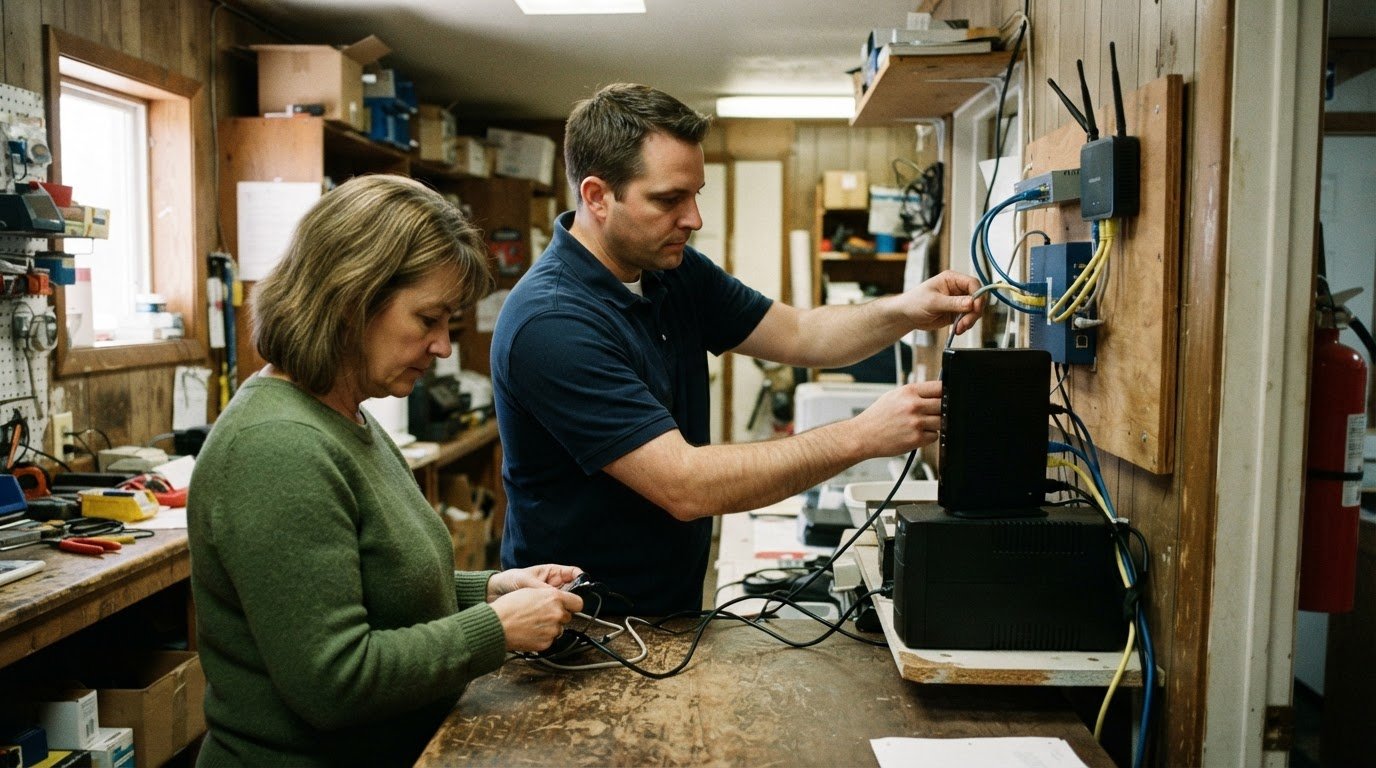
A disruption can stop more than your computers. For South Dakota businesses, business continuity planning is the process of documenting how to keep essential work moving during an interruption and restore operations afterward. It covers people, processes, and resources, while disaster recovery focuses more narrowly on restoring technology and data.
You’re right to look beyond backups: restoring a system won’t keep your business moving if no one knows which work comes first. Business continuity planning SD starts with a business impact analysis, which identifies critical functions, the resources they depend on, and the consequences of an interruption.
This guide explains the purpose of a continuity plan, how it differs from disaster recovery, and how impact analysis informs practical decisions. You’ll learn how to identify threats, assign responsibilities, prepare workarounds, and keep the plan current as your business changes.
Key Takeaways
- Define how essential work will continue during disruption, not just how systems and data will be restored.
- Use a business impact analysis to identify time-sensitive functions, dependencies, and the consequences of interruption.
- Turn priorities into clear responsibilities and practical procedures, then practice and update the plan as your business changes.
- When technology risks or recovery readiness need attention, BENDIX imaging’s managed IT services, cybersecurity, and network security can support your planning.
What Is Business Continuity Planning?
Business continuity planning defines how critical work will continue or resume during disruption; a plan records actions, owners, contacts, and workarounds. South Dakota employer obligations depend on the workplace and activity; continuity planning is distinct from emergency action and IT disaster recovery planning.
-
Identify Businesses That Need a Plan
Map the work your organization must sustain, whatever its size or industry. A small retailer may depend on payment processing and supplier deliveries; a manufacturer may rely on equipment, staff, and utilities. Healthcare providers, professional services firms, and other organizations also have essential functions and resources to protect. Prioritize activities whose interruption would first affect customers, employees, or operations.
-
Compile the Plan Contents
Document essential functions, likely threats, responsible team members, and contacts for employees, first responders, and vendors. Include manual IT workarounds, alternate ways to communicate, and the resources needed to keep priority services operating. Define who makes decisions and how teams resume work. ISO 22301:2019 is the standard for business continuity management system requirements, according to the International Organization for Standardization. ISO/IEC 27031:2011 provides guidelines for information and communication technology readiness for business continuity, according to the International Organization for Standardization.
-
Train Staff and Test the Plan
Assign each continuity responsibility to a specific role, then train the people expected to carry it out. Test the plan with a realistic scenario, such as a power outage that blocks access to business systems. Have participants follow the documented steps, identify gaps, and record decisions. A plan employees have never practiced can be hard to use under pressure, so turn test findings into specific improvements.
-
Update and Maintain the Plan
Review the plan whenever operations, technology, staff responsibilities, or suppliers change. Confirm that contact details, escalation paths, and manual workarounds still match how the business operates. Schedule exercises and revise procedures when tests reveal unclear instructions or missing resources. Keep a current copy accessible to response teams, including when normal systems or work locations are unavailable.
Business continuity versus disaster recovery
Separate procedures for keeping priority work moving from procedures for restoring systems after a disruption. For business continuity planning in South Dakota, use impact analysis to connect both plans and set recovery priorities around actual business needs.
-
Distinguish Continuity from Disaster Recovery
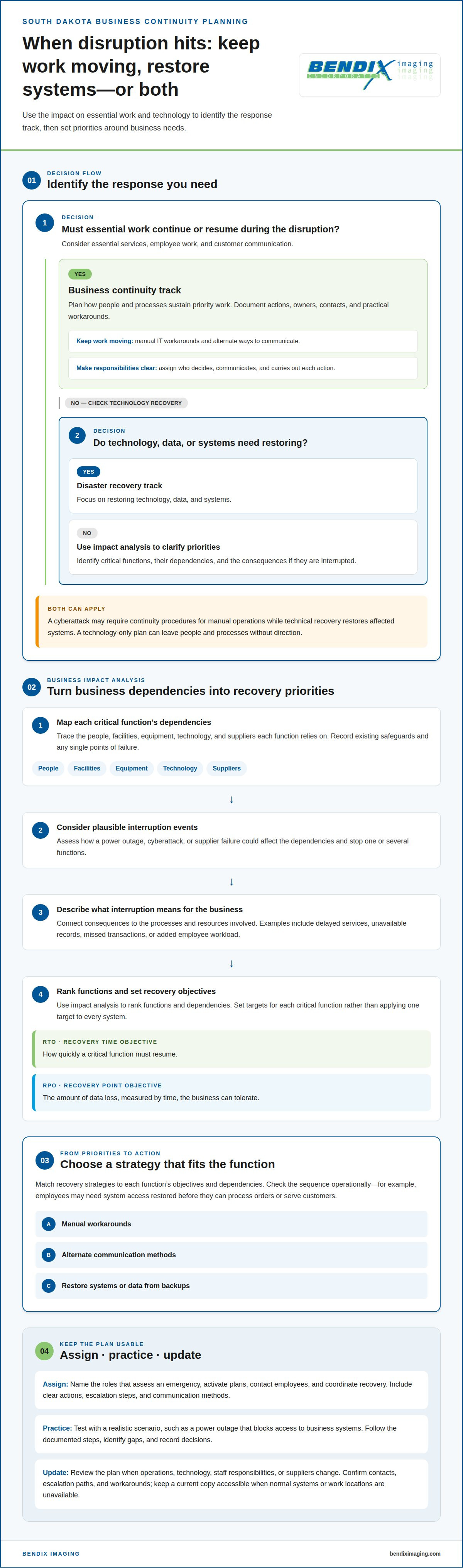
Business continuity is the broader strategy for sustaining essential services, employee work, and customer communication during a disruption. Disaster recovery focuses on restoring technology, data, and systems. A cyberattack, for example, may require both: continuity procedures guide manual operations while technical recovery restores affected systems. Avoid a technology-only plan that leaves people and processes without direction.
-
Set Recovery Objectives
Set a recovery time objective (RTO) for how quickly each critical function must resume. Set a recovery point objective (RPO) for the amount of data loss, measured by time, the business can tolerate. Use impact analysis to rank functions and dependencies, then set appropriate targets. A customer-order system may need different objectives from an internal archive, so don’t apply one target to every system.
-
Choose Recovery Strategies
Choose strategies that match each function’s objectives and dependencies. Options include manual workarounds, alternate communication methods, and restoring systems or data from backups. Check that the sequence works operationally: employees may need system access restored before they can process orders or serve customers. For business continuity planning in South Dakota, align backup and recovery arrangements with the functions they support.
-
Establish Response and Recovery Procedures
Document who assesses an emergency, activates continuity plans, contacts employees, and coordinates recovery. Give each role clear actions, escalation steps, and communication methods. Ready.gov offers business continuity resources; local procedures should also reflect relevant state and community response arrangements. Disaster-related financial assistance or tax relief depends on applicable programs and circumstances, so don’t base recovery plans on aid before it is approved.
Business impact analysis
Use a business impact analysis to connect operational weaknesses with the consequences of interruption. ISO/TS 22317:2021 provides guidelines for business impact analysis in business continuity management systems, according to the International Organization for Standardization.
-
Assess Vulnerabilities
Map the people, facilities, equipment, technology, and suppliers each critical function depends on. Assess how events such as a power outage, cyberattack, or supplier failure could interrupt those dependencies. For example, trace how losing internet access affects order processing, customer communication, and payments. Record existing safeguards and any single points of failure. A vulnerability assessment should reveal where one disruption could stop several functions at once.
-
Identify Risks and Impacts
List plausible events for each critical function, then describe their operational consequences. A risk assessment considers what could happen; a business impact analysis examines what an interruption would mean for the organization. Document effects such as delayed services, unavailable records, missed transactions, or added employee workload. Connect each impact to the processes and resources involved, including knock-on effects such as an outage preventing staff from accessing customer or supplier information.
-
Prioritize Risks and Impacts
Rank functions by how quickly disruption would affect customers, essential operations, or the organization’s ability to meet its commitments. Identify the resources needed to restore each function, including personnel, workspace, equipment, and IT. ISO/TS 22317:2021 gives organizations guidance for structuring this analysis. Use the results to set continuity and disaster recovery priorities, not simply to rank dramatic events. Assign actions that lessen impact, such as alternate procedures, backup communication methods, or an exercise that tests a key workaround.
Business continuity planning definition and purpose
A continuity plan documents how to sustain critical operations through disruptions and guide their recovery. Its practical purpose is to turn analysis of business impacts and threats into decisions, assigned responsibilities, and actions employees can follow.
- Define the outcome. Identify which services must continue, which can pause, and what a workable response looks like. A repair business, for example, might prioritize customer updates and scheduling even if its usual systems are unavailable. Clear priorities keep teams from treating every task as equally urgent during an emergency.
- Set the plan’s scope. Map the departments, locations, people, suppliers, and technology that support those services. Decide which disruptions the plan addresses, such as a facility closure, utility outage, cyberattack, or supplier interruption. A defined scope helps prevent a recovery plan from focusing only on computers while overlooking staff, workspace, or customer communication.
- Connect analysis to action. Use business impact findings to identify which operations need attention first and the resources they require. If order processing depends on a single system, for example, document a manual process and who can authorize it. Link each major threat to a response, a responsible role, and the resources needed to restore work.
- Make the plan usable under pressure. Give employees clear activation steps, role assignments, contact methods, and recovery procedures. Use direct instructions, such as who informs customers if normal phone systems are unavailable, or how cloud VoIP solutions (such as those featured on nexgen.com.au) can reroute calls when physical offices go offline. Separate immediate response actions from steps to restore routine operations, so teams know what to do first and what follows.
- Keep decisions connected. Treat continuity as an operating strategy, not a document filed away after approval. Use exercises to reveal unclear steps, then revise the plan when business processes or dependencies change. To move from priorities to a practical technology readiness discussion, start a conversation about continuity priorities.
BENDIX imaging
BENDIX imaging helps businesses address technology and security risks that can disrupt essential operations. Turn to its team when continuity planning reveals gaps in managed IT, network protection, or cybersecurity. These areas affect employees’ access to systems and the protection of critical business data and infrastructure.
Managed IT Services support coordinated technology operations, while Cyber Security and Network Security address risks to systems and networks. Artificial Intelligence (AI) Consulting helps businesses consider how AI fits their operations and risk decisions. These services support important parts of resilience, but a complete continuity plan also depends on business priorities, people, and procedures.
Contact BENDIX imaging to discuss how technology and security services can support your continuity priorities.
Turn your continuity priorities into action
A plan is more useful when its priorities connect to the systems and support your business relies on. As you refine business continuity planning in South Dakota, consider how technology, security, and operational decisions fit together. The next step may be addressing a specific gap, clarifying who owns a response, or improving how your organization manages technology risk.
BENDIX imaging offers Managed IT Services, Cyber Security, and Artificial Intelligence (AI) Consulting to businesses in Watertown, Brookings, Sioux Falls, Huron, and Montevideo. These services can support technology and security priorities within your continuity plan. Start with the issue that matters most to your operations, then contact BENDIX imaging to discuss the support that fits.
Contact BENDIX imaging today to discuss your business priorities. A clear next step can help you build a more prepared, resilient operation.
Frequently Asked Questions
What are the potential risks and disasters for businesses?
Assess natural hazards, technology failures, cyberattacks, utility interruptions, and supplier problems. Consider how risks can combine: a severe storm might close a facility while disrupting power, internet access, and deliveries. Also account for reputational damage or public health emergencies if they could interrupt customer service or staffing. Match each scenario to the operations and dependencies it could affect.
What are the steps to create and test a business continuity plan?
Identify essential services and the resources they depend on, then assess threats and likely impacts. Assign response roles, document communication methods and workarounds, and set recovery priorities. Test the plan with a realistic scenario, such as losing access to a key system during a busy work period. Record confusing instructions, assign improvements, and revise the plan based on the exercise.
What hazards should South Dakota businesses plan for, including blizzards, floods, tornadoes, and wildfires?
Include blizzards, floods, tornadoes, and wildfires in scenario planning, alongside power outages, cyberattacks, and supply interruptions. Consider how each could affect your facility, employee access, utilities, and deliveries. A blizzard scenario, for example, can test how staff communicate and serve customers when travel is disrupted. Use local exposure and operational dependencies to decide which scenarios need detailed procedures.
How do business continuity planning and disaster recovery planning differ?
Business continuity planning addresses how an organization sustains essential work during a disruption; disaster recovery planning focuses on restoring technology and data. After a cyber incident, for example, continuity procedures can guide customer communication and manual processes while technical recovery restores systems. Coordinate the plans so system restoration supports the business functions employees need, rather than treating technology recovery as the entire response.
What should a South Dakota business continuity plan include for employees, suppliers, facilities, and IT systems?
Include role assignments and employee contact methods, key supplier contacts and alternatives, facility access and relocation procedures, and system recovery instructions. Document how employees receive updates if normal communications fail, which suppliers support priority operations, and how staff access essential records without the usual network. Organize information by function so response teams can quickly find the instructions they need.
{"@context":"https://schema.org","@type":"FAQPage","mainEntity":[{"@type":"Question","name":"What are the potential risks and disasters for businesses?","acceptedAnswer":{"@type":"Answer","text":"Assess natural hazards, technology failures, cyberattacks, utility interruptions, and supplier problems. Consider how risks can combine: a severe storm might close a facility while disrupting power, internet access, and deliveries. Also account for reputational damage or public health emergencies if they could interrupt customer service or staffing. Match each scenario to the operations and dependencies it could affect."}},{"@type":"Question","name":"What are the steps to create and test a business continuity plan?","acceptedAnswer":{"@type":"Answer","text":"Identify essential services and the resources they depend on, then assess threats and likely impacts. Assign response roles, document communication methods and workarounds, and set recovery priorities. Test the plan with a realistic scenario, such as losing access to a key system during a busy work period. Record confusing instructions, assign improvements, and revise the plan based on the exercise."}},{"@type":"Question","name":"What hazards should South Dakota businesses plan for, including blizzards, floods, tornadoes, and wildfires?","acceptedAnswer":{"@type":"Answer","text":"Include blizzards, floods, tornadoes, and wildfires in scenario planning, alongside power outages, cyberattacks, and supply interruptions. Consider how each could affect your facility, employee access, utilities, and deliveries. A blizzard scenario, for example, can test how staff communicate and serve customers when travel is disrupted. Use local exposure and operational dependencies to decide which scenarios need detailed procedures."}},{"@type":"Question","name":"How do business continuity planning and disaster recovery planning differ?","acceptedAnswer":{"@type":"Answer","text":"Business continuity planning addresses how an organization sustains essential work during a disruption; disaster recovery planning focuses on restoring technology and data. After a cyber incident, for example, continuity procedures can guide customer communication and manual processes while technical recovery restores systems. Coordinate the plans so system restoration supports the business functions employees need, rather than treating technology recovery as the entire response."}},{"@type":"Question","name":"What should a South Dakota business continuity plan include for employees, suppliers, facilities, and IT systems?","acceptedAnswer":{"@type":"Answer","text":"Include role assignments and employee contact methods, key supplier contacts and alternatives, facility access and relocation procedures, and system recovery instructions. Document how employees receive updates if normal communications fail, which suppliers support priority operations, and how staff access essential records without the usual network. Organize information by function so response teams can quickly find the instructions they need."}}]}


