A technology purchase can solve today’s problem and still create tomorrow’s bottleneck. Strategic IT consulting in South Dakota helps businesses connect technology decisions to long-term goals by reviewing current systems, identifying priorities, and building a practical plan. The aim is not change for its own sake, but technology that supports how your business operates.
It’s reasonable to expect a clear process, useful recommendations, and a plan grounded in your organization’s needs. This article explains how consulting engagements typically move from understanding your current environment to setting priorities and planning next steps. It also covers the services available and how experience with different industries can shape decisions around security, compliance, infrastructure, and emerging technology.
Knowing what to expect can help you distinguish urgent fixes from longer-term investments. With clearer priorities, you can make informed technology decisions, reduce avoidable risk, and set a steadier direction for your business.
Key Takeaways
- Start with a clear view of your current technology, business priorities, and risks to make the consulting process focused and useful.
- Match consulting services to the problems you need to solve, from security and managed IT to AI planning.
- Industry experience helps connect technology choices to real operational needs, while partnerships can inform the available options.
- Build a long-term technology strategy by setting priorities, sequencing investments, and planning for how your business may change.
Consulting engagement process
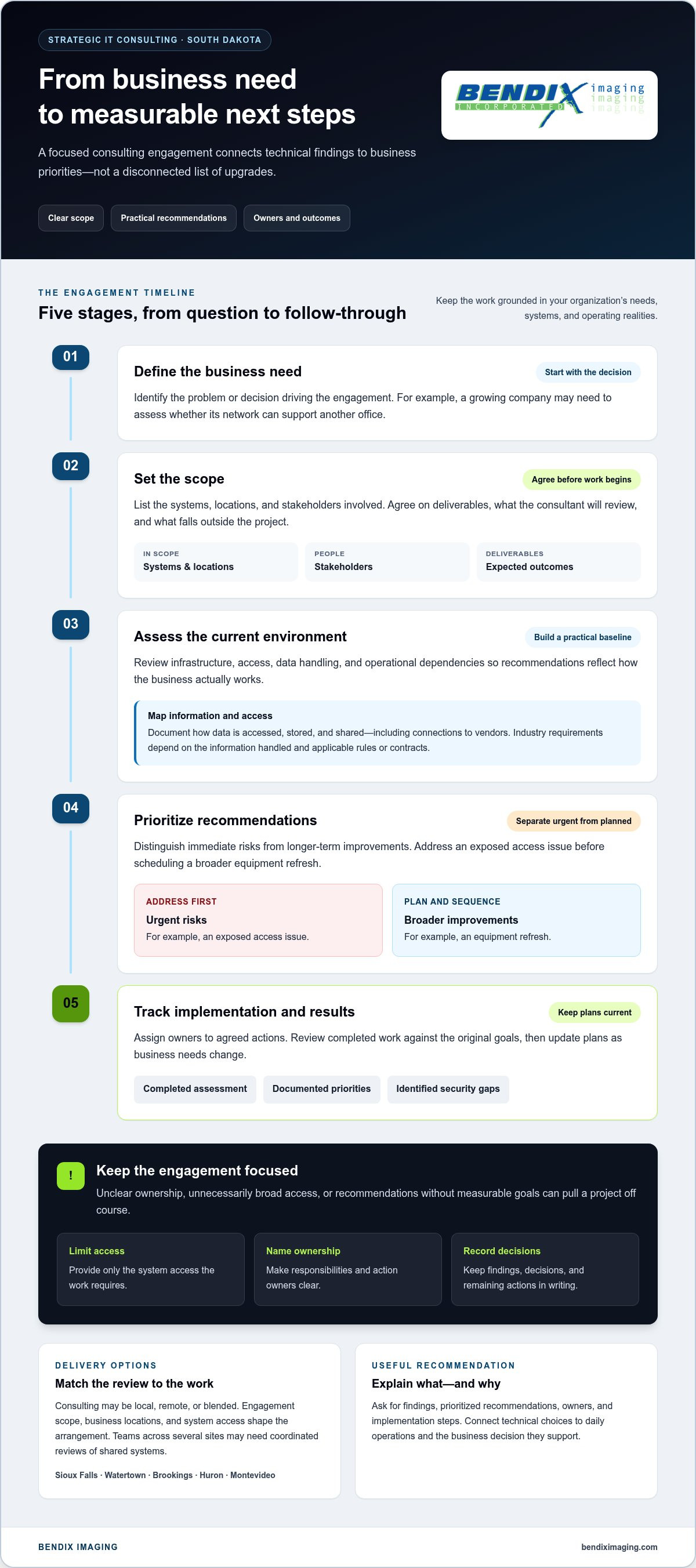
Cybersecurity and data privacy requirements depend on your industry, the information you handle, and applicable rules or contracts. Before setting priorities, map how data is accessed, stored, and shared, including connections to vendors. A healthcare organization and a retailer, for example, may have different obligations because they handle different information.
Businesses in Sioux Falls, Watertown, Brookings, Huron, and Montevideo can work with consultants using local, remote, or blended delivery. Engagement scope, business locations, and system access shape that arrangement. For example, teams at several sites may need coordinated reviews of shared systems.
Consulting projects can lose focus when ownership is unclear, access is broader than necessary, or recommendations lack measurable goals. Define the scope and expected deliverables before work begins, and limit system access to what the work requires. Then review progress against agreed outcomes, such as a completed assessment, documented priorities, or identified security gaps.
- Define the business need. Identify the decision or problem driving the engagement. A growing company may need to assess whether its network can support another office.
- Set the scope. List systems, locations, stakeholders, and expected deliverables. Agree on what the consultant will review and what falls outside the project.
- Assess the current environment. Review infrastructure, access, data handling, and operational dependencies. This gives recommendations a practical basis.
- Prioritize recommendations. Separate urgent risks from planned improvements. Address an exposed access issue before scheduling a broader equipment refresh.
- Track implementation and results. Assign owners to agreed actions. Review completed work against original goals, then update plans as business needs change.
Keep a written record of findings, decisions, and remaining actions. This helps leaders understand why recommendations matter and who owns each next step. Strategic IT consulting in South Dakota should connect technical findings to business priorities, not leave management with a list of disconnected upgrades.
Identify the rules and contractual obligations that apply to your industry and the information you handle. Use them to guide security priorities and define the scope of technology projects.
Consulting services
Consulting can address an urgent problem or guide broader technology decisions. Start with a clear business goal. A company opening a location, for example, may need to consider network planning, access controls, and system capacity together. A focused review can also help evaluate a single decision, such as whether a process is suitable for automation.
Useful technology advice links technical choices to daily operations. Recommendations should explain what to do and why, rather than simply list tools.
- Technology assessment: Review systems, dependencies, and business needs. A warehouse, for example, may rely on stable connectivity for inventory workflows.
- Security planning: Identify weaknesses in access, networks, and data handling. A written action plan helps leaders assign responsibility and prioritize fixes.
- Infrastructure planning: Map current capacity against planned growth. Adding staff or locations can affect storage, connectivity, and support needs.
- AI planning: Identify suitable tasks, data requirements, and human review. Begin with a bounded process, such as sorting routine incoming requests.
Some engagements also address business operations beyond technology. ELO CPAs & Advisors identifies a 13-week cash flow analysis as an example of work a business consultant can help with. That illustrates why leaders should define the decision they need to make before scoping consulting work. A technology plan tied to hiring, expansion, or cash flow can be more useful than a standalone equipment list.
Ask for clear deliverables: findings, prioritized recommendations, owners, and implementation steps. For example, a report might separate a security issue needing attention from a planned system refresh. That distinction helps management sequence work around operational demands. If AI adoption is under consideration, AI consulting services can help connect potential uses with business priorities and safeguards.
Industry experience and partnerships
Industry experience matters because a technology plan must fit the work itself. A manufacturer may rely on connected equipment and production records—an area where specialized digital consultancies like PLM-Sme FZC focus on product lifecycle workflows—while a professional services firm may prioritize secure document access and reliable collaboration. Each needs different questions and priorities. Ask how an advisor translates your operations into technical recommendations instead of relying on a generic template.
Relevant experience should be evident in the assessment. For a company adding a location, an advisor might review connectivity, user access, and shared systems. For a growing organization, the review could consider how new staff affect support needs and data access. In either case, recommendations should address specific operational requirements so leaders can judge whether the advice fits.
Technology vendor relationships can provide access to tools and solutions, but recommendations should remain transparent. Ask how options are selected, what alternatives were considered, and how proposed tools meet your requirements. Vendor input should support the business case, not replace it.
- Check industry relevance: Compare your workflows with examples from similar organizations, such as a clinic managing sensitive records or a manufacturer coordinating production systems.
- Review the reasoning: Ask for the business need behind each recommendation, such as improving access between offices or reducing manual handoffs.
- Clarify vendor roles: Separate independent planning advice from product or implementation decisions, and document who owns each next step.
For businesses in Watertown, Brookings, Sioux Falls, Huron, and Montevideo, local operating conditions can shape technology needs. Teams across urban and rural locations may have different connectivity and support requirements. Consider how staff access systems and how interruptions affect daily work, then use those needs to assess whether proposed solutions are practical.
Before approving a plan, ask for examples that explain the advisor’s approach, not confidential details about other clients. A clear explanation should show how industry knowledge, vendor input, and your business priorities combine. That gives leaders a stronger basis for evaluating recommendations and deciding which actions belong in the long-term roadmap.
Long-term technology strategy
A useful technology strategy connects business goals with systems, security, and planned investment. Start with the outcomes leadership needs, such as opening a location, supporting remote staff, or reducing manual work. Then identify the technology dependencies behind each goal. A new office, for example, may require connectivity, user access, data protection, and support planning to work together.
South Dakota’s Strategic Technology Directions recommends statewide collaboration to facilitate common solutions and architecture across agencies. This guidance is for state agencies, not private-business grants. For business modernization, consider funding separately and evaluate program eligibility against the project’s purpose and requirements.
Build the roadmap around decisions leaders can revisit as business needs change:
- Set priorities: Connect each proposed investment to a business objective, such as improving access between locations.
- Sequence work: Address dependencies first. A system migration may require data cleanup and access planning before implementation.
- Assign ownership: Identify who approves changes, manages vendors, and tracks unresolved risks.
- Review outcomes: Compare completed work with the original goal, such as reducing duplicate data entry.
Include risk and resilience in the plan. A business that relies on cloud applications should consider account access, backup arrangements, and how staff would continue essential work during an outage. A manufacturer may instead prioritize systems connected to production workflows. The right roadmap reflects operational impact, not simply equipment age.
Use a written plan that records priorities, dependencies, owners, and review points. That gives leadership a basis for adjusting projects when hiring, locations, or workflows change. For a South Dakota business planning growth, plan your technology roadmap around both business goals and the security measures those goals require.
Working with experienced professionals ensures that your organization stays aligned with industry best practices and can effectively leverage strategic IT consulting South Dakota initiatives to maintain a competitive edge.
BENDIX imaging: Artificial Intelligence (AI) Consulting
BENDIX imaging provides Artificial Intelligence (AI) Consulting to help businesses assess practical goals for AI. Consider consulting when your team is exploring AI but needs to clarify suitable use cases, business priorities, and security considerations. For example, before applying AI to routine workflows, identify the task, the information involved, and where human review remains necessary.
AI decisions also affect the wider technology environment. Cyber Security and Network Security address protection needs, while Managed IT Services support day-to-day technology operations. Considering these services together helps leaders plan for AI as part of their broader technology environment, rather than as a standalone tool.
Contact BENDIX imaging to discuss how AI Consulting can support your business goals.
Make your next technology decision count
Growth can change what your business needs from technology. Before making a major decision, identify the business outcome you want, the risks to manage, and the people responsible for moving the work forward. This keeps future investments connected to real operating priorities.
For strategic IT consulting in South Dakota, BENDIX imaging offers Artificial Intelligence (AI) Consulting, Cyber Security, and Managed IT Services. These services help businesses evaluate new technology, protect systems, and support ongoing IT needs. Choose a next step that fits your priorities, whether you are exploring AI use cases or strengthening your security approach.
Contact BENDIX imaging today to discuss your technology priorities. A clear plan starts with the business goal you want technology to support, and you can take that step with confidence.
Frequently Asked Questions
What strategic IT consulting services are available in South Dakota?
BENDIX imaging provides AI Consulting, Cyber Security, Network Security, Managed IT Services, Regulatory Compliance, Data Backup and Recovery, and vCSO support for businesses in Watertown, Brookings, Sioux Falls, Huron, and Montevideo. The right mix depends on your needs. A company considering AI, for example, may need to assess data handling and security alongside potential uses.
How can a South Dakota business choose a strategic IT consultant?
Choose a consultant by matching the work to a defined business outcome, such as protecting shared files or supporting a new office. Look for a clear scope, understandable recommendations, and deliverables tied to that outcome. BENDIX imaging’s Managed IT Services, Cyber Security, Network Security, and AI Consulting support different business needs. Prioritize the service that best fits your current risks or growth plans.
What steps are involved in an IT strategy assessment and roadmap?
An assessment can start with a list of current applications, vendor agreements, recurring technology issues, and planned business changes. Map each system to the teams and processes that rely on it. This can reveal duplicated tools, unsupported workflows, or dependencies that need attention. A roadmap then connects proposed actions to owners and business priorities, helping leaders make practical decisions about what to address.
How can strategic IT consulting help South Dakota small and midsize businesses?
Strategic IT consulting in South Dakota can help small and midsize businesses connect technology choices to growth, security, and internal capacity. A firm adding staff, for example, may need to plan user access, protect business data, and maintain reliable systems without overloading managers. BENDIX imaging offers Managed IT Services, Cyber Security, and AI Consulting to help businesses assess these needs.
{"@context":"https://schema.org","@type":"FAQPage","mainEntity":[{"@type":"Question","name":"What strategic IT consulting services are available in South Dakota?","acceptedAnswer":{"@type":"Answer","text":"BENDIX imaging provides AI Consulting, Cyber Security, Network Security, Managed IT Services, Regulatory Compliance, Data Backup and Recovery, and vCSO support for businesses in Watertown, Brookings, Sioux Falls, Huron, and Montevideo. The right mix depends on your needs. A company considering AI, for example, may need to assess data handling and security alongside potential uses."}},{"@type":"Question","name":"How can a South Dakota business choose a strategic IT consultant?","acceptedAnswer":{"@type":"Answer","text":"Choose a consultant by matching the work to a defined business outcome, such as protecting shared files or supporting a new office. Look for a clear scope, understandable recommendations, and deliverables tied to that outcome. BENDIX imaging’s Managed IT Services, Cyber Security, Network Security, and AI Consulting support different business needs. Prioritize the service that best fits your current risks or growth plans."}},{"@type":"Question","name":"What steps are involved in an IT strategy assessment and roadmap?","acceptedAnswer":{"@type":"Answer","text":"An assessment can start with a list of current applications, vendor agreements, recurring technology issues, and planned business changes. Map each system to the teams and processes that rely on it. This can reveal duplicated tools, unsupported workflows, or dependencies that need attention. A roadmap then connects proposed actions to owners and business priorities, helping leaders make practical decisions about what to address."}},{"@type":"Question","name":"How can strategic IT consulting help South Dakota small and midsize businesses?","acceptedAnswer":{"@type":"Answer","text":"Strategic IT consulting in South Dakota can help small and midsize businesses connect technology choices to growth, security, and internal capacity. A firm adding staff, for example, may need to plan user access, protect business data, and maintain reliable systems without overloading managers. BENDIX imaging offers Managed IT Services, Cyber Security, and AI Consulting to help businesses assess these needs."}}]}


