
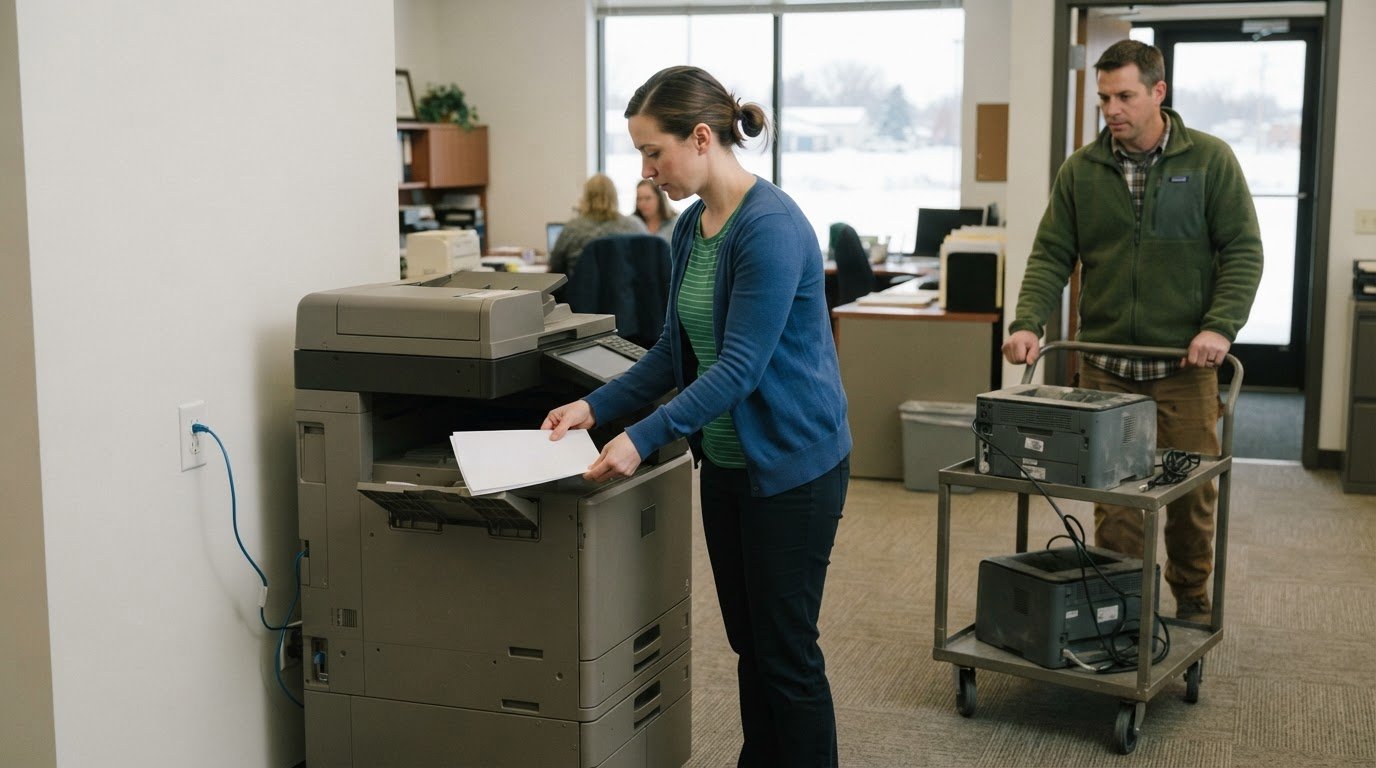
More vendors don’t automatically mean more control. Vendor consolidation for IT and print in Sioux Falls brings related technology and print services into fewer provider relationships, with the aim of simplifying oversight and identifying overlapping costs. Savings aren’t automatic; they depend on what your business uses and how equipment, supplies, software, and service are managed.
When bills, support contacts, and agreements are spread across providers, it can be difficult to spot overlapping costs or know who is accountable when something goes wrong. Vendor consolidation for IT and print in Sioux Falls can make responsibilities clearer, but the arrangement should fit how your team works rather than force every need into one scope.
This article explains what consolidation can cover, how print equipment, software, supplies, and service costs fit together, and what affects its value. You’ll also learn how a managed IT and print partner can help coordinate services and costs, and when keeping arrangements separate may be more practical.
Key Takeaways
- Managed print can bring ordering, approved materials, quantities, and delivery destinations into a more coordinated process, without requiring a self-service portal.
- An assessment can reveal underused equipment and recurring print needs, helping right-size the environment instead of consolidating for its own sake.
- Evaluate equipment, software, supplies, and service together to see where costs overlap and which parts of the print setup drive ongoing spend.
- Potential savings depend on the services and costs a business can practically combine; a manufacturing program, for example, reduced shipping costs by 45% from Q1 2022 to Q1 2023.
Managed print services
Managed print services coordinate equipment, supplies, ordering, and support across a business. They can also connect print processes with digital document workflows and IT support.
Location-Specific Print Management
Location-specific print management assigns approved materials, quantities, users, and delivery destinations to each site. This helps prevent one office receiving another location’s supplies or excess stock. A shared ordering workflow can make nearly 1,300 SKUs searchable while limiting which items each location can request. For example, a regional office can order approved forms directly for its own delivery point. Inventory oversight then helps align replenishment with local demand.
Multiple Print Vendor Challenges
Multiple print vendors mean separate ordering processes, invoices, contacts, specifications, and delivery expectations. An office might order branded forms from one supplier and envelopes from another. That split makes quantities harder to track and complicates follow-up when a shipment is delayed. Staff must work out which provider owns the issue, then reconcile the request and delivery details. A controlled catalog for recurring materials can reduce handoffs without forcing every specialty job into one arrangement.
Combined Versus Separate Providers
Bundled IT and print services put both responsibilities under one provider relationship, while separate providers have distinct scopes. A combined arrangement can simplify escalation when a printer depends on network access or user permissions. It can also connect print ordering with digital document workflows, such as routing a scanned form for review. Separate agreements may clarify responsibility for specialized work, but your business will coordinate those providers directly. Compare ownership, support boundaries, and workflow needs, not just the number of contracts.
Provider Selection and Consolidation Risks
A combined provider should define the print tasks, IT responsibilities, locations, users, and workflows covered. Ask how approved items, quantities, delivery points, support requests, and digital document steps are handled. Review the scope, billing structure, renewal and termination terms, transition duties, and access to business records. These details matter if responsibilities change or a service relationship ends. Clarify who handles supplies, device issues, network access, and escalations before consolidation begins. Clear boundaries make accountability easier to assess.
Print environment assessment and right-sizing
A print assessment maps equipment, usage, locations, and business tasks before recommending changes. It connects each device to work such as producing invoices, scanning records, or printing customer forms. An office printer used for occasional drafts serves a different purpose from a shared device supporting daily document production. For businesses considering vendor consolidation for IT and print in Sioux Falls, this distinction helps separate essential capacity from equipment that may be underused.
The assessment documents each device’s location, users, print and scan functions, supply needs, and support arrangements. It then reviews available usage records and recurring jobs. For example, a device used frequently for scanning but rarely for printing may suit a different workflow from a production printer handling regular batches. The review also captures business-specific requirements, including document quality, access, and delivery needs. A device count alone won’t show whether the setup fits actual work.
Right-sizing aligns equipment and workflows with demonstrated demand, rather than simply removing printers. A busy shared device may need to stay, while an underused device could be reassigned or considered for replacement during a planned transition. An assessment can also identify paper handoffs that a digital workflow might replace. For instance, routing a scanned form for review may eliminate repeat printing without disrupting its approval process.
For businesses evaluating vendor consolidation of IT and print in Sioux Falls, compare usage across offices before changing equipment. A central recommendation can miss local needs if one site handles customer packets while another mainly scans records. The review should explain why each device remains, moves, or becomes unnecessary, then connect that decision to supplies, service responsibilities, and user workflows. A structured print environment assessment can help turn those findings into a practical right-sizing plan, rather than a device reduction target without operational context.
Print equipment, software, supplies and service costs
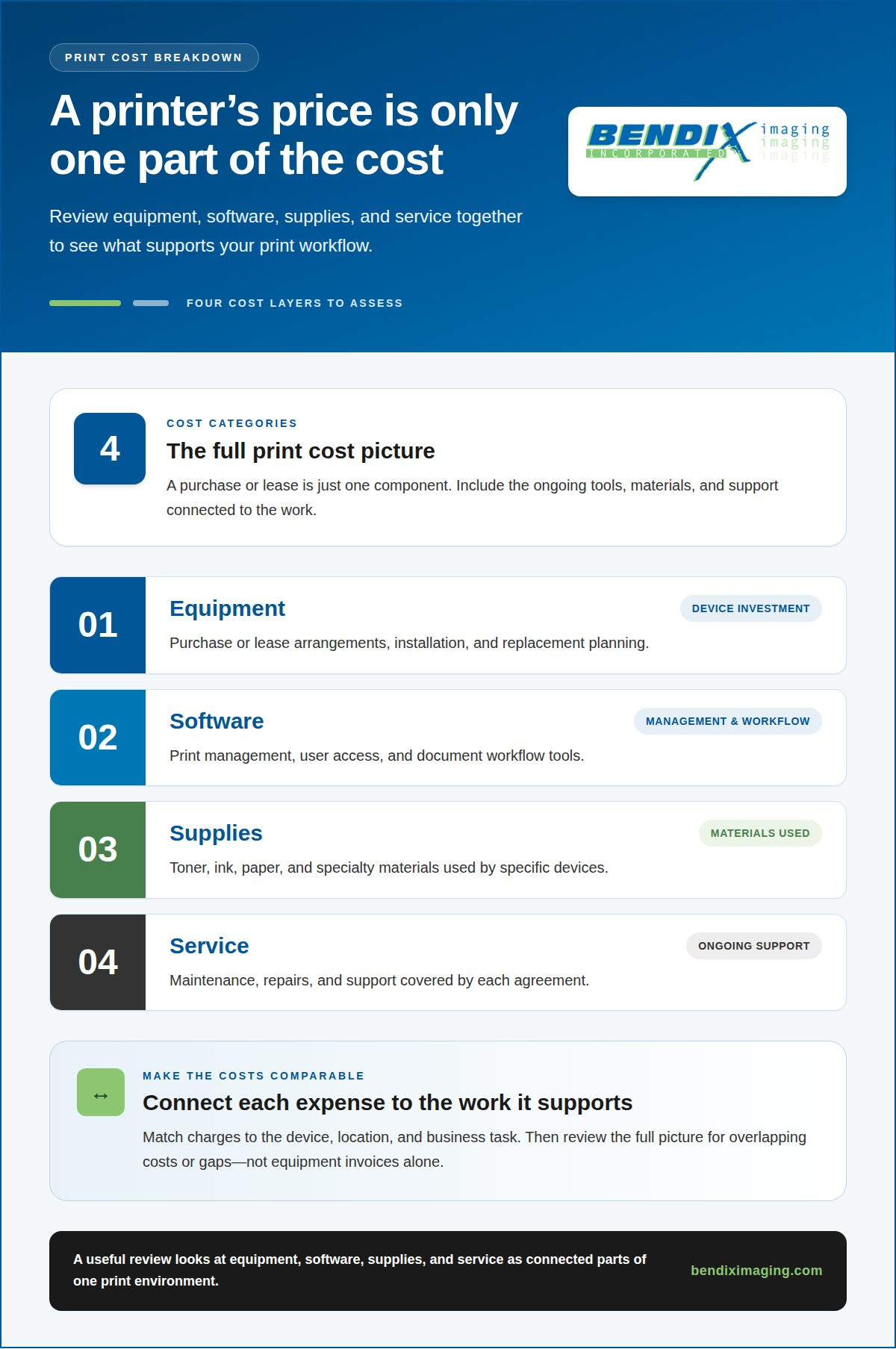
A printer’s purchase or lease is only one part of its operating cost. A useful review also accounts for print-management software, toner, paper, maintenance, and support. For example, a device with a low acquisition cost may still require separate software and supply arrangements. Comparing these components together gives finance teams a clearer view than reviewing equipment invoices alone.
Build the cost picture around the full print workflow. Match each expense to the device, location, and business task it supports. A practical review can group charges into these categories:
- Equipment: purchase or lease arrangements, installation, and replacement planning.
- Software: print management, user access, and document workflow tools.
- Supplies: toner, ink, paper, and specialty materials used by specific devices.
- Service: maintenance, repairs, and support covered by each agreement.
Then look for overlaps and gaps. Two offices may pay separately for similar software, while a shared device depends on supplies ordered through another process. A contract might cover equipment maintenance but leave supply ordering outside its scope. These examples show why invoice totals alone can hide the operational connections behind recurring charges.
Print systems also interact with business technology. A networked device may rely on user access, software settings, and IT support to keep printing and scanning available. Consolidation can clarify responsibility when the service scope connects print and IT, but only if the agreement states who handles each issue. Review support boundaries alongside equipment and software terms.
Use the assessment to compare the current arrangement with a proposed one, category by category. Keep equipment, software, supplies, and service visible rather than accepting a single combined figure without detail. A manufacturing print program reduced shipping costs by 45% from Q1 2022 to Q1 2023 while reducing delivered inventory by 10%. That example shows why inventory and shipping belong in the cost review, not just device expenses.
The manufacturing company initially produced marketing collateral and promotional items through several external print suppliers, distributing jobs across multiple providers.
How much can businesses save by consolidating IT and print vendors?
There’s no single savings figure that applies to every Sioux Falls business. Results depend on which print and IT expenses overlap, how much work can move into one managed process, and what existing agreements cover. A useful comparison includes equipment, supplies, software, support, shipping, and the staff time spent coordinating providers. Consolidation creates value only when the combined arrangement costs less to operate without disrupting essential work.
Measure the current baseline before comparing proposals. Group recurring expenses by service, location, and business need, then identify duplicate charges or avoidable shipments. A manufacturing company’s print program consistently reduced shipped quantities and associated costs during its first year through inventory management. That example shows how better control of ordering can contribute to savings, but it does not establish the same result for every organization.
Look beyond the invoice total. A print program managed access for more than 300 company users, while its order-to-ship time fell to less than 48 hours. Those results demonstrate operational changes, not a universal savings rate. For your business, assess whether consolidated ordering, supply control, and clearer support responsibilities reduce waste or staff effort. Compare those gains with transition work and any contract costs that remain.
For a fair comparison, define the same scope in both scenarios. Include the devices, software, supplies, service, and IT responsibilities each proposal covers. Separate immediate reductions from process improvements, such as fewer duplicate orders or less time routing issues. Then set a review period and track the same expense categories after the change. This gives decision-makers a concrete basis for judging whether consolidation delivers value.
Review your IT and print consolidation options against your current costs and workflows before choosing a scope.
Businesses consolidating print vendors can start with recurring or high-friction materials, then expand only where it makes sense. A focused scope keeps the comparison centered on materials that matter, with expansion considered when it adds value.
Businesses consolidating print vendors do not have to use a portal. Controlled self-service ordering is one option to consider alongside the materials being consolidated, so the process fits the business rather than becoming a requirement.
BENDIX imaging: Managed Print
BENDIX imaging provides Managed Print for businesses seeking clearer oversight of print operations. Turn to this service when equipment, supply ordering, and support feel fragmented across locations or providers. A managed approach can align print needs with approved materials, usage, and delivery workflows, giving business leaders a practical basis for reviewing their environment. Printing Supplies can also support the day-to-day requirements of that print setup. The right scope depends on your equipment, workflows, and operational needs. If print costs or responsibilities are difficult to track, discuss the current setup and the changes you’re considering. Contact BENDIX imaging to discuss Managed Print for your business.
Set a clear direction for your next step
Choose a consolidation model that strengthens accountability without forcing every responsibility into the same scope. Decide which technology and print outcomes matter most, then clarify ownership across support, security, and daily operations. This gives your business a practical basis for evaluating vendor consolidation for IT and print in Sioux Falls, including whether managed services should work together or remain distinct.
BENDIX imaging provides Managed IT Services, Cyber Security, and Artificial Intelligence (AI) Consulting alongside Managed Print. Together, these services can support connected technology and print needs. Start with your priorities, current arrangements, and the outcomes you want from a more coordinated approach.
Explore options with BENDIX imaging and take a considered next step toward a more accountable operating model.
Frequently Asked Questions
What does IT and print vendor consolidation include for a business?
Consolidation can bring selected IT and print responsibilities into a coordinated service arrangement. A Sioux Falls business might combine managed IT services, network security, data backup and recovery, and managed print while keeping specialized systems separate. The practical scope depends on the work involved. For example, a company may coordinate printer access with user accounts while maintaining a separate arrangement for a specialized business system.
What steps does a provider take to help a Sioux Falls business consolidate IT and print vendors?
A provider typically maps existing agreements, systems, locations, and renewal dates before proposing a transition plan. For example, changing print management may require coordinating device access with network and user settings. The plan can define the proposed scope, assign responsibilities, and sequence changes by site. Businesses in Watertown, Brookings, Sioux Falls, Huron, and Montevideo can benefit from including location-specific handoffs.
{"@context":"https://schema.org","@type":"FAQPage","mainEntity":[{"@type":"Question","name":"What does IT and print vendor consolidation include for a business?","acceptedAnswer":{"@type":"Answer","text":"Consolidation can bring selected IT and print responsibilities into a coordinated service arrangement. A Sioux Falls business might combine managed IT services, network security, data backup and recovery, and managed print while keeping specialized systems separate. The practical scope depends on the work involved. For example, a company may coordinate printer access with user accounts while maintaining a separate arrangement for a specialized business system."}},{"@type":"Question","name":"What steps does a provider take to help a Sioux Falls business consolidate IT and print vendors?","acceptedAnswer":{"@type":"Answer","text":"A provider typically maps existing agreements, systems, locations, and renewal dates before proposing a transition plan. For example, changing print management may require coordinating device access with network and user settings. The plan can define the proposed scope, assign responsibilities, and sequence changes by site. Businesses in Watertown, Brookings, Sioux Falls, Huron, and Montevideo can benefit from including location-specific handoffs."}}]}


