
A clean audit can still leave a business exposed. The cost of a cybersecurity audit for SMBs depends on its scope, the systems reviewed, applicable compliance needs, and how deeply controls are tested. There is no single price that fits every business.
It is reasonable to want a clear budget before committing, especially when security work competes with other business priorities. But an audit’s value is not just the report: findings need to lead to practical fixes, and a clean result cannot guarantee that a breach will not happen.
This article explains what shapes audit costs, why gaps can remain after an audit, and how readiness work can strengthen data protection and customer trust. It also covers how scope, remediation, access controls, employee awareness, and recovery planning fit together, so you can assess your needs rather than treating a passing assessment as the finish line.
Key Takeaways
- Define the audit’s scope around your critical systems and applicable compliance needs; frameworks set control expectations but don’t map them to your specific technology stack.
- Look beyond a clean report by reviewing forgotten accounts, shadow software, and whether access is tied to individual users.
- Protect customer confidence by reviewing data access and incident response, and by testing whether backups can actually be restored.
- Turn findings into owned remediation work, then revisit security as systems and business needs change.
How much do cybersecurity audit services cost for an SMB?
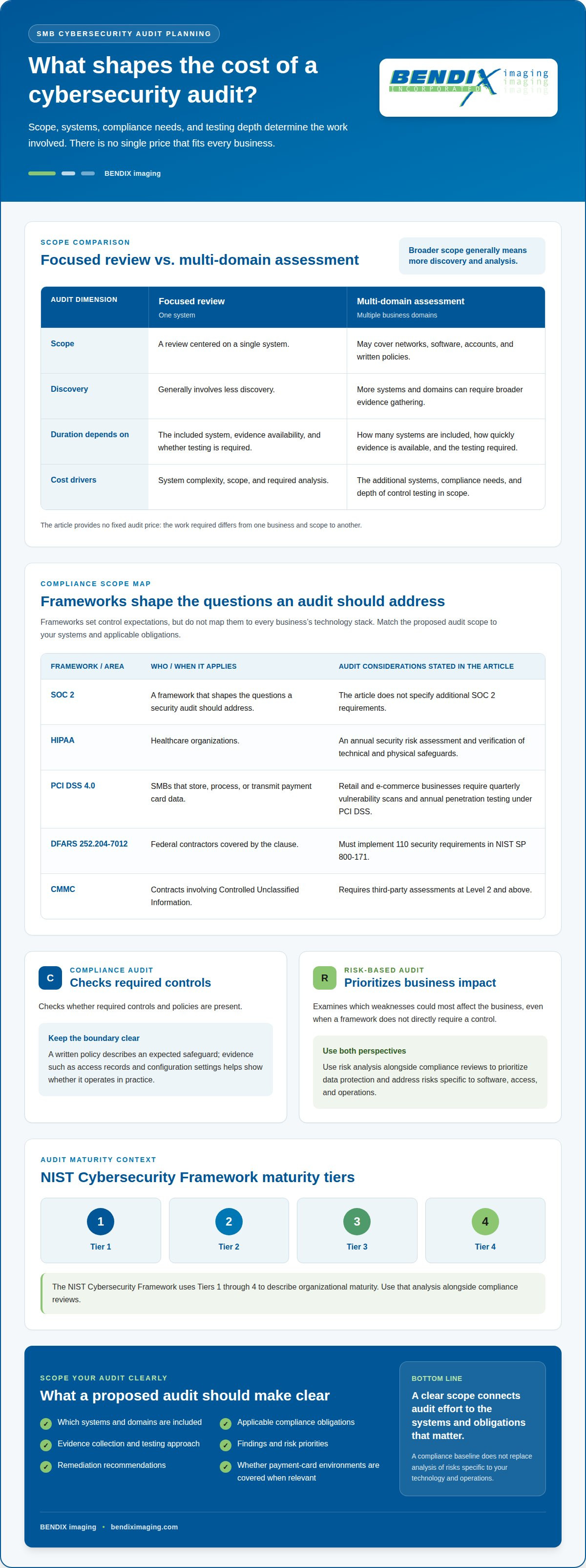
A cybersecurity audit for SMBs can cost different amounts depending on its scope, systems, compliance needs, and testing depth. A single-system review differs from a multi-domain assessment covering networks, software, accounts, and written policies. The price depends on the work involved, including system complexity, scope, and required analysis.
An audit’s duration depends on practical factors: how many systems are included, how quickly evidence is available, and whether testing is required. A focused review of one system generally involves less discovery than a formal audit spanning multiple business domains.
Evaluate an auditor’s fit by matching the proposed scope to your systems and compliance obligations. Look for a clear process covering evidence collection, findings, risk priorities, and remediation recommendations. For example, a review of payment systems should specify whether it covers card-data environments and the controls used there.
Compliance frameworks set a baseline, but they don’t explain how to implement controls for every technology stack. SOC 2, HIPAA, and PCI each shape the questions a security audit should address. PCI DSS version 4.0 applies to SMBs storing, processing, or transmitting payment card data. Retail and e-commerce businesses require quarterly vulnerability scans and annual penetration testing under PCI DSS.
Healthcare organizations need an annual security risk assessment and verification of technical and physical safeguards under HIPAA. Federal contractors covered by DFARS clause 252.204-7012 must implement 110 security requirements in NIST SP 800-171. CMMC requires third-party assessments for contracts involving Controlled Unclassified Information at Level 2 and above.
A compliance audit checks whether required controls and policies are present. A risk-based audit examines which weaknesses could most affect the business, even when no framework directly requires a control. NIST’s Cybersecurity Framework uses Tiers 1 through 4 to describe organizational maturity. Use that analysis alongside compliance reviews to prioritize data protection and address risks specific to your software, access, and operations. A cybersecurity audit for SMBs should make those priorities clear.
Investigating clean audits followed by security breaches
A clean audit reflects the systems and evidence examined at that time, not every exposure a business may face. Common findings include unreviewed access, overlooked software, and controls that exist on paper but do not operate consistently.
Audit Evidence and Written Policies
Written security policies describe expected safeguards; audit evidence shows whether those safeguards work in practice. That distinction matters because a policy requiring unique user accounts proves little without records showing individual access.
Ask the audit report to distinguish documented policies from operating controls. Review evidence such as access records, configuration settings, and completed access reviews. For example, a shared administrator account can hide which employee performed an action, even when a written policy requires accountable access.
Common Small Business Risks and Findings
Common risks include forgotten accounts, unapproved software, weak access practices, and employee susceptibility to phishing. A business might retain a service account created in 2019 after its original purpose has disappeared, leaving access that no longer has a clear owner.
Audit scope matters, too. A review that misses four shadow SaaS apps used by Finance can leave sensitive information and access outside the assessment. Evaluate which systems, vendors, and network connections were included, then update the scope when business tools change.
Review network controls alongside access lists: identify who can reach sensitive systems, whether access belongs to individual users, and whether third-party credentials are limited and monitored. Quarterly privilege audits can help reveal access that remains after an employee changes roles or leaves.
Technology controls alone cannot correct unsafe habits. Train employees to recognize phishing attempts and verify unexpected requests before sharing sensitive information. Check whether training is ongoing, not merely recorded as a completed policy requirement.
Use network security review as a starting point for examining network exposure and access controls.
Customer trust and data protection
Customer trust depends on how carefully a business handles personal and financial information. A useful audit examines data access, endpoint protection, vendor exposure, and recovery readiness across the business infrastructure.
Data Protection Requirements
State privacy requirements set conditions for handling customer data, and applicability can depend on the business and information involved. California’s CCPA/CPRA applies to businesses with annual gross revenue above $25 million or data on 100,000 or more consumers, subject to the stated applicability criteria.
Map customer information to the systems and vendors that store or use it, then review access and incident-response policies. For healthcare organizations, a covered entity must document a risk analysis under the HIPAA Security Rule, cited as 45 CFR §§ 164.302-164.318. That analysis helps connect data protection controls to real systems and risks.
Encryption and Data Protection
Encryption makes data unreadable without the appropriate key, reducing exposure if protected information is accessed improperly. It is one part of a broader data protection plan, not a substitute for access controls or secure configuration.
Ask the audit to identify where sensitive information is stored, transmitted, and backed up, then assess encryption coverage at each point. A controlled penetration test can examine whether weaknesses expose systems or data, while policy and configuration reviews show how safeguards are intended to work.
Endpoint checks matter, too. Inventory business laptops and other devices, identify unsupported operating systems, and review whether security settings match policy. A phishing email that compromises an employee’s device can create a path to shared files or business applications, so assess device access alongside network controls.
Backups only support recovery if the business can restore its data. Test a restoration monthly and record whether files and systems return in usable condition. A backup that has not been tested in 18 months may fail when an incident makes recovery urgent.
Finally, review third-party access and vendor credentials. Limit access to what each vendor needs, monitor accounts, and include relevant connections in the audit scope. These checks link customer trust to evidence of working safeguards, not policies alone.
Audit readiness and remediation support
Start by defining the scope and objectives, collecting evidence, analyzing risks, reporting findings, and assigning remediation owners. This sequence helps an SMB focus effort on sensitive systems and business priorities.
Preparing for an Audit
Audit readiness means organizing the systems, records, and people needed for a useful assessment. Clear preparation reduces delays and helps auditors examine the right risks.
Document the audit scope, objectives, system owners, and key vendors. Gather current asset inventories, security policies, and incident response plans so reviewers can compare written procedures with actual practices.
A two-year rotation across the full technology estate can help manage scope and cost. Keep critical systems in focus, and revisit priorities after a significant software deployment or business restructuring.
Audit Steps and Remediation
A typical audit moves through preparation, data collection, analysis, reporting, and review and implementation. Each stage should connect evidence to specific findings, not just broad recommendations.
For each finding, record its severity, the system affected, a named owner, and a practical next action. An inherited report with 47 findings but no risk-based severity or owners shows why clear accountability matters.
After reporting, assign remediation work and track completion. Update critical systems within 30 days of a patch release, and document exceptions with their rationale and review date.
Internal IT teams can conduct useful self-assessments between formal audits, but those reviews cannot provide independent attestation. Consider conducting targeted reviews after significant changes to systems or business operations.
Use those reviews to test whether fixes work, not merely whether a ticket was closed. For example, after correcting an access issue, examine updated permissions and relevant records. Keep incident response plans current so staff know their roles during a breach.
For structured cybersecurity and remediation support, discuss your audit readiness with a security professional.
BENDIX imaging: Artificial Intelligence (AI) Consulting
Audit findings need clear owners, practical priorities, and follow-through. BENDIX imaging provides Cyber Security, Network Security, and Managed IT Services to help businesses address security gaps and strengthen their technology environment. Its Artificial Intelligence (AI) Consulting helps businesses consider AI alongside security and operational needs.
Turn to BENDIX imaging when an audit identifies issues that need ongoing attention or when you need to connect security priorities with broader IT planning. Focus first on findings that affect your systems, data, and business operations, then build a remediation plan around them.
Contact BENDIX imaging to discuss your cybersecurity and IT priorities.
Make security part of your next business decision
Use your audit as a reason to make security part of business planning, not a document that sits untouched. As your systems, vendors, and use of AI evolve, keep ownership of risk visible and make protection a routine leadership decision. That mindset helps a cybersecurity audit for SMBs support steady, informed choices rather than a one-time review.
BENDIX imaging provides Cyber Security and Managed IT Services to help businesses address security and technology needs. Its Artificial Intelligence (AI) Consulting helps organizations consider AI within their wider business plans. Bring your priorities into focus, then decide what deserves attention first.
Contact BENDIX imaging to discuss your business’s cybersecurity and IT priorities. You can take the next step with a clearer direction and build confidence in the decisions ahead.
Frequently Asked Questions
How often should a business conduct a cybersecurity audit?
Conduct a comprehensive review annually at minimum, with targeted checks between full audits. Add a focused review after significant system changes, software deployments, or business restructuring. The scope should reflect what changed: a new cloud application, for example, may affect access, data handling, and vendor connections. Keep a schedule that assigns an owner to each review and records which systems were examined.
Is a cybersecurity audit the same as a penetration test?
No. An audit evaluates security controls and related evidence across a defined scope; a penetration test actively probes for weaknesses under controlled conditions. A penetration test can reveal whether a particular route into a system is exploitable, but it does not assess every policy or business process. Treat the two as complementary, with a clearly defined scope and authorization for testing.
What is a cybersecurity audit for a small business?
A cybersecurity audit for SMBs is a structured review connecting business systems and information to security risks and safeguards. Its useful outcome is a clear decision: which business process is affected, who must address the issue, and what evidence will show progress. For example, assess access to a customer database and how the business would continue using essential records during a system failure.
What does an SMB cybersecurity audit checklist include?
A checklist for a cybersecurity audit for SMBs should inventory systems, devices, software, data, and vendors, with an owner for each. Record the evidence reviewed, gaps found, risk priority, remediation owner, and follow-up date. Include access permissions, incident-response documentation, employee security practices, patch status, and backup restoration results. This turns the checklist into a working record rather than a box-ticking exercise.
How much does a cybersecurity audit cost for a small business in the US?
The price depends on the work involved and is provided after a quote request. Scope is a major factor: reviewing one system differs from assessing multiple business areas. Other cost factors include the number and complexity of systems, compliance needs, evidence readiness, interviews, testing depth, and reporting requirements. A clear scope explains what the audit covers and why its work differs from a narrower review.
What cybersecurity frameworks should US small businesses use, such as NIST CSF or CIS Controls?
Choose a framework based on your risks, customer expectations, and applicable compliance needs. The NIST Cybersecurity Framework can organize risk analysis; according to the National Institute of Standards and Technology, its Tiers 1 through 4 describe organizational maturity. Compare that structure with CIS Controls when shaping practical safeguards. Businesses in Watertown, Brookings, Sioux Falls, Huron, and Montevideo can use their chosen framework to organize priorities and track improvements.
{"@context":"https://schema.org","@type":"FAQPage","mainEntity":[{"@type":"Question","name":"How often should a business conduct a cybersecurity audit?","acceptedAnswer":{"@type":"Answer","text":"Conduct a comprehensive review annually at minimum, with targeted checks between full audits. Add a focused review after significant system changes, software deployments, or business restructuring. The scope should reflect what changed: a new cloud application, for example, may affect access, data handling, and vendor connections. Keep a schedule that assigns an owner to each review and records which systems were examined."}},{"@type":"Question","name":"Is a cybersecurity audit the same as a penetration test?","acceptedAnswer":{"@type":"Answer","text":"No. An audit evaluates security controls and related evidence across a defined scope; a penetration test actively probes for weaknesses under controlled conditions. A penetration test can reveal whether a particular route into a system is exploitable, but it does not assess every policy or business process. Treat the two as complementary, with a clearly defined scope and authorization for testing."}},{"@type":"Question","name":"What is a cybersecurity audit for a small business?","acceptedAnswer":{"@type":"Answer","text":"A cybersecurity audit for SMBs is a structured review connecting business systems and information to security risks and safeguards. Its useful outcome is a clear decision: which business process is affected, who must address the issue, and what evidence will show progress. For example, assess access to a customer database and how the business would continue using essential records during a system failure."}},{"@type":"Question","name":"What does an SMB cybersecurity audit checklist include?","acceptedAnswer":{"@type":"Answer","text":"A checklist for a cybersecurity audit for SMBs should inventory systems, devices, software, data, and vendors, with an owner for each. Record the evidence reviewed, gaps found, risk priority, remediation owner, and follow-up date. Include access permissions, incident-response documentation, employee security practices, patch status, and backup restoration results. This turns the checklist into a working record rather than a box-ticking exercise."}},{"@type":"Question","name":"How much does a cybersecurity audit cost for a small business in the US?","acceptedAnswer":{"@type":"Answer","text":"The price depends on the work involved and is provided after a quote request. Scope is a major factor: reviewing one system differs from assessing multiple business areas. Other cost factors include the number and complexity of systems, compliance needs, evidence readiness, interviews, testing depth, and reporting requirements. A clear scope explains what the audit covers and why its work differs from a narrower review."}},{"@type":"Question","name":"What cybersecurity frameworks should US small businesses use, such as NIST CSF or CIS Controls?","acceptedAnswer":{"@type":"Answer","text":"Choose a framework based on your risks, customer expectations, and applicable compliance needs. The NIST Cybersecurity Framework can organize risk analysis; according to the National Institute of Standards and Technology, its Tiers 1 through 4 describe organizational maturity. Compare that structure with CIS Controls when shaping practical safeguards. Businesses in Watertown, Brookings, Sioux Falls, Huron, and Montevideo can use their chosen framework to organize priorities and track improvements."}}]}


