

Security leadership doesn’t have to mean hiring a full-time executive. Part-time CISO services in Watertown can provide strategic guidance, risk assessment, security policies, and practical safeguards on a part-time schedule. The role can also help organizations address vulnerabilities and prepare for breach response.
It’s reasonable to want experienced security oversight without adding another full-time executive role. This guide explains what part-time CISO services in Watertown can involve, how the role supports vulnerability management and breach planning, and how outsourced, virtual, and CISO-as-a-Service models differ. You’ll also learn what shapes the work and when this approach may suit your organization.
Key Takeaways
- Understand how part-time security leadership can provide strategic oversight without making the CISO role a full-time hire.
- See how a CISO can turn risk findings into prioritized security policies, projects, and practical responsibilities.
- Learn how vulnerability remediation and breach planning fit into a coordinated security program.
- Recognize how outsourced and virtual CISO models work, and where BENDIX imaging’s managed IT and cybersecurity services can support your organization.
What Is a Part-Time CISO?
A part-time CISO provides senior security leadership without holding a full-time position. This professional assesses risks, sets priorities, develops security policies, and guides protective measures. For organizations considering part-time CISO services in Watertown, that can mean turning a technical vulnerability into a clear decision: who addresses it, how urgently, and what business risk remains.
Hiring a full-time CISO involves more than filling an executive seat. Organizations need to find an experienced candidate and account for salary, benefits, training, and development. Recruiting can be challenging, and retention may be difficult when companies compete for the same professionals. A departure can disrupt security planning, policy ownership, and communication with leadership.
A full-time CISO is embedded in the organization and can dedicate their working schedule to its security program. A part-time CISO provides leadership on an agreed schedule, focusing on defined priorities rather than maintaining a full-time executive position. The right arrangement depends on the organization’s risk exposure, internal technical capacity, compliance needs, and ongoing work. For example, a company with IT staff but no security leader may need strategic direction and oversight, not another person handling routine support tickets.
Choose a provider by assessing relevant security leadership experience, communication with executives and technical teams, and clarity about responsibilities. For part-time CISO services in Watertown, define priorities, deliverables, decision-making authority, and how progress will be reviewed. The process typically moves from identifying the organization’s risks and goals to evaluating fit, agreeing on scope, and establishing an initial security plan.
There is no single monthly hour count that fits every part-time CISO engagement. Workload depends on the organization’s security maturity, risk profile, active remediation projects, and meeting schedule. A focused policy review may require a different level of involvement than coordinating several teams around a complex security program. Define expected outcomes first, then align the schedule with the work instead of treating hours as the measure of security progress.
Part-time CISO role and responsibilities
A part-time CISO turns security concerns into assigned work and leadership decisions. The role can assess risks, set priorities, develop security policies, and guide safeguards. For example, if a review identifies an exposed system, the CISO can explain its business impact, identify the responsible team, and track remediation. Strategic oversight matters, but the CISO does not necessarily carry out every technical fix.
Responsibilities should connect security planning with day-to-day operations. A CISO can maintain a risk register, recommend policy updates, prioritize security projects, and report progress to executives. They can also coordinate with internal IT staff and other technical teams, clarify task ownership, and follow unresolved issues through review. Employee security training helps staff understand expected practices and recognize risks relevant to their work.
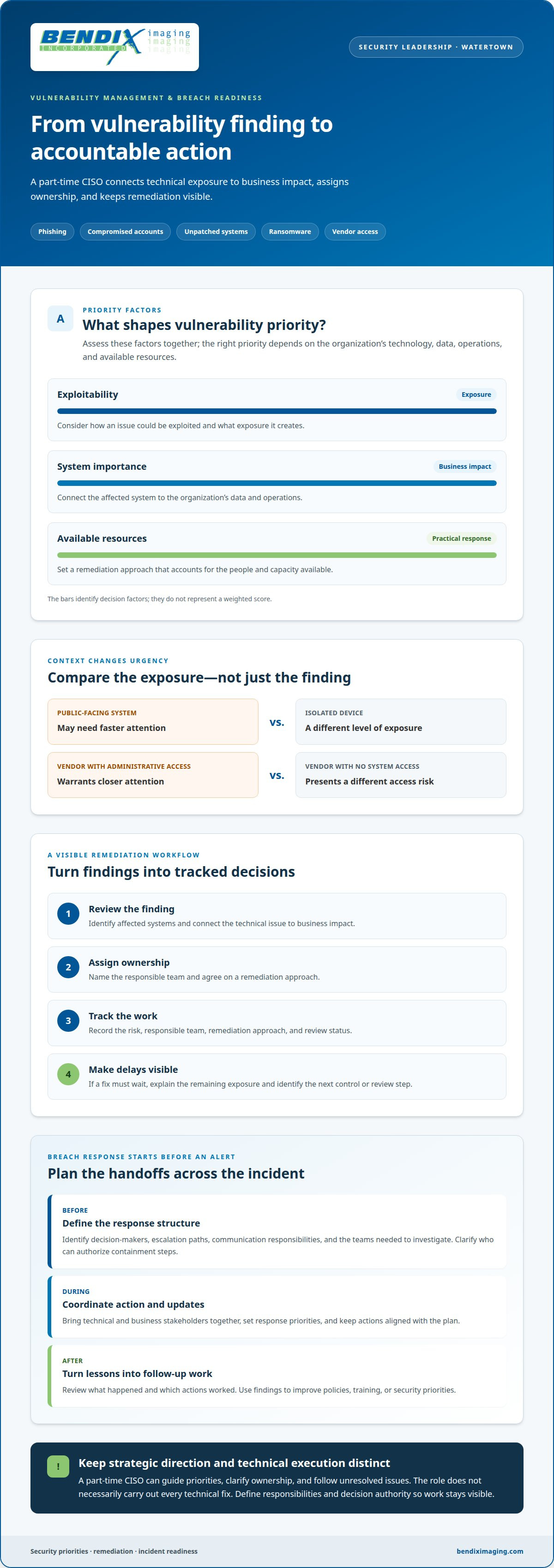
Incident response leadership starts before an alert arrives. The CISO helps establish an incident plan that identifies decision-makers, escalation paths, communication responsibilities, and the teams needed to investigate. The plan should clarify who can authorize containment steps and how leadership receives updates. During an incident, the CISO can coordinate technical and business stakeholders, help set response priorities, and keep actions aligned with the organization’s plan.
After containment and recovery, the CISO can lead a review of what happened, which actions worked, and where the response process needs improvement. Findings can inform updates to policies, training, or security priorities. This turns an incident into specific follow-up work rather than an unresolved concern.
Scope matters. A written engagement should define decision authority, reporting cadence, expected deliverables, and how the CISO coordinates with existing staff. Organizations that also need operational technology support can consider how Managed IT Services fit alongside security leadership. Clear boundaries help distinguish strategic direction from technical execution and keep responsibilities visible.
Vulnerability management and breach response
For organizations in Watertown, Brookings, Sioux Falls, Huron, and Montevideo, relevant cyber risks include phishing, compromised accounts, unpatched systems, ransomware, and vendor access. Which risks matter most depends on the organization’s technology, data, and operations. A part-time CISO maps those exposures to business impact, then sets priorities based on exploitability, system importance, and available resources.
Vulnerability management turns findings into tracked decisions. The CISO reviews assessment results, identifies affected systems, and helps assign remediation owners. A flaw in a public-facing system may need faster attention than an issue on an isolated device. The plan should record the risk, responsible team, remediation approach, and review status. If a fix must wait, leadership needs a clear explanation of the exposure and the next control or review step.
Risk management connects technical findings to a broader security strategy. The CISO can maintain a risk register, identify gaps in policies or safeguards, and recommend projects that address the organization’s most consequential exposures. When managing specialized risks in enterprise infrastructure or operational technology, insights from Bio-Cognitive Solutions highlight how strategic frameworks can reinforce organizational resilience. Program management keeps those efforts moving through assigned owners, defined milestones, and regular leadership updates. This helps prevent security work from becoming a list of findings without accountable follow-through.
Vendor risk deserves its own review. A supplier with access to business systems or sensitive information can introduce exposure beyond the organization’s direct control. The CISO can inventory important vendors, identify the access and data involved in each relationship, and prioritize reviews accordingly. For example, a vendor with administrative access warrants closer attention than one with no system access. Findings should inform access decisions, contract discussions, and ongoing oversight.
If an incident occurs, response priorities include limiting further harm, coordinating technical investigation, and keeping business leaders informed. The CISO helps teams follow established escalation and communication procedures, while documenting key decisions and unresolved risks. A breach also warrants a structured review: identify the entry point, assess affected systems, assign corrective actions, and update the risk register. IBM’s estimate places the average data breach cost at $4.45M, underscoring why prevention and disciplined response planning belong in the same security program.
Outsourced CISO and CISO-as-a-Service models
Outsourcing assigns security leadership to an external professional instead of hiring an in-house CISO. CISO-as-a-Service, often called virtual CISO or vCISO, describes a delivery model for that leadership. The terms can overlap: an organization gains strategic expertise without adding a full-time executive role. Virtual CISO services typically serve companies with 50-500 employees, though staffing size alone doesn’t determine fit.
The practical difference lies in how the engagement is structured. One arrangement may focus on a defined project, such as assessing risks and producing a security roadmap. An ongoing service may include recurring leadership meetings, policy oversight, risk tracking, and coordination with technical teams. CISO-as-a-Service describes an ongoing function delivered externally, not a standard package with identical tasks for every organization.
Before selecting a model, define the outcomes your organization needs. A business preparing for a security assessment may prioritize control reviews and evidence planning. A company with unresolved security findings may need remediation oversight and regular progress reporting. Scope should identify deliverables, decision authority, communication cadence, and how the provider works with internal IT staff. These details help keep strategic guidance connected to implementation.
Evaluate the provider’s ability to explain technical risks in business terms, prioritize competing work, and document decisions. Ask how risk assessments become assigned actions, how progress is reported, and how the engagement adjusts when priorities change. A useful service makes ownership visible: for example, it connects a vulnerability finding to its business impact, remediation owner, and follow-up review. Clear reporting gives leadership a basis for decisions.
Choose an outsourced model when your organization needs security leadership but not a full-time executive, or when existing teams need structured oversight. The best arrangement depends on risk, internal capacity, and the work requiring leadership. To connect security priorities with day-to-day technology operations, discuss a coordinated IT approach.
BENDIX imaging: Managed IT Services
BENDIX imaging helps organizations align managed IT support with day-to-day security needs. If your team needs to connect security priorities with technology operations, Managed IT Services can support that work. Cyber Security and Network Security address broader protection needs, while Artificial Intelligence (AI) Consulting helps organizations consider AI-related business and technology decisions.
Turn to BENDIX imaging when security findings need to fit into a practical IT plan, or when your organization needs support across IT management and security. Discuss your priorities and how they relate to your current environment with the team.
Contact BENDIX imaging to discuss your organization’s IT and security needs.
Set a Clear Direction for Your Security Program
The next step is to turn security leadership into decisions your organization can sustain. Define which business priorities matter most, who owns each decision, and how security work should support operations. For founder-led companies seeking broader executive guidance, Marshall Solutions Group assists leadership teams in refining operational performance and organizational accountability. That direction helps keep future technology choices aligned with the risks your organization needs to manage.
For local organizations considering part-time CISO services in Watertown, the right support connects security planning with practical business needs. BENDIX imaging serves businesses in Watertown, Brookings, Sioux Falls, Huron, and Montevideo with Cyber Security and Managed IT Services, as well as Artificial Intelligence (AI) Consulting for organizations assessing AI-related opportunities and considerations. These offerings support different parts of a technology strategy without treating every challenge as the same problem.
Bring your priorities and current concerns into the conversation, then identify the next useful step for your organization. Start a conversation with BENDIX imaging about aligning your technology and security needs. A clear direction gives your team a stronger foundation for moving forward.
Frequently Asked Questions
Can a CISO be outsourced?
Yes, an organization can outsource its CISO function to an external security professional. This gives leadership access to security expertise without employing an in-house executive. For example, an external CISO can attend leadership reviews, explain priority decisions, and coordinate security work with existing staff. The organization retains its business decisions, while the engagement clarifies the CISO’s scope and authority.
What is CISO as a Service?
CISO as a Service is an outsourced arrangement that provides ongoing cybersecurity leadership. Rather than hiring an executive directly, an organization engages a professional for defined guidance and oversight. The arrangement can reflect business needs, such as executive reporting, security program governance, or planning for upcoming assessments. Clear deliverables and communication expectations distinguish an ongoing service from a one-time report.
Can a vCISO help with CMMC, HIPAA, and NIST 800-171 compliance?
Yes, a vCISO can help an organization assess its security practices against CMMC, HIPAA, and NIST 800-171 requirements. That support may include mapping existing controls, identifying gaps, organizing evidence, and prioritizing corrective work. For example, a contractor can use the assessment to clarify which security tasks need owners and documentation. Advisory support is not itself a certification or official compliance determination.
How is a vCISO different from a security consultant?
A vCISO typically provides continuing security leadership, while a security consultant often handles a defined advisory project. For example, a consultant might assess a specific system and deliver findings; a vCISO can help leadership decide how those findings fit into the broader program. The distinction is ongoing governance and decision support, not simply whether the work happens remotely.
What is a virtual CISO (vCISO)?
A virtual CISO is an external cybersecurity leader who provides CISO-level guidance through a service engagement rather than as an internal executive. “Virtual” describes the delivery arrangement; it doesn’t mean the role is limited to software or automated reports. A vCISO can participate in planning and leadership discussions, helping connect security decisions with business priorities and internal team responsibilities.
What do part-time CISO services include?
Part-time CISO services can include risk assessment, security policy development, program oversight, compliance framework reviews, employee training, and incident readiness. The exact mix follows the organization’s needs and agreed scope. For example, a business preparing for a customer security review may need help organizing control evidence and assigning follow-up tasks, while another may focus on vendor access or executive reporting.
{"@context":"https://schema.org","@type":"FAQPage","mainEntity":[{"@type":"Question","name":"Can a CISO be outsourced?","acceptedAnswer":{"@type":"Answer","text":"Yes, an organization can outsource its CISO function to an external security professional. This gives leadership access to security expertise without employing an in-house executive. For example, an external CISO can attend leadership reviews, explain priority decisions, and coordinate security work with existing staff. The organization retains its business decisions, while the engagement clarifies the CISO’s scope and authority."}},{"@type":"Question","name":"What is CISO as a Service?","acceptedAnswer":{"@type":"Answer","text":"CISO as a Service is an outsourced arrangement that provides ongoing cybersecurity leadership. Rather than hiring an executive directly, an organization engages a professional for defined guidance and oversight. The arrangement can reflect business needs, such as executive reporting, security program governance, or planning for upcoming assessments. Clear deliverables and communication expectations distinguish an ongoing service from a one-time report."}},{"@type":"Question","name":"Can a vCISO help with CMMC, HIPAA, and NIST 800-171 compliance?","acceptedAnswer":{"@type":"Answer","text":"Yes, a vCISO can help an organization assess its security practices against CMMC, HIPAA, and NIST 800-171 requirements. That support may include mapping existing controls, identifying gaps, organizing evidence, and prioritizing corrective work. For example, a contractor can use the assessment to clarify which security tasks need owners and documentation. Advisory support is not itself a certification or official compliance determination."}},{"@type":"Question","name":"How is a vCISO different from a security consultant?","acceptedAnswer":{"@type":"Answer","text":"A vCISO typically provides continuing security leadership, while a security consultant often handles a defined advisory project. For example, a consultant might assess a specific system and deliver findings; a vCISO can help leadership decide how those findings fit into the broader program. The distinction is ongoing governance and decision support, not simply whether the work happens remotely."}},{"@type":"Question","name":"What is a virtual CISO (vCISO)?","acceptedAnswer":{"@type":"Answer","text":"A virtual CISO is an external cybersecurity leader who provides CISO-level guidance through a service engagement rather than as an internal executive. “Virtual” describes the delivery arrangement; it doesn’t mean the role is limited to software or automated reports. A vCISO can participate in planning and leadership discussions, helping connect security decisions with business priorities and internal team responsibilities."}},{"@type":"Question","name":"What do part-time CISO services include?","acceptedAnswer":{"@type":"Answer","text":"Part-time CISO services can include risk assessment, security policy development, program oversight, compliance framework reviews, employee training, and incident readiness. The exact mix follows the organization’s needs and agreed scope. For example, a business preparing for a customer security review may need help organizing control evidence and assigning follow-up tasks, while another may focus on vendor access or executive reporting."}}]}


