
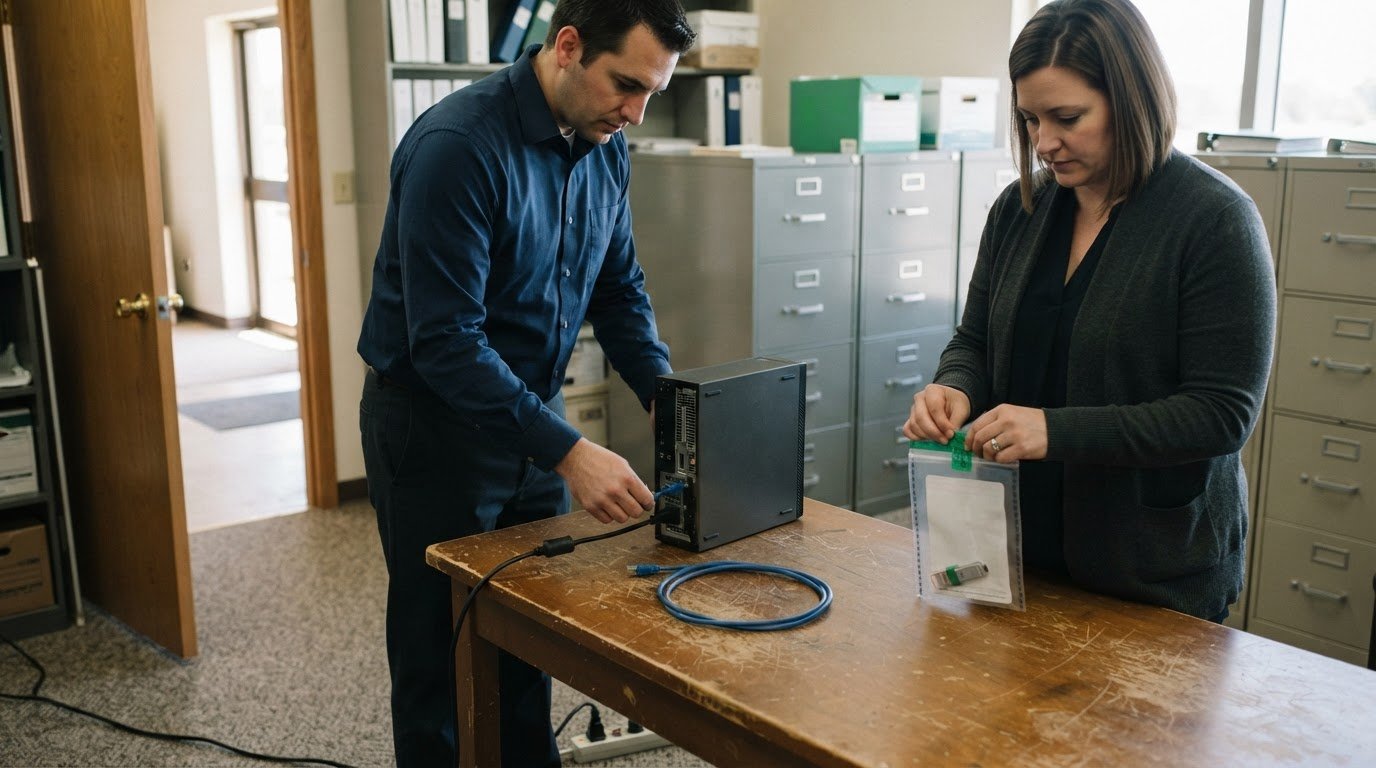
A breach is a business incident, not just an IT problem. Cyber incident and breach response is the coordinated work of limiting damage, investigating what happened, removing the threat, and restoring affected systems safely. The response depends on people as much as technology: a Computer Security Incident Response Team (CSIRT) brings the right decision-makers and specialists together to manage the work.
It’s reasonable to expect a clear plan when systems or data may be at risk. This guide explains Cyber Incident Response and Breach Response, how organizations can plan for incidents and assess suspicious activity, and what a Computer Security Incident Response Team (CSIRT) does. You’ll also see how clear responsibilities and communication help teams contain a problem, support recovery, and learn from the incident.
Key Takeaways
- Understand how a coordinated response limits damage and supports a safer return to business operations.
- See how plans and tabletop exercises clarify responsibilities before an incident puts normal processes under pressure.
- Learn how professionals assess suspicious activity while documenting evidence and response actions.
- Identify the people a CSIRT may bring together, and how BENDIX imaging’s cyber security services can support organizational protection.
What is incident response?
Incident response is an organized process for identifying attacks, limiting compromise, removing threats, and restoring operations. It guides decisions from initial detection through recovery while helping protect an organization’s systems and data.
Incident Response Phases
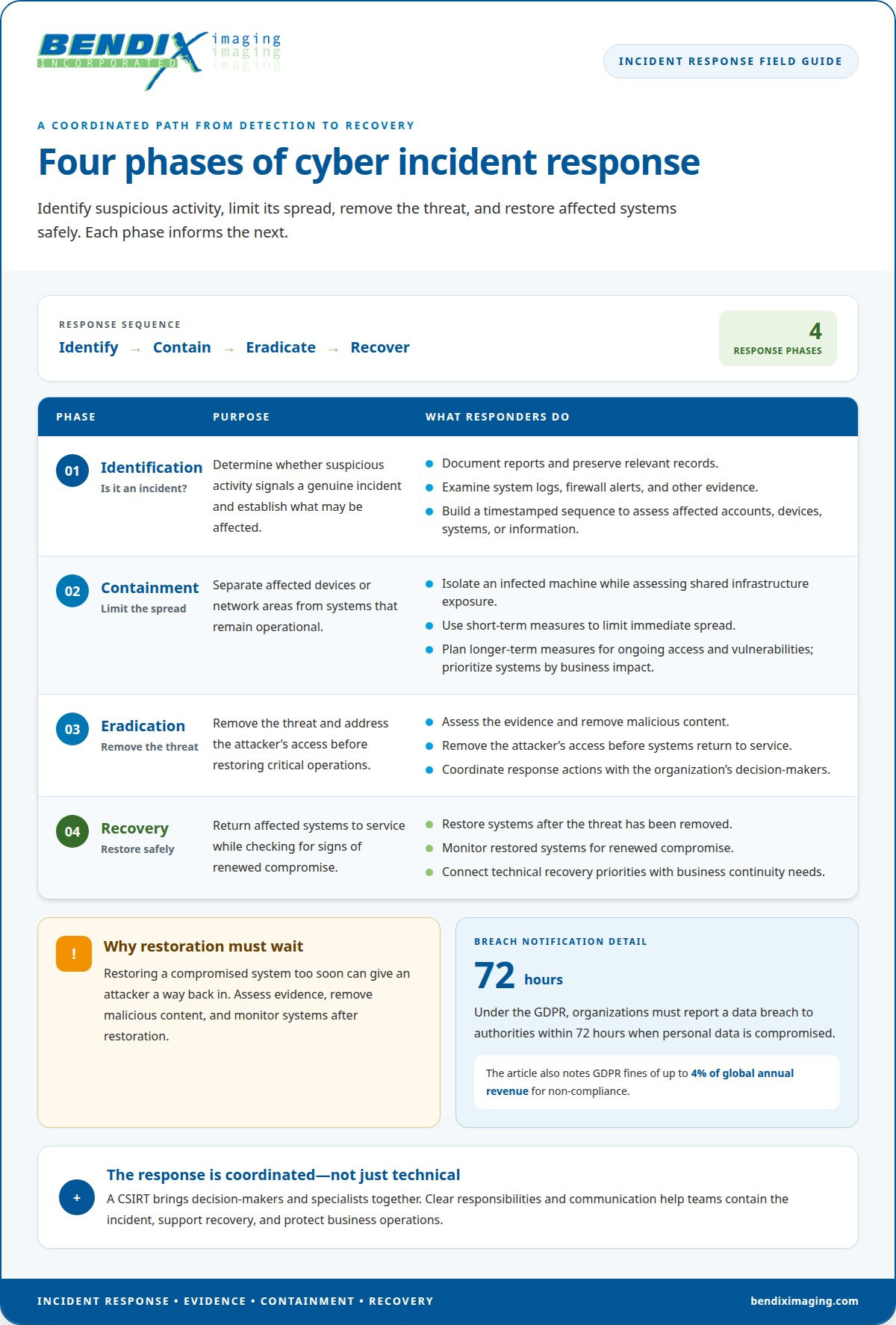
Identification determines whether suspicious activity signals an incident. Containment limits its spread, eradication removes the threat, and recovery returns affected systems to service. These phases matter because restoring a compromised system too soon can give an attacker a way back in. Responders assess the evidence, remove malicious content, and monitor restored systems for signs of renewed compromise.
Containment and Critical System Priorities
Containment separates affected devices or network areas from systems that remain operational. Responders might isolate an infected machine while assessing whether shared infrastructure is also exposed. Short-term containment limits immediate spread; longer-term measures address ongoing access and vulnerabilities. Teams prioritize systems by business impact and remove the attacker’s access before restoring critical operations.
Incident Investigation and Immediate Actions
Professional responders begin by documenting reports, preserving relevant records, and examining sources such as system logs and firewall alerts. This helps establish what happened and which systems or information may be affected. They coordinate containment with the organization’s decision-makers and identify any applicable notification duties. According to the European Union, under the GDPR, organizations must report a data breach to authorities within 72 hours when personal data is compromised. The European Union also states that the GDPR can impose fines of up to 4% of an organization’s global annual revenue for non-compliance.
Breach Recovery Costs
There is no single U.S. cost for incident response or breach recovery. The work depends on factors such as how many systems are affected, the nature of the compromise, investigation needs, and recovery complexity. Professional responders assess the situation and define the scope, from containing the incident and removing threats to restoring infrastructure and monitoring systems. That assessment helps organizations plan recovery spending without mistaking it for a standard service price.
Incident response planning and tabletop exercises
A response plan turns security policies into assigned actions to protect operations during an incident. Professional preparation connects those actions to the organization’s network, recovery priorities, communication channels, and available capabilities.
Response Planning and Preparation
Professionals build a plan around the organization’s systems, critical operations, and decision-making structure. They clarify who can authorize containment, assess business impact, and coordinate recovery. The plan should include alternative communication methods in case email or user accounts become unavailable. Keep essential records accessible outside systems an attack could disrupt, so responders can use them if normal tools fail.
Preparation also means defining how the organization will report incidents and coordinate with relevant partners. CISA recommends meeting with local law enforcement during preparation and documenting how incidents will be reported to local and federal agencies. A useful plan assigns responsibilities, records escalation paths, and connects technology recovery priorities with business continuity needs. This gives responders a workable structure instead of leaving them to make every decision from scratch.
Tabletop Exercises
A tabletop exercise is a guided discussion where participants work through a realistic incident scenario without changing live systems. It lets teams test whether roles and communication paths will work before an attack disrupts operations. For example, a ransomware scenario can prompt participants to consider who leads decisions, how they will reach key personnel, and which business functions need priority.
Facilitators can introduce new information as the scenario unfolds, such as an unavailable network or suspected data exposure. Participants explain their decisions, identify missing information, and flag confusing parts of the response plan. End the exercise with specific improvements, assigned owners, and plan updates. Repeating the discussion after revisions helps test whether the organization has strengthened its response capabilities.
Choosing an External Response Firm
Choose a firm that can explain how it will coordinate with your organization, preserve incident records, and support investigation, containment, and recovery. Technical response needs to connect with business decisions, communications, and operational priorities. For comprehensive support spanning forensics and legal requirements, organizations often engage specialized partners like Trustpoint.One to handle cyber breach response. Ask how the proposed approach fits your infrastructure and existing response plan, and how responsibilities will be divided between internal staff and external partners.
Look for a clear scope of work, defined communication and escalation paths, and planning that accounts for inaccessible systems. A firm should also explain technical findings in terms leaders can act on. Compare its capabilities with your organization’s needs, such as protecting critical network services and coordinating recovery. Defining roles before an incident reduces confusion when quick decisions are needed.
Analyzing suspected cyber incidents
Professional analysis turns alerts and suspicious activity into evidence-based decisions. Responders determine what happened, identify affected systems, and guide the organization’s next steps.
Detection and Incident Analysis
Professionals assess whether an alert, user report, or system change signals a genuine threat. They compare intrusion-detection alerts, firewall records, error messages, and system logs. A timestamped sequence can show when unusual access began and which accounts or devices were affected. This analysis helps distinguish a routine malfunction from a compromise that needs a coordinated response.
Responders document actions and findings as they work, preserving a record for stakeholders and later review. When needed, forensic software captures images of affected systems so investigators can examine how they were compromised. Responders connect evidence from different sources, then assess the incident’s likely scope and whether other systems show related activity. Those findings help incident leaders make informed decisions under the organization’s response plan.
Malware Analysis and Remediation
Malware analysis examines suspicious files and system behavior to understand the threat and its effects. Professionals review affected systems and available evidence to determine whether malicious content is present, where it appears, and whether related activity has reached other devices. This focused examination supports targeted remediation instead of treating every alert as proof of the same compromise.
After identifying malicious content, responders remove it and clean affected systems to reduce the risk of reinfection. They address the vulnerability or access path that enabled the compromise, then monitor cleaned systems for renewed activity. For example, an endpoint that appears normal after cleanup still needs to be checked against related network activity. Documented remediation findings help stakeholders understand what changed and inform future incident response planning.
Computer Security Incident Response Team (CSIRT) roles
A Computer Security Incident Response Team (CSIRT) is the group responsible for leading or handling a security incident. Its value comes from bringing technical investigation, business decisions, and communication together under clear responsibilities.
An Incident Manager leads the response, coordinates internal and external teams, and keeps decisions moving. The incident response plan should name this role and clarify who can approve actions, brief stakeholders, and coordinate with employees. That structure helps prevent conflicting instructions when technical findings affect business operations.
- Executive management sets priorities and makes business decisions, such as which operations need restoration first.
- IT infrastructure experts assess systems and support technical response across the organization’s network.
- Analysts and investigators examine evidence, assess the incident’s scope, and support forensic work.
- Legal and human resources help address legal considerations and employee-related issues.
- Customer service and public relations coordinate customer-facing communication and public updates.
An internal response relies on an organization’s employees and existing technical capabilities. An external response team brings in people from outside the organization to support investigation and response, while internal staff contribute system knowledge and business context. Organizations can use both, with the Incident Manager coordinating responsibilities.
Define how CSIRT members share findings, escalate decisions, and communicate with affected stakeholders. For example, an analyst may identify compromised systems, IT staff may assess operational effects, and executives may set restoration priorities. Legal and communications roles can coordinate relevant messages. Clear handoffs help the team act as one unit rather than as separate departments.
Make roles practical: document who leads, who investigates, who approves containment, and who communicates. To strengthen the technical safeguards a response team depends on, explore cyber security support.
BENDIX imaging: Cyber Security
BENDIX imaging helps businesses strengthen protection through Cyber Security and Network Security. These services can support efforts to assess safeguards, address weaknesses, and build security practices around your systems and business priorities. Managed IT Services can support ongoing technology management, while Artificial Intelligence (AI) Consulting can help organizations consider how AI fits their operations.
Incident readiness also depends on understanding your infrastructure, clarifying priorities, and connecting security decisions with day-to-day needs. BENDIX imaging can help businesses in Watertown, Brookings, Sioux Falls, Huron, and Montevideo consider those needs as part of a broader technology approach. Contact BENDIX imaging to discuss your organization’s cyber security needs.
Make security readiness part of the next business decision
Cyber incident and breach response is easier to coordinate when security responsibilities fit the way your organization operates. Consider where security planning, technology management, and leadership decisions need to work together before a suspected incident forces those choices under pressure.
BENDIX imaging offers Cyber Security, Managed IT Services, and Artificial Intelligence (AI) Consulting to help businesses address technology and security needs. These services can support a broader approach to protecting operations and making informed technology decisions. Contact BENDIX imaging to discuss your priorities and the support that fits your organization.
Contact BENDIX imaging today to discuss your needs and move forward with greater clarity.
Frequently Asked Questions
What are security incidents?
Security incidents are events that threaten an organization’s information, systems, or operations. Examples include an employee entering credentials on a phishing page, an unfamiliar login to a business account, unexpected file encryption, or a lost device containing company data. An alert alone doesn’t prove an attack occurred, but it gives the organization a reason to assess the evidence and decide whether response procedures apply.
What are the Frameworks and Standards?
Frameworks and standards give organizations structured ways to manage cybersecurity incidents. Common references include NIST’s Cybersecurity Framework (CSF) 2.0, the NIST cybersecurity event recovery guide, the SANS Institute’s Incident Handler’s Handbook, and ISO/IEC 27035. They support planning, handling, recovery, and improvement. They aren’t interchangeable: organizations select guidance that fits their operations, then use it to clarify responsibilities and evaluate their response practices.
What are the Regulatory Obligations?
Regulatory duties depend on the law that applies to the organization and information involved. According to the European Union, under the GDPR, organizations must report a data breach to authorities within 72 hours when personal data is compromised. The California Legislature says the CCPA requires businesses to notify affected California residents about breaches involving personal information. Organizations should identify affected data and jurisdictions promptly to assess applicable notification duties.
What is cyber incident response and breach response?
Cyber incident response is the organized management of a suspected or confirmed cybersecurity event; breach response focuses on incidents involving compromised information. The terms overlap, but an alert may need investigation before anyone can determine whether data was exposed. For businesses in Watertown, Brookings, Sioux Falls, Huron, and Montevideo, the distinction helps leaders separate technical investigation from decisions about affected information, business impact, and any required notifications.
What are the steps in a cybersecurity incident response plan?
A practical plan typically moves from identifying and assessing an event to assigning a response lead, containing its effects, removing the threat, and restoring systems. It should explain how decisions are escalated and response records maintained. After normal operations return, a review can document the incident’s cause, actions taken, and changes needed to strengthen the organization’s readiness.
What are the U.S. data breach notification requirements and deadlines by state?
The United States has no single notification deadline that applies to every data breach; state requirements vary. To determine which rules apply, identify where affected residents live, what personal information was involved, and which state laws govern the incident. Those details shape who may need notice and when. California, for example, requires notice to affected residents for breaches involving personal information under the CCPA.
{"@context":"https://schema.org","@type":"FAQPage","mainEntity":[{"@type":"Question","name":"What are security incidents?","acceptedAnswer":{"@type":"Answer","text":"Security incidents are events that threaten an organization’s information, systems, or operations. Examples include an employee entering credentials on a phishing page, an unfamiliar login to a business account, unexpected file encryption, or a lost device containing company data. An alert alone doesn’t prove an attack occurred, but it gives the organization a reason to assess the evidence and decide whether response procedures apply."}},{"@type":"Question","name":"What are the Frameworks and Standards?","acceptedAnswer":{"@type":"Answer","text":"Frameworks and standards give organizations structured ways to manage cybersecurity incidents. Common references include NIST’s Cybersecurity Framework (CSF) 2.0, the NIST cybersecurity event recovery guide, the SANS Institute’s Incident Handler’s Handbook, and ISO/IEC 27035. They support planning, handling, recovery, and improvement. They aren’t interchangeable: organizations select guidance that fits their operations, then use it to clarify responsibilities and evaluate their response practices."}},{"@type":"Question","name":"What are the Regulatory Obligations?","acceptedAnswer":{"@type":"Answer","text":"Regulatory duties depend on the law that applies to the organization and information involved. According to the European Union, under the GDPR, organizations must report a data breach to authorities within 72 hours when personal data is compromised. The California Legislature says the CCPA requires businesses to notify affected California residents about breaches involving personal information. Organizations should identify affected data and jurisdictions promptly to assess applicable notification duties."}},{"@type":"Question","name":"What is cyber incident response and breach response?","acceptedAnswer":{"@type":"Answer","text":"Cyber incident response is the organized management of a suspected or confirmed cybersecurity event; breach response focuses on incidents involving compromised information. The terms overlap, but an alert may need investigation before anyone can determine whether data was exposed. For businesses in Watertown, Brookings, Sioux Falls, Huron, and Montevideo, the distinction helps leaders separate technical investigation from decisions about affected information, business impact, and any required notifications."}},{"@type":"Question","name":"What are the steps in a cybersecurity incident response plan?","acceptedAnswer":{"@type":"Answer","text":"A practical plan typically moves from identifying and assessing an event to assigning a response lead, containing its effects, removing the threat, and restoring systems. It should explain how decisions are escalated and response records maintained. After normal operations return, a review can document the incident’s cause, actions taken, and changes needed to strengthen the organization’s readiness."}},{"@type":"Question","name":"What are the U.S. data breach notification requirements and deadlines by state?","acceptedAnswer":{"@type":"Answer","text":"The United States has no single notification deadline that applies to every data breach; state requirements vary. To determine which rules apply, identify where affected residents live, what personal information was involved, and which state laws govern the incident. Those details shape who may need notice and when. California, for example, requires notice to affected residents for breaches involving personal information under the CCPA."}}]}


