

HIPAA compliance for local businesses depends on the work they do, not their size. Healthcare organizations and businesses working with healthcare clients must comply with HIPAA, even when they’re small. They also need to take reasonably appropriate steps to safeguard protected health information.
Owners may be unsure whether the rules apply to their business or whether software alone can close security gaps. This guide explains who must comply, when a Business Associate Agreement is needed, and how risk planning, practical checklists, and compliance software can support ongoing safeguards. Tools are only part of the picture: clear responsibilities, documented policies, and careful handling of health information matter too. Start by determining whether HIPAA applies, then identify how your business should manage its risks.
Key Takeaways
- Determine whether your business is a covered entity or handles protected health information for a healthcare organization; business size alone doesn’t settle the question.
- Understand when a Business Associate Agreement is needed and what responsibilities it should clarify between organizations.
- Use risk plans and security checklists to organize safeguards, document decisions, and keep reviews from slipping through the cracks.
- Assess compliance software as a support for tracking policies and tasks, not a substitute for sound security practices and accountable oversight.
Do all small businesses need to follow HIPAA?
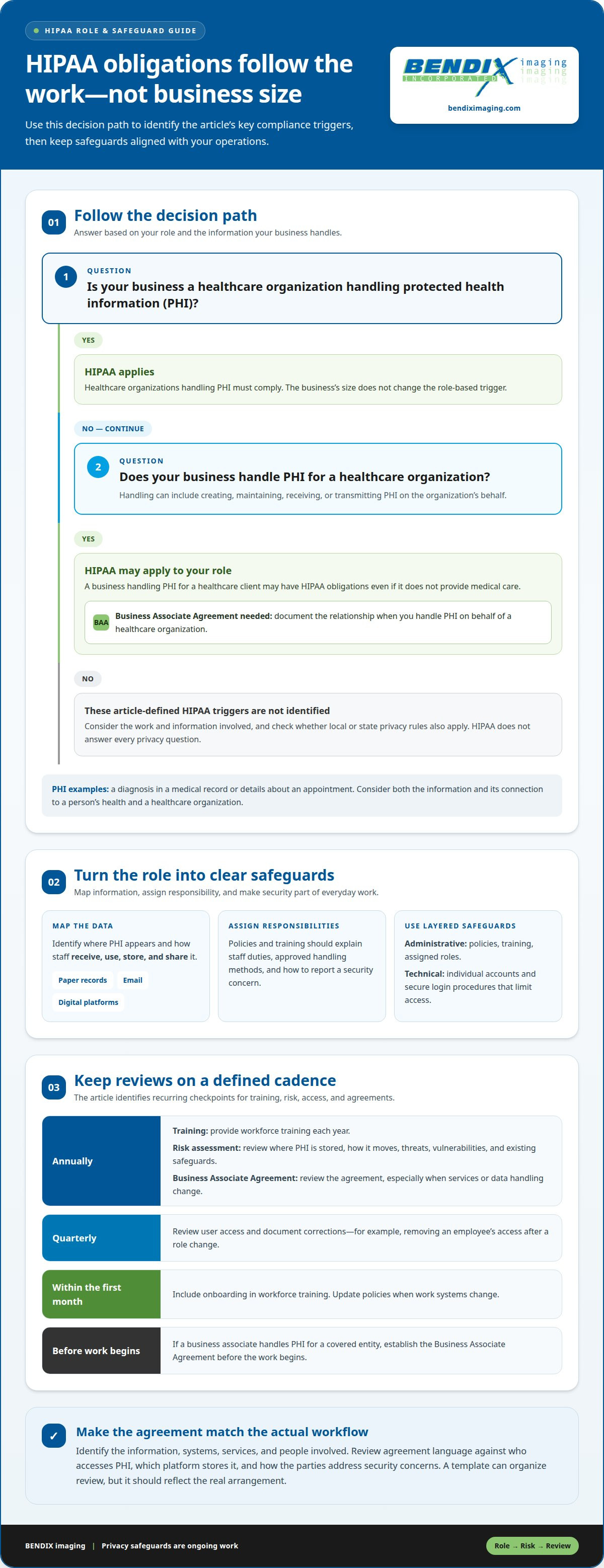
Small businesses must follow HIPAA when they are healthcare organizations or handle protected health information for healthcare clients. The deciding factor is their role, not their employee count.
Administrative security and technical safeguards
Administrative safeguards include the policies, training, and assigned responsibilities that guide staff in protecting patient data. Technical safeguards are system controls that limit access, such as individual accounts and secure login procedures. Together, these measures put security policies into practice in everyday work.
HIPAA training and policies should clarify staff responsibilities, approved ways to handle information, and how to report a security concern. Provide workforce training annually and include onboarding within the first month of employment. For example, train employees who use a scheduling platform to avoid exposing patient details in messages or on shared screens. Similarly, when dental practices adopt communication platforms like practcom.com for digital informed consent and post-treatment instructions, team members must be trained to handle that data securely. Update the policy when work systems change.
Health information protected under HIPAA
HIPAA protects patient health information handled by organizations subject to the law. Examples include a diagnosis in a medical record or details about an appointment. Both content and context matter: consider whether information relates to someone’s health and whether your work connects to a healthcare organization.
This distinction helps owners identify where patient data appears, including paper records, email, and digital platforms. Map how staff receive, use, store, and share the information. If a local business handles patient information for a healthcare client, its role may bring HIPAA obligations even if it doesn’t provide medical care.
Local and state privacy laws
HIPAA is a federal law, and local or state privacy rules may also apply to a business’s activities and information. Requirements depend on the location and the work being done, so don’t assume HIPAA answers every privacy question. Start by mapping where your business operates and handles patient data.
Compare relevant privacy rules with existing policies, business associate agreements, and technical safeguards. For example, a procedure for sending patient records should account for the rules that apply to your business and the information involved. Keep requirements organized together, and update procedures when you add a location, vendor, or new way to handle data.
Enforcement can carry serious consequences. The U.S. Department of Justice may pursue criminal charges for HIPAA violations that can result in fines of up to $250,000. Small businesses should treat training, documented policies, and access controls as practical parts of protecting patient information, not paperwork to set aside.
Business Associate Agreements
A Business Associate Agreement documents the relationship between a covered entity and a business associate. It is needed when a business handles protected health information on behalf of a healthcare organization.
Covered entity and business associate roles
Healthcare organizations that work with protected health information may have responsibilities for safeguarding it. A business associate handles that information on the organization’s behalf. A business that creates, maintains, receives, or transmits protected health information for a covered entity must enter into a Business Associate Agreement with it.
Consider a technology provider maintaining a platform that stores patient records for a clinic, such as healthcare software providers like SMAART Medical Systems, Inc. that manage clinical and imaging workflows. The agreement helps define each party’s responsibilities and makes security expectations explicit, rather than leaving staff to guess how information should be handled.
Before work begins, identify the information involved, the systems or services that handle it, and the people responsible for each part. Note relevant controls and vulnerabilities, then establish how you’ll monitor whether the approach still fits the work. Review the agreement annually, especially when services or data handling change.
Business associate agreement templates
A template is a starting point for documenting the terms of a business associate relationship. It can help organize a review, but a generic form may not reflect the actual services, systems, or information involved in a particular arrangement.
For example, a clinic hiring a records-hosting vendor should describe the service and the patient information it handles. Review each clause against the actual workflow: who accesses the information, which platform stores it, and how the parties address security concerns. Don’t keep language that conflicts with the arrangement simply because it came from a template.
Use the draft to identify topics that need agreement, then document the final terms with the covered entity. Keep the signed version with related service records so staff can find it when responsibilities or monitoring procedures need review. A clear agreement supports coordination, but it does not replace operational safeguards.
If reviewing the relationship reveals gaps in system protection, strengthen security controls around the information involved.
Risk management plans and security checklists
Effective HIPAA compliance for local businesses means turning security findings into assigned actions, procedures, and records. Annual reviews help keep safeguards aligned with changes to systems, vendors, and employee access.
Security risk assessments
A security risk assessment identifies where patient information is stored, how it moves, and what could expose it. For a HIPAA Security Rule risk analysis, map systems such as a records platform and network, then assess threats, vulnerabilities, and existing safeguards. This helps prioritize practical protections instead of relying on a generic checklist.
Conduct a data security assessment annually. Review user access quarterly and document corrections, such as removing an employee’s access after a role change. A checklist can track each system, the information it handles, responsible staff, identified risks, and selected safeguards. This makes follow-up clearer than a list of unchecked tasks.
Compliance planning and documentation
Compliance planning connects each risk assessment finding to a procedure, an owner, and evidence of action. For HIPAA compliance for local businesses, identify patient-data systems, record vulnerabilities, select safeguards, and set dates to review unresolved issues. Documentation shows how the business assessed risk and responded, rather than merely stating that security matters.
Review HIPAA policies at least annually and whenever the business introduces new technology or vendors. Keep records of assessments, policy updates, employee training, access reviews, and corrective actions. Retain HIPAA compliance documentation for at least six years from its creation date or last effective date. The Office for Civil Rights may request these records during an audit.
Build ongoing checks into the plan. Schedule incident-response tabletop exercises twice a year, and record participants, decisions, and follow-up actions. If an exercise reveals a gap, assign responsibility and document the corrective step. This gives employees a defined procedure and helps management track whether weaknesses were addressed.
HIPAA compliance software for small businesses
HIPAA compliance software can organize policies, training records, risk tasks, and review dates. Treat it as a support system, not proof that an organization meets every requirement.
Compliance software options
Compliance software is a digital platform for managing records and activities related to privacy and security practices. For a small healthcare provider, it can make assigned tasks and follow-ups easier to track across employees.
Before adopting a platform, map the work it needs to support. For example, determine whether it can organize policy versions, record staff training, track risk assessment findings, and flag upcoming reviews. Assign an owner to maintain the records and act on open items. A dashboard won’t fix a weak access policy on its own.
Also consider where patient information is stored and whether the software will handle it. Document the platform’s role, access permissions, and connection to existing systems. Maintain operational safeguards and assess whether staff use the tool as intended. Software can support consistent practices, but people remain responsible for decisions and follow-through.
Small-business compliance costs
The cost of HIPAA compliance for a small business depends on its needs and the work required. The price depends on the case and is given after a quote request; cost factors include the systems in use, the amount of remediation, staff training, and ongoing compliance support.
Separate software expenses from broader implementation work. A small clinic with organized policies may need different support from an organization with scattered records, outdated controls, or several platforms handling patient information. Allow time for employees to use the system and for responsible staff to review its records.
Budget decisions should account for more than a software subscription. A tool that stores policies but leaves access issues or staff practices unaddressed can create a false sense of completion. Define the tasks the software will manage, who is responsible for each, and how completed work will be documented. This grounds the purchase decision in actual needs.
Need help aligning compliance planning with your systems? Get support with regulatory compliance and connect software decisions to practical security practices.
BENDIX imaging: Regulatory Compliance
BENDIX imaging helps businesses address regulatory compliance by connecting compliance planning with the technology and security practices that support it. Turn to this support when policies, systems, and daily processes need a clearer, coordinated approach.
Regulatory compliance can intersect with Cyber Security and Managed IT Services, particularly when access controls, business systems, and documented procedures affect how sensitive information is handled. BENDIX imaging provides Regulatory Compliance support alongside relevant technology services, helping businesses identify practical priorities and connect compliance needs with technology support. The goal is a workable plan based on your systems and operations, not software alone.
If you’re ready to discuss your compliance needs, contact BENDIX imaging.
Make your next compliance decision deliberate
Use your next planning conversation to connect compliance responsibilities with the systems your team relies on. Clarify ownership, priorities, and the support needed to keep privacy and security practices active as operations change.
For HIPAA compliance for local businesses, BENDIX imaging can connect Regulatory Compliance with relevant technology support for businesses in Watertown, Brookings, Sioux Falls, Huron, and Montevideo. Cyber Security and Managed IT Services address the systems and security practices that underpin daily operations, while Artificial Intelligence (AI) Consulting can support organizations evaluating AI-related needs. The focus is practical coordination, not adding tools without a defined purpose.
Bring forward the compliance questions or technology concerns your team needs to resolve, and start a focused discussion about the work ahead. Contact BENDIX imaging today to discuss your business needs and take a confident next step.
Frequently Asked Questions
What are the components of HIPAA?
HIPAA’s key operational components address privacy, security, and breach notification. Privacy practices govern how protected health information is handled and individuals’ rights. Security measures safeguard electronic health information. Breach notification procedures address informing affected individuals when a breach occurs. For example, a clinic needs processes to protect digital records and respond if patient information is exposed.
How often should risk assessments be conducted?
Conduct a data security assessment annually, and revisit it when technology, vendors, or business processes change. For example, adding a cloud records platform can affect where patient information is stored and who can access it. A follow-up assessment helps identify new vulnerabilities and document safeguards or corrective actions that need attention.
What are the three main rules of HIPAA?
The three commonly referenced rules are the Privacy Rule, Security Rule, and Breach Notification Rule. Together, they address handling protected health information, safeguarding electronic information, and notifying affected individuals after a breach. For example, a business handling patient records needs to consider daily access practices and how it will respond if information is exposed.
What are the three patient rights under the HIPAA Privacy Rule?
Individuals have rights to access their health information, request amendments, and receive an accounting of disclosures. For example, a patient may ask for a copy of a record, request a correction, or seek information about disclosures. Covered organizations should have processes to receive and handle each request, rather than treating them as informal staff inquiries.
Which local businesses must comply with HIPAA?
Healthcare organizations and businesses working with healthcare clients must comply when their roles involve protected health information, regardless of business size. A local clinic is one example; a service business handling patient records for a healthcare organization may also have obligations. The key is the organization’s role and how it handles the information, not its storefront or employee count.
When are small businesses business associates under HIPAA?
A small business is a business associate when it creates, maintains, receives, or transmits protected health information for a covered entity. For example, a company maintaining a healthcare organization’s records platform may meet this description. The relationship requires a Business Associate Agreement with the covered entity, documenting responsibilities tied to the information and services involved.
{"@context":"https://schema.org","@type":"FAQPage","mainEntity":[{"@type":"Question","name":"What are the components of HIPAA?","acceptedAnswer":{"@type":"Answer","text":"HIPAA’s key operational components address privacy, security, and breach notification. Privacy practices govern how protected health information is handled and individuals’ rights. Security measures safeguard electronic health information. Breach notification procedures address informing affected individuals when a breach occurs. For example, a clinic needs processes to protect digital records and respond if patient information is exposed."}},{"@type":"Question","name":"How often should risk assessments be conducted?","acceptedAnswer":{"@type":"Answer","text":"Conduct a data security assessment annually, and revisit it when technology, vendors, or business processes change. For example, adding a cloud records platform can affect where patient information is stored and who can access it. A follow-up assessment helps identify new vulnerabilities and document safeguards or corrective actions that need attention."}},{"@type":"Question","name":"What are the three main rules of HIPAA?","acceptedAnswer":{"@type":"Answer","text":"The three commonly referenced rules are the Privacy Rule, Security Rule, and Breach Notification Rule. Together, they address handling protected health information, safeguarding electronic information, and notifying affected individuals after a breach. For example, a business handling patient records needs to consider daily access practices and how it will respond if information is exposed."}},{"@type":"Question","name":"What are the three patient rights under the HIPAA Privacy Rule?","acceptedAnswer":{"@type":"Answer","text":"Individuals have rights to access their health information, request amendments, and receive an accounting of disclosures. For example, a patient may ask for a copy of a record, request a correction, or seek information about disclosures. Covered organizations should have processes to receive and handle each request, rather than treating them as informal staff inquiries."}},{"@type":"Question","name":"Which local businesses must comply with HIPAA?","acceptedAnswer":{"@type":"Answer","text":"Healthcare organizations and businesses working with healthcare clients must comply when their roles involve protected health information, regardless of business size. A local clinic is one example; a service business handling patient records for a healthcare organization may also have obligations. The key is the organization’s role and how it handles the information, not its storefront or employee count."}},{"@type":"Question","name":"When are small businesses business associates under HIPAA?","acceptedAnswer":{"@type":"Answer","text":"A small business is a business associate when it creates, maintains, receives, or transmits protected health information for a covered entity. For example, a company maintaining a healthcare organization’s records platform may meet this description. The relationship requires a Business Associate Agreement with the covered entity, documenting responsibilities tied to the information and services involved."}}]}


