

Cyber Liability Insurance can help cover breach response and certain claims, but it won’t prevent an attack or replace strong security defenses. Policy wording matters: coverage varies, and exclusions can leave costs with your business.
It’s reasonable to expect protection when a cyber incident disrupts operations or exposes customer information. The practical question is what your policy will pay for and where its limits begin. This guide explains common first-party and third-party coverage, typical exclusions, and how insurance works alongside safeguards such as access controls, multifactor authentication, software updates, and backups.
Incident response can involve investigation, notifications, data recovery, system repairs, and legal support. Preparation before an incident matters, too. Understanding your coverage and security defenses can help your Watertown, Brookings, Sioux Falls, Huron, or Montevideo business respond with greater confidence.
Key Takeaways
- Identify which incident-related expenses a policy may help cover, from investigation and notifications to recovery and legal support.
- Understand how business risk, industry, revenue, and security posture can shape coverage and premiums.
- Review exclusions and limits closely so you can spot costs that may remain your responsibility.
- Use insurance alongside practical safeguards, such as access controls, multifactor authentication, timely updates, and backups.
Incident response, breach notification, and recovery costs
A cyber incident can trigger investigations, customer communications, legal support, and computer recovery. Coverage depends on the policy’s terms, limits, and response requirements.
Start by identifying the incident and preserving relevant records, including affected systems, dates, and data types. A breach investigation may use digital forensics to determine how attackers entered, what information they accessed, and whether they remain in the network. Policies may help cover investigation, crisis communications, legal services, and remediation costs related to an attack. Read the policy’s notice instructions carefully, since response steps and covered expenses vary.
Breach Notification Requirements
Most U.S. states require companies to notify individuals when a breach may have compromised their personal information. Federal laws require most institutions to notify individuals if their personal health information is compromised. The applicable requirements depend on the information involved, affected people, and relevant jurisdictions.
For a business in Sioux Falls or elsewhere in the region, state compliance depends on where affected individuals live, not just where the business operates. Record the data involved and follow the applicable notification process. A policy may help pay for legal guidance and notification expenses, but it doesn’t replace compliance duties.
Customer Notifications and Recovery Costs
Customer notifications may involve preparing notices and arranging credit monitoring for affected people. Some policies also cover identity recovery support, public relations, or customer refunds. Review which services qualify, who coordinates them, and whether the insurer must approve costs before they are incurred.
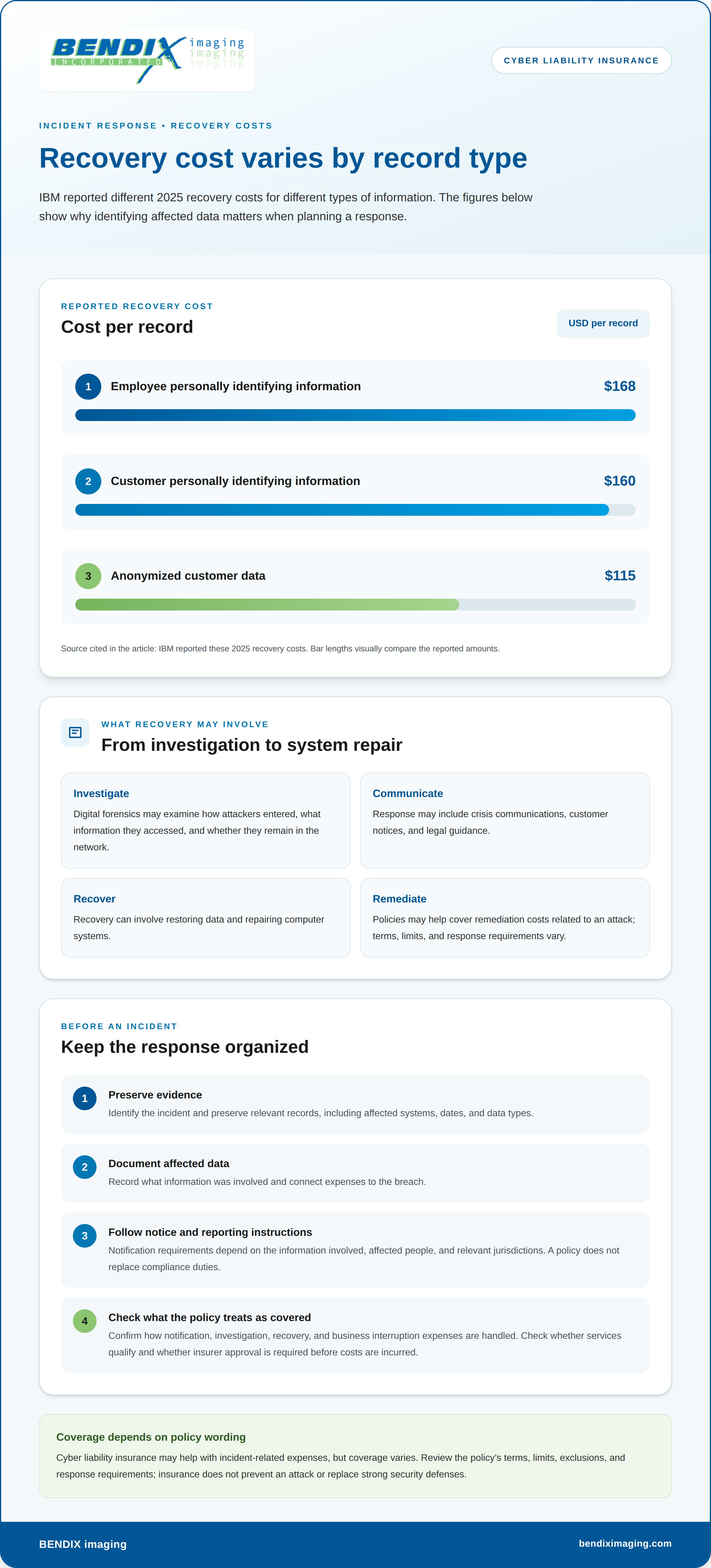
Recovery can include restoring data, repairing computer systems, and addressing the cause of the attack. IBM reported 2025 recovery costs of $168 USD per record for employee personally identifying information, $160 USD per record for customer personally identifying information, and $115 USD per record for anonymized customer data. These figures show why record type matters when estimating response needs.
Before an incident, map the response process: preserve evidence, document affected data, and follow the policy’s reporting instructions. Confirm how the policy treats notification, investigation, recovery, and business interruption expenses. Clear records help connect each expense to the breach and support a more organized claim.
What Is Cyber Liability Insurance?
Cyber Liability Insurance can help protect a business from financial losses tied to electronic activity. Coverage may address direct losses, claims from others, or both. A Cyber Liability Insurance policy is one part of risk management, not a substitute for safeguards that help prevent attacks.
Businesses Exposed to Cyber Risk
Any organization that uses technology to conduct business faces cyber risk, regardless of size or industry. A Sioux Falls retailer processing online orders, for example, may depend on customer and payment information. A professional firm may store sensitive client files. Assess the systems, services, and data your operations rely on, then consider how an incident could affect income or interrupt essential work. Cyber Liability Insurance may be relevant wherever operations depend on electronic systems.
Sensitive Data and Business Insurance Needs
The type and volume of information a business holds can shape its insurance needs. Customer personal information, employee records, and health data can each create different response and liability concerns. A business owners policy may include limited cyber liability coverage for breach notifications, while a separate policy may address broader exposures. Review overlapping policies and exclusions, including costs for technology improvements after an attack. The key is matching coverage to the data and services your business relies on.
Coverage Needs for Small Businesses
There’s no single coverage limit that suits every small business. Consider the sensitivity of stored data, reliance on computer systems, potential lost income, and the costs of investigation and recovery. Policy limits should reflect the losses your business could face, including claims from customers or business partners. Compare covered events, limits, deductibles, and exclusions because coverage varies by policy.
Premiums depend on factors such as revenue and industry. Insurers also assess cybersecurity posture, and stronger defenses can help a business obtain better coverage. To buy a policy, assess your risks, document security practices, compare terms and limits, then complete the insurer’s application or assessment process. For help strengthening defenses, explore cybersecurity support.
Common exclusions
Policy wording draws the line between covered cyber losses and costs left to the business. Common exclusions may involve earlier incidents, unresolved vulnerabilities, and system upgrades.
Cyber liability insurance may exclude prior breaches, insider attacks, and known vulnerabilities that remain unremediated. Policies also commonly exclude future profit losses, decreases in company value, and technology improvements after an attack. Read each exclusion alongside the coverage grant: a policy may cover data recovery while excluding a security upgrade intended to prevent another incident.
Ransomware Payment Coverage
Some policies include cyber extortion coverage, which may address ransom demands and related response costs. That doesn’t mean every ransomware payment is covered. Check the policy’s extortion language, conditions, limits, and approval process before relying on reimbursement. Understand which investigation or negotiation expenses qualify, too, since those costs can differ from the payment itself.
Business Interruption and Regulatory Fines
Business interruption coverage may help with lost income and extra expenses when a cyberattack disrupts operations. Review how the policy defines interruption, which events trigger coverage, and what time periods or limits apply. Cyber and privacy policies may also cover regulatory defense, fines, or penalties. The wording determines which proceedings and expenses qualify.
Check exclusions against realistic scenarios. For example, a business with an unpatched system should understand how a known, unremediated vulnerability affects coverage. A breach caused by an employee’s actions also raises questions about insider-attack exclusions. Record remediation steps and policy notices, then match each potential loss to the relevant coverage section.
Before renewal, review the policy for prior acts, extortion, business interruption, and regulatory expenses. Confirm how the contract treats costs associated with attacks, data breaches, and efforts to notify affected people. Ask how limits, deductibles, and exclusions interact: listed coverage doesn’t automatically mean every related loss qualifies. Clear answers can reveal gaps before cyber threats become financial losses.
Cyber insurance and security defenses
Insurance transfers some financial risk; it doesn’t build a defense against cyber threats. In 2025, ransomware was involved in 88% of small-business data breaches. The median ransom paid by businesses was $115,000. Those figures underline why business insurance belongs beside practical safeguards, not in place of them.
Strengthen defenses before an attacker finds a weak point. Take a practical approach: limit employee access to sensitive files, require multifactor authentication, install timely software updates, and keep offline backups. Each measure addresses a different exposure. Restricted access, for example, can limit which records an employee account can reach, while an offline backup can help restore data if ransomware encrypts online systems.
- Limit access: Give employees only the data their job functions require.
- Verify logins: Use multifactor authentication for an extra identity check.
- Reduce vulnerabilities: Apply software updates in a timely way.
- Protect recovery options: Keep backups offline, beyond ransomware’s reach through online systems.
These controls also matter during underwriting. Insurers assess an organization’s cybersecurity posture, and businesses may need a security audit or documentation from an approved assessment tool. Organizations seeking to strengthen their baseline can review strategic resilience frameworks on missupport.com. Keep records of safeguards and remediation steps. That evidence can help explain how your risk management addresses threats and supports the coverage you’re seeking.
Plan for claims as well as prevention. Map who reports an incident, preserves relevant records, and coordinates recovery. A policy may help with covered expenses, but its limits and conditions still apply. Security upgrades after an attack may be excluded, so don’t treat insurance as a budget for future improvements. A prepared response plan helps employees act quickly and keeps responsibilities clear.
Build a stronger defense with cybersecurity support that addresses your business’s security needs.
BENDIX imaging: Cyber Security
BENDIX imaging helps businesses in Watertown, Brookings, Sioux Falls, Huron, and Montevideo strengthen the security defenses that work alongside cyber insurance. Turn to its Cyber Security and Network Security services to address vulnerabilities, improve protection for business systems, or align safeguards with your risk management priorities.
Managed IT Services can support the ongoing care of your technology environment, while Artificial Intelligence (AI) Consulting can help assess appropriate AI use in your business. These services focus on reducing exposure and building operational readiness; they don’t replace an insurance policy or determine what an insurer will cover.
If your current safeguards leave gaps, start by identifying the systems and information your business relies on most. Then consider how security measures can support those priorities. Contact BENDIX imaging to discuss Cyber Security for your business.
Make your next security decision deliberate
Make your policy part of a working risk plan, not a document filed away after renewal. Choose someone in your organization to coordinate security priorities, track changes to business systems, and keep response responsibilities clear. That gives leadership a practical way to connect a Cyber Liability Insurance policy with the protections the business actually uses.
BENDIX imaging offers Cyber Security, Managed IT Services, and Artificial Intelligence (AI) Consulting to help businesses address technology and security needs. Consider which systems need attention first, where current processes create uncertainty, and how security priorities fit your operations. A focused discussion can clarify next steps without treating insurance as a substitute for prevention.
Build a more prepared business by making security an ongoing management priority. Start a conversation with BENDIX imaging about the right next step for your organization.
Frequently Asked Questions
What’s the Difference Between First-Party Cyber Coverage and Third-Party Coverage?
First-party coverage addresses losses your business experiences directly; third-party coverage responds to claims against it. For example, a breach could require your organization to restore its systems while a business partner also seeks compensation for resulting losses. Review whether each coverage part has separate limits, deductibles, and conditions. This distinction helps clarify which financial exposure each part is intended to address.
What does cyber liability insurance cover?
Cyber Liability Insurance may cover direct incident expenses and claims from others, depending on the policy. A business might have coverage for forensic investigation, data restoration, legal services, crisis communications, or lost income after a covered interruption. Third-party protection may address claims, settlements, litigation, or regulatory inquiries. Compare each example with your operations rather than assuming it will automatically be paid.
How much does cyber liability insurance cost in the United States?
That average isn’t a quote for an individual business. Premiums can vary with industry, revenue, and cybersecurity posture. Compare the policy’s deductible, limits, and covered exposures alongside the premium to understand what the price provides.
What factors affect cyber insurance premiums and coverage limits?
Insurers consider factors such as business revenue, industry, and cybersecurity posture. A company holding sensitive customer records may face different exposures from a business with fewer digital dependencies. Cyber Liability Insurance limits should reflect plausible direct losses and claims from customers or business partners. Insurers may also assess documented safeguards, so an accurate account of your systems and security practices can inform underwriting.
What cybersecurity controls do insurers require for coverage?
There isn’t one universal control list for every policy. Insurers may request a security audit or documentation from an approved assessment tool. Common safeguards include multifactor authentication, timely software updates, limited employee access to sensitive information, offline backups, and staff training on phishing. Describe the controls actually in place during underwriting, since inaccurate application details can complicate coverage discussions after an incident.
How does a cyber insurance claim work after a data breach or ransomware attack?
Start by following the policy’s incident reporting instructions and preserving available evidence. Record which systems were affected, when the incident was discovered, and which expenses arise during response. The insurer can assess those details against the policy’s coverage, exclusions, limits, and approval conditions. Keep investigation, recovery, legal, and notification records organized, and document claim-related communications.
{"@context":"https://schema.org","@type":"FAQPage","mainEntity":[{"@type":"Question","name":"What’s the Difference Between First-Party Cyber Coverage and Third-Party Coverage?","acceptedAnswer":{"@type":"Answer","text":"First-party coverage addresses losses your business experiences directly; third-party coverage responds to claims against it. For example, a breach could require your organization to restore its systems while a business partner also seeks compensation for resulting losses. Review whether each coverage part has separate limits, deductibles, and conditions. This distinction helps clarify which financial exposure each part is intended to address."}},{"@type":"Question","name":"What does cyber liability insurance cover?","acceptedAnswer":{"@type":"Answer","text":"Cyber Liability Insurance may cover direct incident expenses and claims from others, depending on the policy. A business might have coverage for forensic investigation, data restoration, legal services, crisis communications, or lost income after a covered interruption. Third-party protection may address claims, settlements, litigation, or regulatory inquiries. Compare each example with your operations rather than assuming it will automatically be paid."}},{"@type":"Question","name":"How much does cyber liability insurance cost in the United States?","acceptedAnswer":{"@type":"Answer","text":"That average isn’t a quote for an individual business. Premiums can vary with industry, revenue, and cybersecurity posture. Compare the policy’s deductible, limits, and covered exposures alongside the premium to understand what the price provides."}},{"@type":"Question","name":"What factors affect cyber insurance premiums and coverage limits?","acceptedAnswer":{"@type":"Answer","text":"Insurers consider factors such as business revenue, industry, and cybersecurity posture. A company holding sensitive customer records may face different exposures from a business with fewer digital dependencies. Cyber Liability Insurance limits should reflect plausible direct losses and claims from customers or business partners. Insurers may also assess documented safeguards, so an accurate account of your systems and security practices can inform underwriting."}},{"@type":"Question","name":"What cybersecurity controls do insurers require for coverage?","acceptedAnswer":{"@type":"Answer","text":"There isn’t one universal control list for every policy. Insurers may request a security audit or documentation from an approved assessment tool. Common safeguards include multifactor authentication, timely software updates, limited employee access to sensitive information, offline backups, and staff training on phishing. Describe the controls actually in place during underwriting, since inaccurate application details can complicate coverage discussions after an incident."}},{"@type":"Question","name":"How does a cyber insurance claim work after a data breach or ransomware attack?","acceptedAnswer":{"@type":"Answer","text":"Start by following the policy’s incident reporting instructions and preserving available evidence. Record which systems were affected, when the incident was discovered, and which expenses arise during response. The insurer can assess those details against the policy’s coverage, exclusions, limits, and approval conditions. Keep investigation, recovery, legal, and notification records organized, and document claim-related communications."}}]}


