
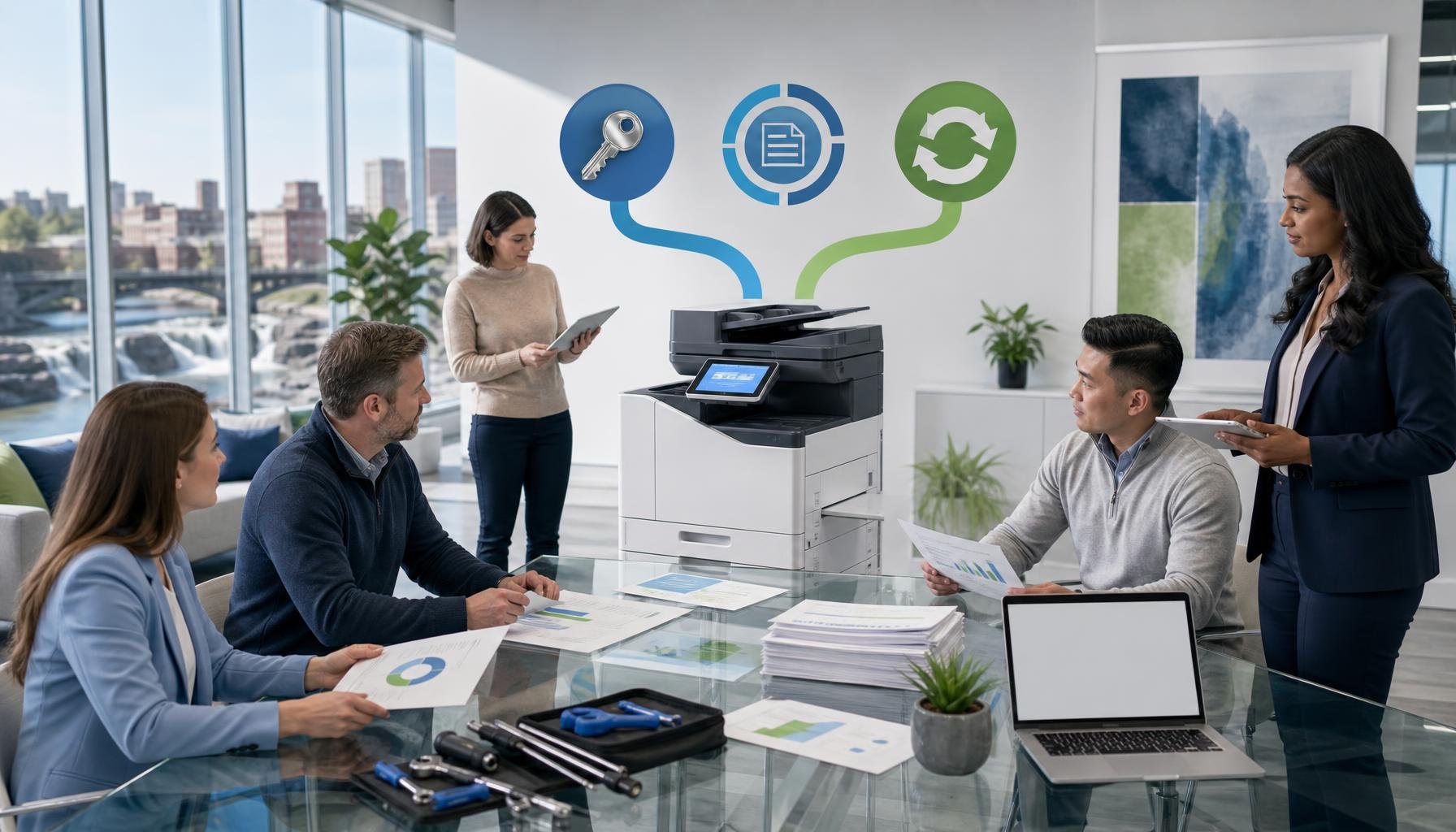
Leasing isn’t the only way to get copier support for your Sioux Falls business. BENDIX imaging copier lease alternatives include buying a copier outright, renting one, or pairing owned or leased equipment with a service agreement or managed print program. The right fit depends on whether you prioritize ownership, flexibility, or ongoing print support.
Predictable monthly payments can make leasing appealing, while ownership offers more control over the equipment. But the contract term, service coverage, and options if your needs change matter just as much as the payment.
This guide compares buying, leasing, and renting, then explains how service agreements and managed print programs can complement owned or leased equipment. Use the trade-offs to weigh which option best fits your print needs and budget priorities.
Key Takeaways
- Compare the full agreement, including service coverage, print-volume limits, renewal terms, and equipment return requirements, before choosing a copier arrangement.
- Buying, leasing, and renting differ in ownership, flexibility, and long-term expense; match the structure to how your business uses print equipment.
- Pairing a copier with a service agreement or managed print program can support ongoing maintenance and more predictable operating costs.
- Account for upkeep and repairs when weighing ownership, and consider how the equipment’s expected lifespan affects the total cost over time.
- Once your print needs are clear, BENDIX imaging’s Artificial Intelligence (AI) Consulting can be a next step for businesses also evaluating how AI fits into their operations.
Copier service agreements and managed print programs
A service agreement can support an owned or leased copier with maintenance, repairs, and supplies. Managed print programs offer a broader way to match equipment and service to changing print needs.
Prices depend on equipment, print volume, color needs, and service coverage. When comparing quotes, check what each agreement includes and whether extra charges apply, such as fees for exceeding a print-volume allowance or adding features.
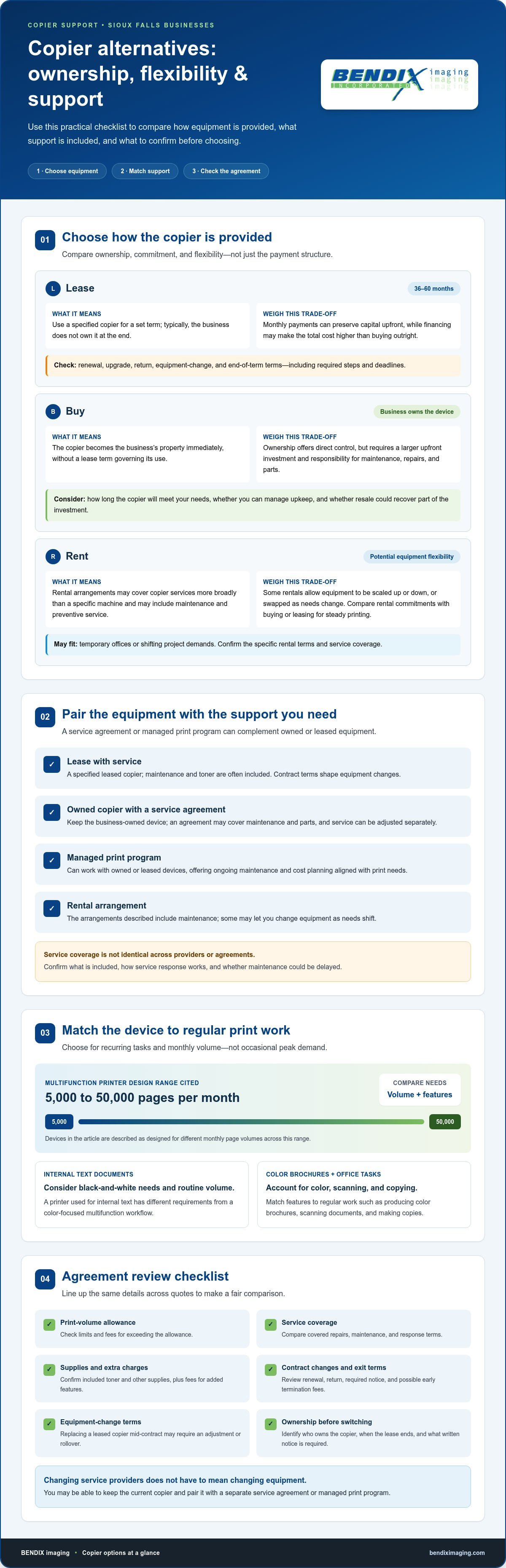
Providers’ models and service response terms vary by agreement. Multifunction printers range from devices designed for 5,000 pages a month to machines designed for 50,000 pages, and included maintenance can still be delayed.
Color versus black-and-white is another practical distinction. A printer for internal text documents has different needs from a multifunction device used to produce color brochures, scan documents, and make copies. Match monthly volume and features to regular tasks, not occasional peak demand.
| Option | Equipment | Service and supplies | Flexibility |
|---|---|---|---|
| Lease with service | Specified leased copier | Often maintenance and toner | Contract terms shape changes |
| Owned copier with agreement | Business-owned device | May cover maintenance and parts | Keep the device; adjust service |
| Managed print program | Owned or leased devices | Ongoing maintenance and cost planning | Can align support with print needs |
| Copier rental | Equipment provided through rental | Rental arrangements described here include maintenance | May allow device changes as needs shift |
Flexible Leases for Multifunction Printers
A lease can place a multifunction printer under a service arrangement while spreading equipment costs across the contract term. Unlike buying a copier and adding a service agreement, leasing ties the agreement to a specified device. A rental may instead charge a monthly fee for copier services as a whole, with terms that can let a business scale its equipment up or down or swap in newer technology as needs change.
Switching Providers and Existing Leases
Before switching providers, identify who owns the copier, when the lease ends, and what written notice is required. Some leases charge an early termination fee, and replacing equipment mid-contract may require an adjustment or rollover. You can also keep your current copier and pair it with a separate service agreement or managed print program. Changing service providers does not have to mean changing equipment.
Maintenance and toner may be included in copier arrangements, while service coverage can vary. For a fair comparison, line up print volume, color requirements, covered repairs, included supplies, and service terms. Choose the arrangement whose equipment and support fit your current output and likely changes.
What's the Difference Between Leasing, Buying, and Renting Copiers?
For a Sioux Falls business, the key differences are ownership, commitment, and flexibility. When comparing A&B Business Solutions copier lease alternatives, consider how each option fits your equipment plans and cash flow.
Each arrangement handles equipment and service differently. Before deciding, consider whether your print needs are likely to stay steady or change enough to call for a different device or contract structure.
Leasing a Copier
A lease gives a business use of a specified printer, copier, or multifunction printer for a set term, typically without ownership at the end. Copier lease agreements commonly run from 36 to 60 months, spreading costs into monthly payments. This can preserve capital upfront, but financing may make the total cost higher than an outright purchase.
Read the end-of-term and equipment-change clauses closely. Replacing a copier during a lease may require an adjustment or rollover. Check whether the agreement allows you to renew, upgrade, or return the device, and note the steps and deadlines for each option.
Buying a Copier
Buying makes the copier your business’s property immediately, without a lease term governing its use. Ownership can suit a business that wants direct control and plans to keep its equipment. The trade-off is a larger upfront investment, with the business responsible for maintenance, repairs, and replacement parts.
An owner may also resell the copier and recover part of the investment. Consider how long the device is likely to meet your needs, whether your business can manage upkeep, and how changes to your workflows could affect its usefulness.
Renting a Copier
Renting may offer flexibility when equipment needs change. Rental agreements may cover copier services more broadly than a specific machine. Rental arrangements may include maintenance and preventive service.
Some rentals let businesses scale equipment up or down or swap in newer technology as needs change. This can suit temporary offices or shifting project demands. For steady, ongoing printing, compare rental commitments with the costs and terms of leasing or buying.
Use a consistent checklist to compare the options:
- Estimate how long the business needs the copier and whether print demands may change.
- Compare the full lease commitment with purchasing and ongoing ownership responsibilities.
- Review service coverage, equipment-change terms, and end-of-agreement choices.
- Consider whether rental flexibility matters more than its potentially higher long-term cost.
Buying may suit a business with available capital and a long-term equipment plan. Leasing may fit when spreading payments matters and the contract term matches expected use. Renting can work when equipment needs are likely to shift. When weighing A&B Business Solutions copier lease alternatives, consider ownership, contract commitment, and flexibility in light of your operating needs.
Buy or Lease a Copier: Which is Better for Your Business?
Buying requires more money upfront, while leasing spreads payments across a contract term. Compare the total commitment with your available budget and how long you expect to use the copier.
These figures offer a comparison point, not a quote for a specific device or agreement.
Upfront Purchase Costs
Purchasing a copier turns available capital into equipment ownership immediately.
Budget for more than the initial purchase. A business that owns its copier is responsible for maintenance, repairs, and replacement parts. These expenses can arise at different times, so account for them in the equipment budget rather than treating the purchase payment as the full cost.
Monthly Lease Payments
Leasing replaces a large upfront equipment outlay with recurring payments.
The lower upfront cost has a trade-off: financing can make the total lease cost higher than buying outright. Before comparing leasing with ownership, review what the payment covers, the print-volume allowance, and potential extra charges. The monthly payment alone does not show the agreement’s full cost.
Lease Terms and Payment Structures
Copier leases commonly run from 36 to 60 months, with terms also available for 24 or 48 months. A shorter term can mean higher monthly payments; 36-month copier leases cost 40% more than 60-month leases, according to the provided market comparison.
Choose a lease term that reflects the equipment’s expected useful life and your growth plans. A growing office may value the cash flow from monthly payments, while a stable business with available capital may prefer ownership. Either way, compare the full payment schedule and end-of-term options before committing.
Use a consistent comparison:
- For purchasing, include the upfront investment, maintenance, repairs, and replacement parts.
- For leasing, total the scheduled monthly payments and account for the lease term.
- Compare equipment needs, such as color printing or finishing, against the copier’s actual features.
- Review how business growth could affect print volume and equipment fit during the agreement.
Buying can cost less over time when the business can fund the upfront investment and manage upkeep. Leasing may suit a budget that prioritizes predictable monthly payments and preserving capital. Compare the total cost of ownership with the full lease commitment, then consider how long the copier is likely to meet your needs.
Capital expenses and operating expenses
A copier decision affects cash flow and how office equipment is recorded. Buying generally creates a capital expense, while leasing is typically treated as an operating expense. The distinction can affect budgeting, accounting, and tax planning, but the agreement’s structure matters. Don’t assume a monthly payment determines its tax classification.
With a purchase, the business pays upfront and owns the copier. The equipment is usually treated as a capital expense and depreciated over time. As a result, the initial cash outlay and accounting treatment occur on different schedules. For example, a business buying a multifunction printer must plan for the purchase as well as later maintenance, repairs, and replacement parts.
Lease payments are typically treated as operating expenses and may be deductible as business expenses in the United States. Fair market value lease payments are deductible as operating expenses. Tax treatment can vary, so distinguish the contract type before making budget assumptions. A capital lease, also called a $1 buyout lease, can allow the business to own the equipment for $1 at the end.
Section 179 of the Internal Revenue Code and bonus depreciation may allow businesses to deduct up to 100% of capital leases in the first year. This is not a universal result for every copier agreement. The lease classification, purchase structure, and business circumstances affect the treatment. Have the agreement and equipment records reviewed as part of tax planning.
Consider cash flow separately from tax treatment. Monthly lease payments spread spending across the agreement, while purchasing requires a larger upfront investment. Neither payment pattern alone establishes which option has the lower total cost or preferred tax treatment. Compare the full agreement and ownership obligations with your accounting goals.
Use these steps to organize the decision:
- Identify whether the agreement is a purchase, fair market value lease, or capital lease.
- Record the upfront payment or monthly schedule and any stated end-of-term ownership option.
- Account for maintenance, repairs, and replacement parts when estimating ownership expenses.
- Discuss the agreement’s tax treatment with the professional who handles your business records.
A business prioritizing cash flow, for example, may prefer spreading equipment payments, while one with available capital may choose to buy and record the copier as an asset. A document outlining payment terms, ownership, and service coverage gives your accounting team a clearer basis for classification. Keep the agreement with your equipment records and use the same details for budgeting and tax planning. This helps you compare options without confusing cash expense with tax treatment.
Differences between copier leases, purchases, and rentals
The key difference is what your business pays for: owning a device, using it for a set term, or accessing copier services through a rental. In Sioux Falls, compare the total commitment, control over equipment, and how easily the arrangement can change as print needs shift.
Buying outright transfers ownership to the business immediately. It avoids lease financing and may cost less over time, but the owner handles maintenance, repairs, and replacement parts. A purchased copier can also be resold, potentially recovering part of the investment. Include these responsibilities in your comparison, not just the purchase amount.
A lease provides use of a specified copier for a contract term, typically without ownership at the end. Copier lease terms commonly range from 36 to 60 months. Monthly payments can spread out equipment spending, but financing may make the full lease cost higher than purchasing outright. The contract also controls how the business can replace or return the device.
A rental may cover copier services more broadly than an agreement tied to one specific machine. Rental arrangements may include maintenance and preventive service. They can let businesses scale equipment up or down or swap in newer technology as print demands change. That flexibility may suit a temporary office or shifting workload, though rentals generally cost more over time than leasing.
Use this comparison to identify the trade-offs:
- Buy: Own the device immediately, with greater control and responsibility for upkeep.
- Lease: Use specified equipment during the contract, with financing spread across monthly payments.
- Rent: Pay for copier services as a whole, with options to adjust equipment as needs change.
- Service agreement: Pair a separately owned or leased copier with ongoing service support.
End-of-term details can change the calculation. When a lease matures, the business may be able to renew, upgrade the equipment, or return it. Returning a copier may involve shipping costs, while renewal may require written notice well before the scheduled end. Replacing equipment before maturity may also require a contract adjustment or rollover.
A stable office expecting consistent use, for example, may value outright ownership, while a business anticipating near-term changes may prioritize rental flexibility. Leasing can fit when spreading equipment payments matters, but review the term and exit conditions carefully. Compare the full agreement, including service coverage, volume limits, and equipment-return responsibilities.
Decision guide: Buy if ownership and control matter most. Lease if predictable payments fit your budget and the term suits your plans. Rent if equipment flexibility is the priority. To plan print support alongside your equipment choice, discuss your copier needs.
BENDIX imaging: Artificial Intelligence (AI) Consulting
BENDIX imaging helps businesses assess technology needs through Artificial Intelligence (AI) consulting. If your copier decision is part of a broader effort to streamline office workflows, AI consulting can help you consider where AI may fit. For print equipment and ongoing service planning, Managed Print connects copier needs with a broader approach to print operations.
Turn to BENDIX imaging when evaluating technology choices alongside business workflows, or when considering cybersecurity, network security, or managed IT services as part of your technology planning. Start with your current processes, document demands, and priorities, then focus on practical next steps.
Contact BENDIX imaging to discuss your business technology needs.
Make Your Next Copier Decision Part of a Bigger Plan
Comparing A&B Business Solutions copier lease alternatives can also prompt a broader look at how printing fits into your technology plans. Consider more than the device: identify workflows that could benefit from change, the information your teams handle, and the support your operations depend on. That wider view can help you choose equipment that works alongside your future business priorities.
BENDIX imaging offers Artificial Intelligence (AI) Consulting, Cyber Security, and Managed IT Services to support businesses considering those connected needs. Bring your copier and workflow questions into the conversation, and explore practical next steps for your organization. Contact BENDIX imaging to discuss your business technology needs and move forward with a clearer plan.
Frequently Asked Questions
Is leasing always a good idea?
No. Leasing may be a poor fit if your Sioux Falls business expects steady equipment needs and wants to keep one copier long-term. It can also restrict changes if print demand shifts during the agreement. Before choosing, map expected document workflows, identify who controls equipment changes, and consider whether your budget favors recurring commitments or ownership. The right option depends on how those priorities align.
What Happens at the End of the Lease Term?
At lease end, businesses commonly renew, upgrade the copier, or return it, but the agreement sets the process. Renewal notice may be due between 180 and 90 days before the scheduled end. Written notice to terminate and return the machine is generally due 30 to 90 days before maturity. Put those dates on a calendar early so renewal terms don’t take you by surprise.
What about service and support?
Service coverage depends on the agreement, so identify who handles a breakdown and which costs are included. One agreement, for example, may cover technician travel, while another lists that expense separately. Also note how to submit a service request and which maintenance is excluded. If the copier supports essential work, such as preparing customer documents, understand how service issues are handled before signing.
What are the advantages and disadvantages of leasing, buying, or renting a copier?
Each option suits a different business situation. Leasing can help a new office preserve cash for other priorities, while buying may suit a team that wants control over its equipment. Renting can work for a temporary workspace or a project with changing print needs. Compare who manages upkeep, how easily the equipment can change, and whether the arrangement will still fit if your workflows shift.
What fees, renewal terms, and early termination penalties should copier lessees check?
Review early termination charges, excess-volume or feature fees, insurance requirements, and equipment-return shipping terms. A lessee who misses a stated insurance requirement may face a surcharge of 6-8% of the monthly lease payment. Also record renewal and return-notice deadlines, since missing them can affect the contract’s end.
How do copier lease prices and service plans compare among local providers?
Local prices depend on the equipment, print volume, color needs, and service coverage; a provider quote sets the price. Compare included maintenance, toner and other supplies, covered repairs, response terms, and possible extra charges.
{"@context":"https://schema.org","@type":"FAQPage","mainEntity":[{"@type":"Question","name":"Is leasing always a good idea?","acceptedAnswer":{"@type":"Answer","text":"No. Leasing may be a poor fit if your Sioux Falls business expects steady equipment needs and wants to keep one copier long-term. It can also restrict changes if print demand shifts during the agreement. Before choosing, map expected document workflows, identify who controls equipment changes, and consider whether your budget favors recurring commitments or ownership. The right option depends on how those priorities align."}},{"@type":"Question","name":"What Happens at the End of the Lease Term?","acceptedAnswer":{"@type":"Answer","text":"At lease end, businesses commonly renew, upgrade the copier, or return it, but the agreement sets the process. Renewal notice may be due between 180 and 90 days before the scheduled end. Written notice to terminate and return the machine is generally due 30 to 90 days before maturity. Put those dates on a calendar early so renewal terms don’t take you by surprise."}},{"@type":"Question","name":"What about service and support?","acceptedAnswer":{"@type":"Answer","text":"Service coverage depends on the agreement, so identify who handles a breakdown and which costs are included. One agreement, for example, may cover technician travel, while another lists that expense separately. Also note how to submit a service request and which maintenance is excluded. If the copier supports essential work, such as preparing customer documents, understand how service issues are handled before signing."}},{"@type":"Question","name":"What are the advantages and disadvantages of leasing, buying, or renting a copier?","acceptedAnswer":{"@type":"Answer","text":"Each option suits a different business situation. Leasing can help a new office preserve cash for other priorities, while buying may suit a team that wants control over its equipment. Renting can work for a temporary workspace or a project with changing print needs. Compare who manages upkeep, how easily the equipment can change, and whether the arrangement will still fit if your workflows shift."}},{"@type":"Question","name":"What fees, renewal terms, and early termination penalties should copier lessees check?","acceptedAnswer":{"@type":"Answer","text":"Review early termination charges, excess-volume or feature fees, insurance requirements, and equipment-return shipping terms. A lessee who misses a stated insurance requirement may face a surcharge of 6-8% of the monthly lease payment. Also record renewal and return-notice deadlines, since missing them can affect the contract’s end."}},{"@type":"Question","name":"How do copier lease prices and service plans compare among local providers?","acceptedAnswer":{"@type":"Answer","text":"Local prices depend on the equipment, print volume, color needs, and service coverage; a provider quote sets the price. Compare included maintenance, toner and other supplies, covered repairs, response terms, and possible extra charges."}}]}


