

What if your cybersecurity decisions had a clear owner at the executive level, without adding a full-time security leader to your payroll? For South Dakota businesses, vCSO services connect security activity to business risks, priorities, and compliance responsibilities. The result is clearer direction, not just another list of technical tasks.
Security and compliance can be difficult to coordinate when responsibility is spread across leadership and IT teams. A virtual Chief Security Officer provides strategic guidance, while managed IT and cybersecurity services support related operational needs. The roles complement each other, but they are not the same. This article explains what vCSO services South Dakota businesses can use, where a vCSO’s responsibilities begin and end, and which situations may call for strategic security leadership. You’ll also learn how to prepare for an engagement so discussions about risk, compliance, and priorities lead to useful decisions. Whether your business operates in Sioux Falls, Brookings, Watertown, Huron, Montevideo, or elsewhere in Eastern South Dakota, start by identifying who owns security decisions and what leadership support could clarify.
Key Takeaways
- See how vCSO leadership connects security priorities with business risk, ownership, and governance.
- Understand where strategic security leadership ends and managed IT’s operational role begins.
- Use four practical preparation steps to make a vCSO engagement more focused, even if your security program isn’t perfect.
- Explore how vCSO services South Dakota businesses can use fit alongside cybersecurity and compliance support.
What Are vCSO Services in South Dakota, and What Do They Do?
A virtual Chief Security Officer provides outsourced strategic security leadership. Instead of hiring a full-time executive, an organization brings in security leadership to connect protection decisions with business priorities, risk ownership, and governance. The aim is to help leaders understand which risks need attention, who is responsible, and how security decisions support the organization’s plans.
That is different from buying a security tool or relying on a general help desk. Software can monitor systems or help enforce controls, and IT support can maintain technology and address operational issues. A vCSO helps leadership set security priorities and make informed decisions. The role may coordinate with internal teams and existing technology partners, but it does not automatically replace them or eliminate every risk.
Responsibilities depend on the organization’s needs, industry obligations, and agreed scope. One engagement may focus on governance and executive communication; another may emphasize risk prioritization or security planning. Define the boundaries so business leaders understand what strategic guidance covers and which operational tasks remain with IT or other teams.
What does the vCSO abbreviation mean?
vCSO means “virtual Chief Security Officer.” It describes a security leadership function delivered on an outsourced basis, rather than one standardized job description. Some organizations use vCISO, meaning “virtual Chief Information Security Officer,” for a similar role. For background on the executive function, see this overview of the Chief Information Security Officer (CISO). Titles vary, so define responsibilities through the engagement rather than inferring them from the acronym.
Why might a South Dakota business consider virtual security leadership?
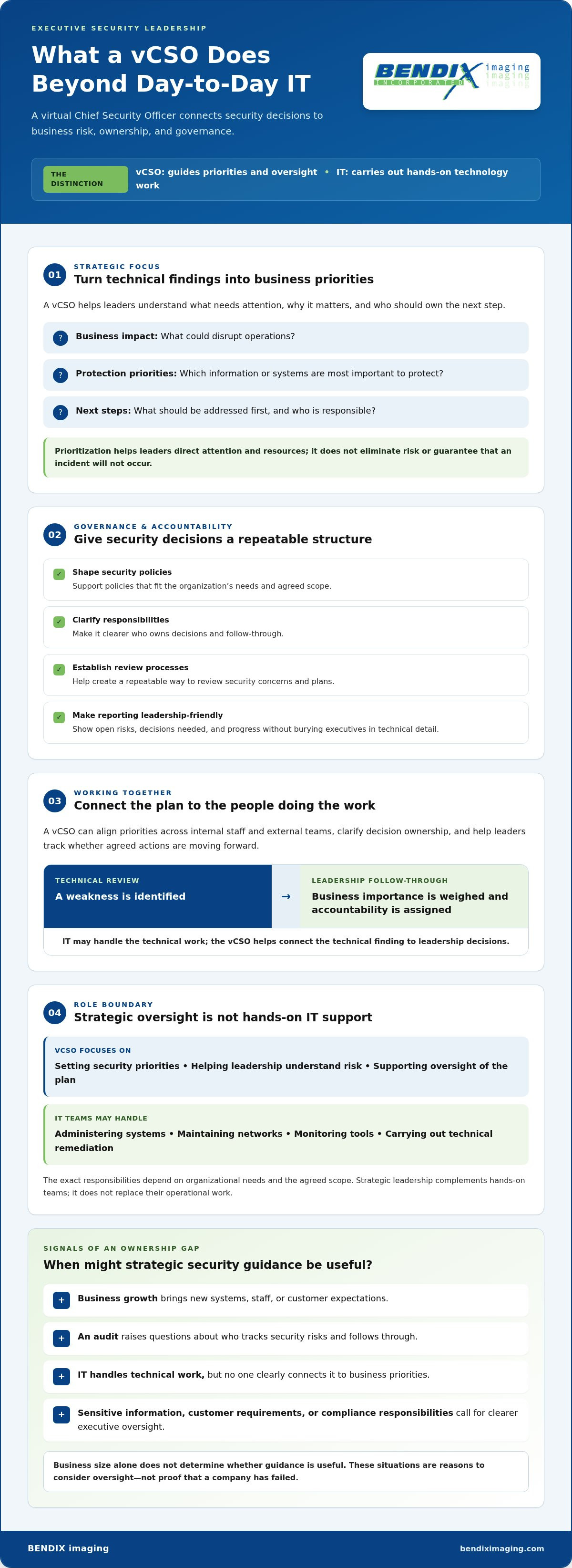
A business change can reveal a gap in security ownership. Growth may bring new systems, staff, or customer expectations. An audit may raise questions about who tracks security risks and follows through. Leaders may also find that IT handles technical work, but no one clearly connects those tasks to business priorities. These are practical reasons to consider strategic oversight, not proof that a company has failed.
Organizations in Watertown, Brookings, Sioux Falls, Huron, Montevideo, and nearby communities can face these coordination challenges in different ways. Business size alone does not determine whether guidance is useful. A smaller organization with sensitive information, demanding customer requirements, or complex compliance responsibilities may need clearer executive oversight. A larger business may already have established security leadership.
As you assess whether vCSO services South Dakota businesses use could help, consider whether leaders can confidently answer:
- Which security risks matter most to the business?
- Who owns decisions and follow-through?
- How do security priorities connect to business and compliance needs?
If those answers are unclear, the issue may not be a shortage of tools. It may be a need for leadership that brings risk, accountability, and business objectives into the same conversation.
What Does a vCSO Do Beyond Day-to-Day IT Support?
A vCSO’s value is not measured by the number of technical tasks completed. The role brings structure to security decisions so leaders can see what needs attention, why it matters to the business, and who should own the next step. That oversight helps keep security work from becoming a disconnected set of alerts, tools, and urgent requests.
How does a vCSO guide security strategy and risk decisions?
Technical findings do not always make business priorities obvious. A vCSO can help translate them into questions executives can act on: What could disrupt operations? Which information or systems are most important to protect? What should be addressed first, and who is responsible for moving it forward? Prioritization helps leaders direct attention and resources, but it does not eliminate risk or guarantee that an incident will not occur.
Governance gives those decisions a repeatable structure. Depending on the organization’s needs and agreed scope, a vCSO may help shape security policies, clarify responsibilities, and establish review processes. Leadership-friendly reporting should make open risks, decisions needed, and progress easy to understand without burying executives in technical detail. The goal is informed oversight, not a promise that every concern can be fixed at once.
Strategic direction works best alongside practical safeguards. Businesses looking to connect leadership decisions with day-to-day protection can use this Cybersecurity Eastern South Dakota protection guide for broader security practices.
How does strategic oversight work alongside IT and security teams?
IT teams keep technology operating. Depending on their responsibilities, they may administer systems, maintain networks, monitor tools, or carry out technical remediation. A vCSO works at a different level by setting security priorities, helping leadership understand risk, and supporting oversight of the plan. Strategic leadership does not replace hands-on IT work.
This distinction matters when several people or service providers are involved. A vCSO can help align security priorities across internal staff and external teams, clarify who owns decisions, and help leaders track whether agreed actions are moving forward. For example, if a technical review identifies a weakness, IT may handle the technical work while leadership weighs its business importance and assigns accountability. The vCSO helps connect those steps rather than taking on every technical task.
For a closer look at operational technology support, explore the managed IT support South Dakota guide. Operational support and security oversight together clarify how technology is maintained and how security decisions are governed. For organizations considering vCSO services South Dakota, define who sets direction, who performs the work, and how leaders stay informed.
VCSO vs. CISO vs. Managed IT: Which Role Owns What?
Security leadership and technology support address different needs. A business may have reliable IT operations and still lack a clear executive process for deciding which security risks matter most, who owns them, and how leadership reviews progress. IT support does not automatically establish executive security governance.
| Role | Leadership ownership | Organizational placement | Typical focus |
|---|---|---|---|
| Internal CISO | Provides security leadership within the organization, with authority shaped by its structure. | An internal executive or senior leader. | Security strategy, governance, risk, and coordination with business leaders. |
| vCSO | Provides virtual or outsourced strategic security leadership; authority depends on the agreed scope. | External to the organization, working with its leadership and teams. | Security direction, risk priorities, governance, and executive communication. |
| Managed IT | Supports technology operations under an agreed service scope. | An internal IT team or an external service provider. | Technology administration, support, maintenance, and related operational work. |
These roles can work together. Strategic security leadership can set direction while IT teams carry out operational work. The distinction helps executives see who guides security decisions and who manages the technology involved.
How is a vCSO different from a full-time CISO?
A CISO is an internal executive role integrated into the organization. A vCSO provides virtual or outsourced leadership rather than joining as a full-time internal executive. That changes how the role is positioned and resourced, but it does not dictate its authority. The organization defines responsibilities, decision rights, and reporting relationships. Clarify those boundaries so leaders know which decisions the vCSO guides and which remain with internal executives.
How is a vCSO different from a managed service provider?
Managed IT is primarily operational, covering technology maintenance and support. A vCSO focuses on strategic security leadership. The responsibilities should be explicit: a provider may perform technical work, while a vCSO helps leadership determine how that work fits into broader security priorities.
Coordination connects planning to follow-through. Leadership may prioritize a risk, IT may carry out agreed remediation, and the organization can track ownership and progress. Policies establish expectations, while review processes help leaders see whether actions are advancing. Without clear roles, security tasks can stall between decision-makers and those responsible for implementation.
For businesses considering vCSO services South Dakota, the key question is not simply whether IT is in place. Ask whether executive security decisions have clear ownership and whether technical priorities connect to business risk. BENDIX imaging’s vCSO expertise supports strategic leadership alongside managed IT and cybersecurity, with each function serving a distinct purpose.
How Can a South Dakota Business Prepare for vCSO Services?
You do not need a polished security program before bringing in strategic leadership. Provide enough context to make conversations about business priorities, current safeguards, and unclear ownership useful. Start with what you know, then fill gaps as priorities emerge.
Use this four-step sequence to prepare for vCSO services South Dakota businesses may use:
- Identify business priorities. Note the services, customer commitments, and processes that must keep running. Consider which disruptions would have the greatest effect on customers or operations.
- Gather current security information. Assemble existing policies, assessments, security plans, and compliance-related materials, along with a general overview of key systems and vendors. Do not include passwords, access keys, or other sensitive credentials in preparation notes.
- Clarify ownership. Record who currently makes security decisions, who handles IT operations, and who follows up on identified concerns. Flag unassigned or unclear responsibilities rather than guessing.
- Set desired outcomes. Decide what leaders want to understand or manage better, such as clearer accountability, prioritized risks, documented decisions, or improved visibility into progress.
What information helps establish security priorities?
A useful starting point is a high-level inventory, not a technical dossier. List important systems, categories of sensitive information, key vendors, and business-critical processes. Add known incidents, recurring security concerns, customer security requirements, and upcoming audits or reviews. Keep notes general enough to avoid exposing confidential operational details. This context connects security questions to the organization’s actual dependencies and obligations.
Governance materials can also show how decisions are made and recorded. For a broader view of how compliance connects with risk management, consult this regulatory compliance practical guide. Bring relevant documentation together where appropriate, but do not delay because a record is incomplete or a process needs work. Identifying gaps is part of understanding the starting point.
How should leaders define useful vCSO outcomes?
Make goals specific enough to review. Instead of expecting “better security,” define what would give leadership a clearer view, such as assigning owners to priority risks, documenting key security decisions, or tracking agreed actions. These objectives support accountability without promising that breaches, disruptions, or compliance issues can never occur.
Frameworks can help structure the discussion when they fit the organization’s needs. The NIST Cybersecurity Framework, for example, may provide a shared reference for organizing security conversations. It is not an automatic requirement or a substitute for considering the organization’s circumstances and obligations.
To turn business priorities and existing security information into a practical leadership discussion, explore BENDIX imaging vCSO expertise for support connecting security oversight with business and compliance needs.
How BENDIX imaging Connects vCSO Expertise to South Dakota Business Needs
Security decisions should connect to the realities of running a business. BENDIX imaging provides vCSO expertise alongside managed IT, cybersecurity, network security, and regulatory compliance support. These services address related needs, but they are not interchangeable: vCSO leadership brings a strategic view to security priorities, while technology and cybersecurity support address operational and protective needs.
This distinction helps leaders connect security concerns with business priorities. An organization may need to weigh which systems are essential to operations, which security responsibilities need clearer ownership, and how compliance considerations fit into its plans. Strategic oversight frames those decisions in business terms. The appropriate focus depends on the organization’s circumstances and agreed scope, rather than a one-size-fits-all package.
What makes a local, business-focused security approach useful?
A useful security conversation starts with how the organization operates. Which processes depend on technology? Where could a disruption affect customers or staff? Which concerns need leadership attention? Practical discussion helps executives connect security decisions to business priorities instead of treating them as isolated technical issues.
BENDIX imaging serves businesses across Eastern South Dakota, including Watertown, Brookings, Sioux Falls, and Huron, as well as Montevideo. A local business context helps ground conversations in the concerns organizations bring forward, without assuming every company faces the same risks or obligations. Whether leadership is coordinating compliance responsibilities or aligning security priorities with IT operations, the aim is to make the relationship between business needs and technology decisions easier to understand.
What is a sensible next step for business leaders?
Start with the business, not a list of tools. Identify the operations and customer commitments that matter most, then discuss known security concerns, compliance responsibilities, and who owns key decisions. This gives leaders a practical basis for deciding what deserves attention first.
Next, consider how strategic oversight works alongside existing managed IT and cybersecurity support. Managed IT addresses technology operations, cybersecurity supports protection, and vCSO expertise brings security decisions into a broader leadership context. BENDIX imaging’s services connect these needs while allowing the scope to reflect each organization’s priorities.
Explore BENDIX imaging’s business technology and security services to see how vCSO expertise, managed IT, cybersecurity, and compliance support can fit into your organization’s priorities. Start with a straightforward conversation about what your business needs to protect and where leadership wants greater visibility.
Make Security Leadership Part of the Next Business Decision
Do not wait for a difficult audit or urgent security concern to expose who owns the next decision. Use an upcoming business change, such as a new system or customer commitment, to ask what risks it introduces, who should evaluate them, and how leadership will track follow-through. This habit can make security a deliberate part of planning rather than a disconnected technical concern.
For leaders considering vCSO services South Dakota, connect those questions to the business priorities that matter most. BENDIX imaging provides vCSO expertise and regulatory compliance support alongside related technology and security services, helping businesses consider strategic oversight in practical context.
Explore BENDIX imaging’s business technology and security services and take the next step toward clearer, more accountable security decisions. Start with a conversation about what your business needs to protect and where leadership wants greater clarity.
Frequently Asked Questions
Is a vCSO the same as a vCISO?
They often describe similar virtual security leadership, but the titles are not universally standardized. “vCSO” refers to a virtual Chief Security Officer, while “vCISO” refers to a virtual Chief Information Security Officer. Duties can vary by organization and engagement. Clarify the role’s decision-making authority, responsibilities, and reporting relationships so everyone understands how it fits with existing leadership.
Can a small business benefit from vCSO services?
Yes. Business size alone does not determine whether strategic security guidance is useful. A smaller company may handle sensitive customer information, depend on a few critical systems, or face customer security reviews without a dedicated security executive. These conditions can make risk ownership and priorities harder to manage. For businesses in Watertown, Brookings, Sioux Falls, Huron, or Montevideo, the key question is whether leaders have the clarity they need to make security decisions.
Does a vCSO replace a managed IT provider?
No. A vCSO does not automatically take over operational work handled by managed IT, such as maintaining systems or supporting users. The roles complement each other: strategic security guidance helps leadership set priorities, while IT teams handle technical responsibilities within their scope. Agree on how security concerns will be communicated, who approves decisions, and how assigned technical work will be tracked.
How does a vCSO support regulatory compliance?
A vCSO can help leaders connect compliance responsibilities with security oversight by clarifying relevant priorities, ownership, and review processes. For example, if an organization must respond to a customer questionnaire, leadership can identify who gathers the supporting information and who reviews the response. Requirements depend on the organization and its applicable obligations. A vCSO can support coordination, but is not a substitute for legal advice or the organization’s own accountability.
Does vCSO support guarantee that a business will not be breached?
No. No security leadership role can guarantee that a breach will not happen. A vCSO can help an organization make informed decisions, assign responsibility, and focus effort on identified risks, but threats and vulnerabilities can change. Treat security as an ongoing business responsibility, not a promise of perfect protection. Ask how risks, unresolved issues, and decisions requiring executive attention will be made visible.
What should a business discuss before starting vCSO services?
Discuss the business outcomes you want, such as a clearer view of risk, defined decision owners, or better visibility into security priorities. Share a high-level picture of critical systems, important vendors, customer expectations, and upcoming reviews. Clarify the vCSO’s scope, authority, and relationship to existing IT and compliance responsibilities. Do not send passwords or access keys in planning notes. Clear context helps shape a focused engagement without requiring a perfect program first.
{"@context":"https://schema.org","@type":"FAQPage","mainEntity":[{"@type":"Question","name":"What does the vCSO abbreviation mean?","acceptedAnswer":{"@type":"Answer","text":"vCSO means “virtual Chief Security Officer.” It describes a security leadership function delivered on an outsourced basis, rather than one standardized job description. Some organizations use vCISO, meaning “virtual Chief Information Security Officer,” for a similar role. For background on the executive function, see this overview of the Chief Information Security Officer (CISO). Titles vary, so define responsibilities through the engagement rather than inferring them from the acronym."}},{"@type":"Question","name":"Why might a South Dakota business consider virtual security leadership?","acceptedAnswer":{"@type":"Answer","text":"A business change can reveal a gap in security ownership. Growth may bring new systems, staff, or customer expectations. An audit may raise questions about who tracks security risks and follows through. Leaders may also find that IT handles technical work, but no one clearly connects those tasks to business priorities. These are practical reasons to consider strategic oversight, not proof that a company has failed. Organizations in Watertown, Brookings, Sioux Falls, Huron, Montevideo, and nearby communities can face these coordination challenges in different ways. Business size alone does not determine whether guidance is useful. A smaller organization with sensitive information, demanding customer requirements, or complex compliance responsibilities may need clearer executive oversight. A larger business may already have established security leadership. As you assess whether vCSO services South Dakota businesses use could help, consider whether leaders can confidently answer: If those answers are unclear, the issue may not be a shortage of tools. It may be a need for leadership that brings risk, accountability, and business objectives into the same conversation. A vCSO’s value is not measured by the number of technical tasks completed. The role brings structure to security decisions so leaders can see what needs attention, why it matters to the business, and who should own the next step. That oversight helps keep security work from becoming a disconnected set of alerts, tools, and urgent requests."}},{"@type":"Question","name":"How does a vCSO guide security strategy and risk decisions?","acceptedAnswer":{"@type":"Answer","text":"Technical findings do not always make business priorities obvious. A vCSO can help translate them into questions executives can act on: What could disrupt operations? Which information or systems are most important to protect? What should be addressed first, and who is responsible for moving it forward? Prioritization helps leaders direct attention and resources, but it does not eliminate risk or guarantee that an incident will not occur. Governance gives those decisions a repeatable structure. Depending on the organization’s needs and agreed scope, a vCSO may help shape security policies, clarify responsibilities, and establish review processes. Leadership-friendly reporting should make open risks, decisions needed, and progress easy to understand without burying executives in technical detail. The goal is informed oversight, not a promise that every concern can be fixed at once. Strategic direction works best alongside practical safeguards. Businesses looking to connect leadership decisions with day-to-day protection can use this Cybersecurity Eastern South Dakota protection guide for broader security practices."}},{"@type":"Question","name":"How does strategic oversight work alongside IT and security teams?","acceptedAnswer":{"@type":"Answer","text":"IT teams keep technology operating. Depending on their responsibilities, they may administer systems, maintain networks, monitor tools, or carry out technical remediation. A vCSO works at a different level by setting security priorities, helping leadership understand risk, and supporting oversight of the plan. Strategic leadership does not replace hands-on IT work. This distinction matters when several people or service providers are involved. A vCSO can help align security priorities across internal staff and external teams, clarify who owns decisions, and help leaders track whether agreed actions are moving forward. For example, if a technical review identifies a weakness, IT may handle the technical work while leadership weighs its business importance and assigns accountability. The vCSO helps connect those steps rather than taking on every technical task. For a closer look at operational technology support, explore the managed IT support South Dakota guide. Operational support and security oversight together clarify how technology is maintained and how security decisions are governed. For organizations considering vCSO services South Dakota, define who sets direction, who performs the work, and how leaders stay informed. Security leadership and technology support address different needs. A business may have reliable IT operations and still lack a clear executive process for deciding which security risks matter most, who owns them, and how leadership reviews progress. IT support does not automatically establish executive security governance. These roles can work together. Strategic security leadership can set direction while IT teams carry out operational work. The distinction helps executives see who guides security decisions and who manages the technology involved."}},{"@type":"Question","name":"How is a vCSO different from a full-time CISO?","acceptedAnswer":{"@type":"Answer","text":"A CISO is an internal executive role integrated into the organization. A vCSO provides virtual or outsourced leadership rather than joining as a full-time internal executive. That changes how the role is positioned and resourced, but it does not dictate its authority. The organization defines responsibilities, decision rights, and reporting relationships. Clarify those boundaries so leaders know which decisions the vCSO guides and which remain with internal executives."}},{"@type":"Question","name":"How is a vCSO different from a managed service provider?","acceptedAnswer":{"@type":"Answer","text":"Managed IT is primarily operational, covering technology maintenance and support. A vCSO focuses on strategic security leadership. The responsibilities should be explicit: a provider may perform technical work, while a vCSO helps leadership determine how that work fits into broader security priorities. Coordination connects planning to follow-through. Leadership may prioritize a risk, IT may carry out agreed remediation, and the organization can track ownership and progress. Policies establish expectations, while review processes help leaders see whether actions are advancing. Without clear roles, security tasks can stall between decision-makers and those responsible for implementation. For businesses considering vCSO services South Dakota, the key question is not simply whether IT is in place. Ask whether executive security decisions have clear ownership and whether technical priorities connect to business risk. BENDIX imaging’s vCSO expertise supports strategic leadership alongside managed IT and cybersecurity, with each function serving a distinct purpose. You do not need a polished security program before bringing in strategic leadership. Provide enough context to make conversations about business priorities, current safeguards, and unclear ownership useful. Start with what you know, then fill gaps as priorities emerge. Use this four-step sequence to prepare for vCSO services South Dakota businesses may use:"}},{"@type":"Question","name":"What information helps establish security priorities?","acceptedAnswer":{"@type":"Answer","text":"A useful starting point is a high-level inventory, not a technical dossier. List important systems, categories of sensitive information, key vendors, and business-critical processes. Add known incidents, recurring security concerns, customer security requirements, and upcoming audits or reviews. Keep notes general enough to avoid exposing confidential operational details. This context connects security questions to the organization’s actual dependencies and obligations. Governance materials can also show how decisions are made and recorded. For a broader view of how compliance connects with risk management, consult this regulatory compliance practical guide. Bring relevant documentation together where appropriate, but do not delay because a record is incomplete or a process needs work. Identifying gaps is part of understanding the starting point."}},{"@type":"Question","name":"How should leaders define useful vCSO outcomes?","acceptedAnswer":{"@type":"Answer","text":"Make goals specific enough to review. Instead of expecting “better security,” define what would give leadership a clearer view, such as assigning owners to priority risks, documenting key security decisions, or tracking agreed actions. These objectives support accountability without promising that breaches, disruptions, or compliance issues can never occur. Frameworks can help structure the discussion when they fit the organization’s needs. The NIST Cybersecurity Framework, for example, may provide a shared reference for organizing security conversations. It is not an automatic requirement or a substitute for considering the organization’s circumstances and obligations. To turn business priorities and existing security information into a practical leadership discussion, explore BENDIX imaging vCSO expertise for support connecting security oversight with business and compliance needs. Security decisions should connect to the realities of running a business. BENDIX imaging provides vCSO expertise alongside managed IT, cybersecurity, network security, and regulatory compliance support. These services address related needs, but they are not interchangeable: vCSO leadership brings a strategic view to security priorities, while technology and cybersecurity support address operational and protective needs. This distinction helps leaders connect security concerns with business priorities. An organization may need to weigh which systems are essential to operations, which security responsibilities need clearer ownership, and how compliance considerations fit into its plans. Strategic oversight frames those decisions in business terms. The appropriate focus depends on the organization’s circumstances and agreed scope, rather than a one-size-fits-all package."}},{"@type":"Question","name":"What makes a local, business-focused security approach useful?","acceptedAnswer":{"@type":"Answer","text":"A useful security conversation starts with how the organization operates. Which processes depend on technology? Where could a disruption affect customers or staff? Which concerns need leadership attention? Practical discussion helps executives connect security decisions to business priorities instead of treating them as isolated technical issues. BENDIX imaging serves businesses across Eastern South Dakota, including Watertown, Brookings, Sioux Falls, and Huron, as well as Montevideo. A local business context helps ground conversations in the concerns organizations bring forward, without assuming every company faces the same risks or obligations. Whether leadership is coordinating compliance responsibilities or aligning security priorities with IT operations, the aim is to make the relationship between business needs and technology decisions easier to understand."}},{"@type":"Question","name":"What is a sensible next step for business leaders?","acceptedAnswer":{"@type":"Answer","text":"Start with the business, not a list of tools. Identify the operations and customer commitments that matter most, then discuss known security concerns, compliance responsibilities, and who owns key decisions. This gives leaders a practical basis for deciding what deserves attention first. Next, consider how strategic oversight works alongside existing managed IT and cybersecurity support. Managed IT addresses technology operations, cybersecurity supports protection, and vCSO expertise brings security decisions into a broader leadership context. BENDIX imaging’s services connect these needs while allowing the scope to reflect each organization’s priorities. Explore BENDIX imaging’s business technology and security services to see how vCSO expertise, managed IT, cybersecurity, and compliance support can fit into your organization’s priorities. Start with a straightforward conversation about what your business needs to protect and where leadership wants greater visibility. Do not wait for a difficult audit or urgent security concern to expose who owns the next decision. Use an upcoming business change, such as a new system or customer commitment, to ask what risks it introduces, who should evaluate them, and how leadership will track follow-through. This habit can make security a deliberate part of planning rather than a disconnected technical concern. For leaders considering vCSO services South Dakota, connect those questions to the business priorities that matter most. BENDIX imaging provides vCSO expertise and regulatory compliance support alongside related technology and security services, helping businesses consider strategic oversight in practical context. Explore BENDIX imaging’s business technology and security services and take the next step toward clearer, more accountable security decisions. Start with a conversation about what your business needs to protect and where leadership wants greater clarity."}},{"@type":"Question","name":"Is a vCSO the same as a vCISO?","acceptedAnswer":{"@type":"Answer","text":"They often describe similar virtual security leadership, but the titles are not universally standardized. “vCSO” refers to a virtual Chief Security Officer, while “vCISO” refers to a virtual Chief Information Security Officer. Duties can vary by organization and engagement. Clarify the role’s decision-making authority, responsibilities, and reporting relationships so everyone understands how it fits with existing leadership."}},{"@type":"Question","name":"Can a small business benefit from vCSO services?","acceptedAnswer":{"@type":"Answer","text":"Yes. Business size alone does not determine whether strategic security guidance is useful. A smaller company may handle sensitive customer information, depend on a few critical systems, or face customer security reviews without a dedicated security executive. These conditions can make risk ownership and priorities harder to manage. For businesses in Watertown, Brookings, Sioux Falls, Huron, or Montevideo, the key question is whether leaders have the clarity they need to make security decisions."}},{"@type":"Question","name":"Does a vCSO replace a managed IT provider?","acceptedAnswer":{"@type":"Answer","text":"No. A vCSO does not automatically take over operational work handled by managed IT, such as maintaining systems or supporting users. The roles complement each other: strategic security guidance helps leadership set priorities, while IT teams handle technical responsibilities within their scope. Agree on how security concerns will be communicated, who approves decisions, and how assigned technical work will be tracked."}},{"@type":"Question","name":"How does a vCSO support regulatory compliance?","acceptedAnswer":{"@type":"Answer","text":"A vCSO can help leaders connect compliance responsibilities with security oversight by clarifying relevant priorities, ownership, and review processes. For example, if an organization must respond to a customer questionnaire, leadership can identify who gathers the supporting information and who reviews the response. Requirements depend on the organization and its applicable obligations. A vCSO can support coordination, but is not a substitute for legal advice or the organization’s own accountability."}},{"@type":"Question","name":"Does vCSO support guarantee that a business will not be breached?","acceptedAnswer":{"@type":"Answer","text":"No. No security leadership role can guarantee that a breach will not happen. A vCSO can help an organization make informed decisions, assign responsibility, and focus effort on identified risks, but threats and vulnerabilities can change. Treat security as an ongoing business responsibility, not a promise of perfect protection. Ask how risks, unresolved issues, and decisions requiring executive attention will be made visible."}},{"@type":"Question","name":"What should a business discuss before starting vCSO services?","acceptedAnswer":{"@type":"Answer","text":"Discuss the business outcomes you want, such as a clearer view of risk, defined decision owners, or better visibility into security priorities. Share a high-level picture of critical systems, important vendors, customer expectations, and upcoming reviews. Clarify the vCSO’s scope, authority, and relationship to existing IT and compliance responsibilities. Do not send passwords or access keys in planning notes. Clear context helps shape a focused engagement without requiring a perfect program first."}}]}


