

Could a more locally focused provider be a better fit than a larger one? If you’re searching for managed IT Sioux Falls alternatives that put your needs first, company size alone won’t tell you who will protect your systems, support your staff, and stay accountable.
It’s reasonable to want proactive support, clear security responsibilities, and a transition that keeps daily operations moving. Start by comparing what your business needs, not a provider’s name or size. This guide looks at service scope, cybersecurity, strategic guidance, and regional fit. It also introduces BENDIX imaging, a privately owned provider established in Watertown that serves Sioux Falls and Eastern South Dakota with managed IT, cybersecurity, backup and recovery, compliance support, and vCSO expertise. Use the practical criteria below to compare providers and plan a smoother change while keeping business continuity in view.
Key Takeaways
- Identify the support gaps, security priorities, or business changes prompting your search before comparing providers.
- Compare Loffler Companies alternatives managed IT Sioux Falls businesses can consider by service scope, security, strategic guidance, and regional fit.
- Use the same checklist for each provider to record what is covered and what your business still needs to clarify.
- Reduce transition risk by documenting systems, users, vendors, access ownership, backups, and operational dependencies before making a change.
- Assess whether BENDIX imaging’s regional service area and business technology offerings align with your needs and transition plans.
Considering Loffler Companies alternatives in Sioux Falls? Start with the business problem
Before comparing providers, identify why you’re considering a change. Is recurring downtime slowing staff down? Are security responsibilities unclear? Has your business added users, locations, or systems that require a different support model? The search for Loffler Companies alternatives managed IT Sioux Falls businesses can consider should begin with operational needs, not assumptions about which provider is bigger or whose marketing sounds more convincing.
Managed IT generally means ongoing support and oversight for business technology, though the exact scope varies. That differs from one-off troubleshooting: a technician may fix a printer or restore access after a problem, while managed support can include continuing attention to systems and user needs. For a foundational explanation, see What are managed services? Treat the term as a starting point, not proof that two providers deliver the same coverage.
What should Sioux Falls businesses expect from managed IT?
Evaluate how day-to-day support connects with the systems your business relies on. User support helps employees resolve technology issues. Network operations keep business connectivity and related systems in view. Security and backup planning address different risks to information and continuity. These areas can overlap, but they aren’t interchangeable. A backup, for example, is not the same as a plan for restoring access and resuming work.
Separate ongoing services from project work and specialized consulting. A planned system change or strategic security review may be handled differently from routine support, and provider agreements can define scope in different ways. For example, seeing how established providers like uptimeco.com frame strategic technology consulting alongside ongoing network administration can help you benchmark these distinct service tiers. Compare the written service descriptions and responsibilities rather than assuming a familiar service label means the same thing across contracts.
When does it make sense to compare Loffler alternatives?
A review can be worthwhile even if no single incident demands an immediate switch. Look for patterns that affect productivity, risk, or ownership, and record what happened before drawing conclusions about the provider.
- Recurring technology issues return after being addressed or continue to interrupt work.
- Security needs have changed, but responsibilities for protection, escalation, or recovery feel unclear.
- Employees aren’t sure where to direct support requests or what to expect after submitting them.
- New systems, users, locations, or business priorities have changed the support your organization needs.
- Leadership lacks a clear view of technology priorities, upcoming work, or who owns key decisions.
For each signal, record the affected system or team, how the issue disrupted work, what steps were taken, and the outcome your business needs. Keep the record factual. A slow application, for instance, may point to a performance concern, but the underlying cause still needs to be identified. This prevents a comparison from becoming a list of frustrations without evidence.
Then compare providers against documented needs: service scope, support approach, cybersecurity, strategic guidance, and transition planning. The aim isn’t to presume that Loffler or another provider has failed. It’s to determine which operating model fits your business, what responsibilities are covered, and how a change could be managed with minimal disruption.
Compare managed IT alternatives in Sioux Falls using five business-critical criteria
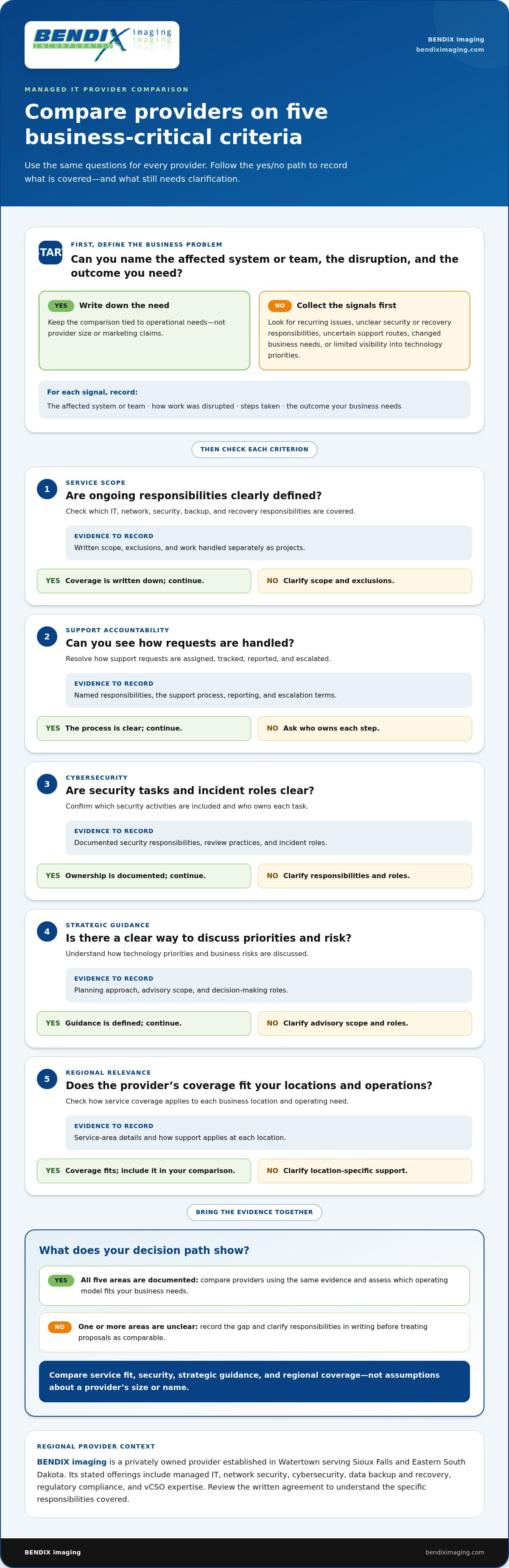
Compare proposals against the same five criteria, then record what each provider puts in writing. That turns the search for Loffler Companies alternatives managed IT Sioux Falls businesses can use into an operational comparison, rather than a contest of broad service labels or polished claims.
| Criterion | Questions to resolve | Evidence to record |
|---|---|---|
| Service scope | Which ongoing IT, network, security, backup, and recovery responsibilities are covered? | Written scope, exclusions, and separate project work |
| Support accountability | How are requests assigned, tracked, reported, and escalated? | Named responsibilities, support process, reporting, and escalation terms |
| Cybersecurity | Which security activities are included, and who owns each task? | Documented security responsibilities, review practices, and incident roles |
| Strategic guidance | How are technology priorities and business risks discussed? | Planning approach, advisory scope, and decision-making roles |
| Regional relevance | Does the provider’s coverage fit your business locations and operating needs? | Service-area details and how support applies to each business location |
Which managed IT services matter most to your business?
Start with workflows and risks, not a checklist of impressive-sounding services. A company relying on connected offices may prioritize network security and user support. One handling sensitive records may place greater weight on cybersecurity, backup and recovery, and compliance support—much like how healthcare organizations often partner with specialized providers such as MEDITIL for industry-tailored IT solutions. A business without internal security leadership may also consider whether vCSO guidance fits its needs. CISA’s cybersecurity resources offer useful context for treating security as an ongoing business concern.
BENDIX imaging provides managed IT, network security, cybersecurity, data backup and recovery, regulatory compliance, and vCSO expertise. These services align with common comparison areas. Review the written agreement to understand the specific responsibilities it covers. For broader context on regional service considerations, read this managed IT support guide for South Dakota.
How can you compare support and accountability fairly?
Read each proposal for ownership, not just promises. Identify who receives requests, who communicates progress, how unresolved issues are escalated, and what reporting the business receives. Compare written terms side by side. Don’t treat verbal descriptions as commitments or assume response times, availability, or pricing are equivalent unless the proposals state comparable terms.
Make sure the provider’s approach addresses your priority needs. If backup continuity is a concern, record who manages the backup process and what responsibilities your team retains. If security oversight is the priority, capture who handles planning, routine responsibilities, and incident coordination. BENDIX imaging serves Sioux Falls and Eastern South Dakota from its regional base in Watertown. Businesses assessing that regional fit can explore BENDIX imaging’s business technology services as part of the comparison.
Loffler vs. a regional managed IT provider: compare service fit, not assumptions
A broad business technology provider and a regional partner can both be worth considering, but they may suit different operating models. The useful question isn’t which company is larger or has the longer service list. It’s whether the provider’s documented responsibilities match your systems, locations, risk priorities, and need for business technology support. That’s the practical lens for evaluating Loffler Companies alternatives managed IT Sioux Falls businesses may consider.
What does a broad business technology provider comparison reveal?
Service categories can show where providers may overlap, but they don’t prove that offerings are identical or included in the same way. The comparison profile for Loffler referenced IT security, unified communications, and print-related categories. Treat those as reported categories, not a complete or current catalog. Compare them with Loffler’s up-to-date, first-party service descriptions and the written scope relevant to your business.
Translate each category into an operational need. Unified communications may matter if your organization is reviewing how employees connect. Print services may be relevant if printing is part of everyday workflows. Security needs require a closer look than a category name alone: clarify the responsibilities involved and how they align with your organization’s risk priorities. A label points to a topic for comparison, not the specific work or accountability provided.
Where can BENDIX imaging fit as a Sioux Falls alternative?
BENDIX imaging is a privately owned regional business technology provider established in Watertown, South Dakota, serving Sioux Falls and Eastern South Dakota. Its service portfolio spans managed IT, cybersecurity, network security, backup and recovery, regulatory compliance, vCSO expertise, managed print, and VoIP systems. This gives businesses a way to consider IT, security, continuity, print, and communications needs together, with the written service arrangement defining the actual scope.
- IT and security: Managed IT, cybersecurity, and network security support ongoing technology operations and protection.
- Continuity and oversight: Backup and recovery, compliance support, and vCSO expertise address data resilience, regulatory needs, and security leadership.
- Business technology: Managed print and VoIP systems let organizations evaluate print and communications needs alongside IT support.
Regional relevance is about more than a map pin. Consider whether a provider’s stated service area aligns with where your business operates and whether its documented arrangement fits how your teams work. BENDIX imaging serves businesses in Watertown, Brookings, Sioux Falls, Huron, and Montevideo, as well as across Eastern South Dakota. That regional coverage does not imply a Sioux Falls office. For organizations weighing security priorities as part of provider fit, the Eastern South Dakota cybersecurity guide offers relevant regional context.
There’s no universal winner. One business may value a wider combination of technology categories; another may prioritize a regional provider whose portfolio aligns with its needs. Compare current service descriptions and agreements, distinguish listed capabilities from included responsibilities, and choose based on the specific scope your organization requires.
Plan a managed IT provider transition without creating avoidable business risk
A provider change touches more than the support inbox. Systems, user access, vendor relationships, security duties, and backup processes can all affect whether employees keep working through the handoff. If you’re comparing Loffler Companies alternatives managed IT Sioux Falls businesses might choose, treat transition planning as part of provider fit, not a task to postpone until after a decision.
Start with a shared picture of the current environment, then agree on who owns each handoff and when key responsibilities change. The right sequence and timing depend on your systems, the work involved, and the responsibilities agreed with the providers. A plan can reduce avoidable confusion, but it can’t guarantee zero disruption.
What should a business document before changing providers?
Build a practical record that reflects how your business operates, not just an equipment list. Include critical systems, applications, network dependencies, vendor contacts, user groups, account ownership, backup responsibilities, security controls, known issues, compliance obligations, and internal decision-makers. For example, document a business application’s dependency on a specific network connection so it isn’t overlooked during planning.
- Define business requirements. Identify essential workflows, systems, and user needs, along with the risks or service gaps prompting the review.
- Inventory the environment. Record devices, applications, networks, locations, vendors, and the people who use or manage each system.
- Map ownership and access. Document who controls administrator accounts, domains, licenses, vendor portals, and other important credentials. Keep access records secure.
- Describe backup and security responsibilities. Note what is backed up, who manages the process, who owns security controls, and how known issues are handled.
- Identify dependencies and decision-makers. Flag systems that rely on one another, operationally sensitive periods, applicable compliance needs, and the internal leaders who must approve decisions.
- Agree on handoff milestones. Define the sequence for transferring documentation, access, support responsibilities, and open work, with an owner for each task.
How should the incoming provider coordinate the handoff?
Use the inventory to align your business and incoming provider on scope, access, responsibilities, and transition milestones. Establish who communicates with employees, who tracks unresolved issues, and how changes affecting systems or users will be coordinated. Keep the current provider’s responsibilities and ongoing vendor dependencies visible until ownership has clearly transferred.
BENDIX imaging can discuss managed IT alongside cybersecurity, network security, and data backup and recovery needs as part of a project. Use a business technology audit guide to frame the environment review. Transition scope and timing should reflect your organization’s systems and agreed responsibilities, not an assumed standard schedule.
Ready to discuss your requirements and transition priorities? Talk with BENDIX imaging about managed IT.
Is BENDIX imaging the right Loffler alternative for your Sioux Falls business?
The right provider depends on the work your business needs covered, the risks you’re managing, and how technology supports daily operations. BENDIX imaging is worth considering if you’re evaluating managed IT alongside cybersecurity, backup and recovery, compliance support, or broader business technology services. A regional option isn’t automatically the best fit for every organization. Compare the actual scope and responsibilities with your requirements.
Which Sioux Falls businesses should consider a regional IT partner?
Organizations assessing managed IT alongside security, data recovery, compliance, or vCSO expertise may find a regional provider relevant to their search. Businesses that also want to consider managed print or VoIP can include those services in the same evaluation. BENDIX imaging is a privately owned business established in Watertown and serves Sioux Falls and Eastern South Dakota. Fit still depends on each organization’s environment and agreed service scope.
Use this checklist to decide whether BENDIX imaging belongs in your comparison of Loffler Companies alternatives managed IT Sioux Falls businesses may evaluate:
- Service scope: Do managed IT and related services align with your critical systems, employee support needs, and business workflows?
- Security priorities: Have you identified the cybersecurity and network security responsibilities your organization needs addressed?
- Compliance needs: Does your business need compliance support or vCSO expertise as part of its technology and security planning?
- Regional coverage: Does the provider’s stated service area fit where your business operates? BENDIX imaging serves Sioux Falls and Eastern South Dakota from Watertown.
- Transition readiness: Can your organization document its systems, access ownership, vendors, backup responsibilities, and key dependencies well enough to plan a handoff?
- Related technology: Would managed print or VoIP systems be useful to assess alongside IT and security needs?
What is the next step in comparing BENDIX imaging with Loffler?
Prepare a short, practical summary before discussing provider fit. List your critical systems, recurring support needs, security concerns, compliance priorities, business locations, and desired outcomes. Add transition considerations, such as vendor relationships or responsibilities that must be coordinated. This gives decision-makers a concrete basis for comparing documented scope without assuming that two providers’ service labels or agreements are identical.
Then discuss those priorities with BENDIX imaging’s team. Focus on your environment, the services relevant to your needs, and the responsibilities involved in a potential arrangement. A clear understanding of fit comes from matching your requirements with the agreed scope, not choosing a provider based on size or a broad promise.
Explore BENDIX imaging’s business technology services and start a focused conversation about managed IT for your Sioux Falls business.
Make your next IT decision with clear priorities
A provider conversation doesn’t have to begin with a commitment. Start by naming one business outcome you need technology support to advance, such as reducing recurring workflow interruptions, clarifying security ownership, or preparing for planned growth. Decide how you’ll recognize progress and who in your organization should take part in evaluating options. Clear priorities keep the discussion focused on your business rather than a generic service pitch.
If you’re weighing Loffler Companies alternatives managed IT Sioux Falls businesses can consider, use those priorities to shape a practical conversation about fit, scope, and next steps. Bring the questions that matter to your team, including how support connects to your systems and where responsibilities should sit. A focused discussion can help you decide whether to explore a regional relationship further.
Talk with BENDIX imaging about managed IT for your business. Take the next step with a clear picture of what your business needs.
Frequently Asked Questions
What are the best alternatives to Loffler Companies for managed IT in Sioux Falls?
There’s no single best alternative for every business. Options identified in the Sioux Falls market include BENDIX imaging, Marco Technologies, designDATA, Net at Work LLC, Integris, Corporate Technologies, SoftDoes, TPx, and Red River. Treat that as a starting list, not a ranking or endorsement. Narrow it by matching each provider’s documented services to your business requirements, operating locations, security priorities, and internal capacity.
Does BENDIX imaging provide managed IT services in Sioux Falls?
Yes. BENDIX imaging provides managed IT services to businesses in Sioux Falls as part of its Eastern South Dakota service area. The company is established in Watertown, so consider its regional coverage rather than assuming it operates a Sioux Falls office. For a useful first conversation, outline your main systems, employee support needs, and the technology responsibilities you want a provider to address.
How should a Sioux Falls business compare Loffler Companies with a local IT provider?
Compare the written scope against your operating needs, not just company profiles. For example, if a branch office depends on a particular application, identify the network and vendor responsibilities that keep it available, then see how each proposal addresses them. Also compare who owns routine decisions, how open issues are tracked, and whether the provider’s stated coverage fits your business locations.
Can a regional managed IT provider support cybersecurity and compliance needs?
Yes, a regional provider can offer cybersecurity and compliance support, but the key question is whether its documented responsibilities fit your organization’s needs. Map tasks such as network security, backup and recovery, compliance support, and security oversight to the systems and information they relate to. BENDIX imaging provides cybersecurity, network security, regulatory compliance, backup and recovery, and vCSO expertise for business clients.
What should a business include in a managed IT provider transition plan?
Include a list of business-critical applications, system owners, vendor contacts, user accounts, administrator access, backup arrangements, and unresolved technology issues. Record any systems that depend on one another, such as software that requires a specific network connection. Assign an internal decision-maker to coordinate approvals, and document when each responsibility transfers so staff know where to direct requests during the handoff.
How long does it take to switch managed IT providers?
There isn’t one reliable timeline for every business. The transition depends on the size and complexity of the technology environment, the number of vendor dependencies, the state of existing documentation, and the responsibilities both parties agree to handle. A business with several locations or specialized systems may need different planning than a simpler environment. Set milestones after the systems and handoff requirements are understood.
Does BENDIX imaging offer managed print alongside managed IT services?
Yes. BENDIX imaging offers managed print alongside managed IT services, as well as printing supplies and iColor equipment. This is relevant if print operations affect staff workflows or need to be considered alongside broader business technology planning. Identify your business’s print requirements and compare them with the written service scope, rather than assuming managed print is automatically part of a managed IT arrangement.
{"@context":"https://schema.org","@type":"FAQPage","mainEntity":[{"@type":"Question","name":"What should Sioux Falls businesses expect from managed IT?","acceptedAnswer":{"@type":"Answer","text":"Evaluate how day-to-day support connects with the systems your business relies on. User support helps employees resolve technology issues. Network operations keep business connectivity and related systems in view. Security and backup planning address different risks to information and continuity. These areas can overlap, but they aren’t interchangeable. A backup, for example, is not the same as a plan for restoring access and resuming work. Separate ongoing services from project work and specialized consulting. A planned system change or strategic security review may be handled differently from routine support, and provider agreements can define scope in different ways. Compare the written service descriptions and responsibilities rather than assuming a familiar service label means the same thing across contracts."}},{"@type":"Question","name":"When does it make sense to compare Loffler alternatives?","acceptedAnswer":{"@type":"Answer","text":"A review can be worthwhile even if no single incident demands an immediate switch. Look for patterns that affect productivity, risk, or ownership, and record what happened before drawing conclusions about the provider. For each signal, record the affected system or team, how the issue disrupted work, what steps were taken, and the outcome your business needs. Keep the record factual. A slow application, for instance, may point to a performance concern, but the underlying cause still needs to be identified. This prevents a comparison from becoming a list of frustrations without evidence. Then compare providers against documented needs: service scope, support approach, cybersecurity, strategic guidance, and transition planning. The aim isn’t to presume that Loffler or another provider has failed. It’s to determine which operating model fits your business, what responsibilities are covered, and how a change could be managed with minimal disruption. Compare proposals against the same five criteria, then record what each provider puts in writing. That turns the search for Loffler Companies alternatives managed IT Sioux Falls businesses can use into an operational comparison, rather than a contest of broad service labels or polished claims."}},{"@type":"Question","name":"Which managed IT services matter most to your business?","acceptedAnswer":{"@type":"Answer","text":"Start with workflows and risks, not a checklist of impressive-sounding services. A company relying on connected offices may prioritize network security and user support. One handling sensitive records may place greater weight on cybersecurity, backup and recovery, and compliance support. A business without internal security leadership may also consider whether vCSO guidance fits its needs. CISA’s cybersecurity resources offer useful context for treating security as an ongoing business concern. BENDIX imaging provides managed IT, network security, cybersecurity, data backup and recovery, regulatory compliance, and vCSO expertise. These services align with common comparison areas. Review the written agreement to understand the specific responsibilities it covers. For broader context on regional service considerations, read this managed IT support guide for South Dakota."}},{"@type":"Question","name":"How can you compare support and accountability fairly?","acceptedAnswer":{"@type":"Answer","text":"Read each proposal for ownership, not just promises. Identify who receives requests, who communicates progress, how unresolved issues are escalated, and what reporting the business receives. Compare written terms side by side. Don’t treat verbal descriptions as commitments or assume response times, availability, or pricing are equivalent unless the proposals state comparable terms. Make sure the provider’s approach addresses your priority needs. If backup continuity is a concern, record who manages the backup process and what responsibilities your team retains. If security oversight is the priority, capture who handles planning, routine responsibilities, and incident coordination. BENDIX imaging serves Sioux Falls and Eastern South Dakota from its regional base in Watertown. Businesses assessing that regional fit can explore BENDIX imaging’s business technology services as part of the comparison. A broad business technology provider and a regional partner can both be worth considering, but they may suit different operating models. The useful question isn’t which company is larger or has the longer service list. It’s whether the provider’s documented responsibilities match your systems, locations, risk priorities, and need for business technology support. That’s the practical lens for evaluating Loffler Companies alternatives managed IT Sioux Falls businesses may consider."}},{"@type":"Question","name":"What does a broad business technology provider comparison reveal?","acceptedAnswer":{"@type":"Answer","text":"Service categories can show where providers may overlap, but they don’t prove that offerings are identical or included in the same way. The comparison profile for Loffler referenced IT security, unified communications, and print-related categories. Treat those as reported categories, not a complete or current catalog. Compare them with Loffler’s up-to-date, first-party service descriptions and the written scope relevant to your business. Translate each category into an operational need. Unified communications may matter if your organization is reviewing how employees connect. Print services may be relevant if printing is part of everyday workflows. Security needs require a closer look than a category name alone: clarify the responsibilities involved and how they align with your organization’s risk priorities. A label points to a topic for comparison, not the specific work or accountability provided."}},{"@type":"Question","name":"Where can BENDIX imaging fit as a Sioux Falls alternative?","acceptedAnswer":{"@type":"Answer","text":"BENDIX imaging is a privately owned regional business technology provider established in Watertown, South Dakota, serving Sioux Falls and Eastern South Dakota. Its service portfolio spans managed IT, cybersecurity, network security, backup and recovery, regulatory compliance, vCSO expertise, managed print, and VoIP systems. This gives businesses a way to consider IT, security, continuity, print, and communications needs together, with the written service arrangement defining the actual scope. Regional relevance is about more than a map pin. Consider whether a provider’s stated service area aligns with where your business operates and whether its documented arrangement fits how your teams work. BENDIX imaging serves businesses in Watertown, Brookings, Sioux Falls, Huron, and Montevideo, as well as across Eastern South Dakota. That regional coverage does not imply a Sioux Falls office. For organizations weighing security priorities as part of provider fit, the Eastern South Dakota cybersecurity guide offers relevant regional context. There’s no universal winner. One business may value a wider combination of technology categories; another may prioritize a regional provider whose portfolio aligns with its needs. Compare current service descriptions and agreements, distinguish listed capabilities from included responsibilities, and choose based on the specific scope your organization requires. A provider change touches more than the support inbox. Systems, user access, vendor relationships, security duties, and backup processes can all affect whether employees keep working through the handoff. If you’re comparing Loffler Companies alternatives managed IT Sioux Falls businesses might choose, treat transition planning as part of provider fit, not a task to postpone until after a decision. Start with a shared picture of the current environment, then agree on who owns each handoff and when key responsibilities change. The right sequence and timing depend on your systems, the work involved, and the responsibilities agreed with the providers. A plan can reduce avoidable confusion, but it can’t guarantee zero disruption."}},{"@type":"Question","name":"What should a business document before changing providers?","acceptedAnswer":{"@type":"Answer","text":"Build a practical record that reflects how your business operates, not just an equipment list. Include critical systems, applications, network dependencies, vendor contacts, user groups, account ownership, backup responsibilities, security controls, known issues, compliance obligations, and internal decision-makers. For example, document a business application’s dependency on a specific network connection so it isn’t overlooked during planning."}},{"@type":"Question","name":"How should the incoming provider coordinate the handoff?","acceptedAnswer":{"@type":"Answer","text":"Use the inventory to align your business and incoming provider on scope, access, responsibilities, and transition milestones. Establish who communicates with employees, who tracks unresolved issues, and how changes affecting systems or users will be coordinated. Keep the current provider’s responsibilities and ongoing vendor dependencies visible until ownership has clearly transferred. BENDIX imaging can discuss managed IT alongside cybersecurity, network security, and data backup and recovery needs as part of a project. Use a business technology audit guide to frame the environment review. Transition scope and timing should reflect your organization’s systems and agreed responsibilities, not an assumed standard schedule. Ready to discuss your requirements and transition priorities? Talk with BENDIX imaging about managed IT. The right provider depends on the work your business needs covered, the risks you’re managing, and how technology supports daily operations. BENDIX imaging is worth considering if you’re evaluating managed IT alongside cybersecurity, backup and recovery, compliance support, or broader business technology services. A regional option isn’t automatically the best fit for every organization. Compare the actual scope and responsibilities with your requirements."}},{"@type":"Question","name":"Which Sioux Falls businesses should consider a regional IT partner?","acceptedAnswer":{"@type":"Answer","text":"Organizations assessing managed IT alongside security, data recovery, compliance, or vCSO expertise may find a regional provider relevant to their search. Businesses that also want to consider managed print or VoIP can include those services in the same evaluation. BENDIX imaging is a privately owned business established in Watertown and serves Sioux Falls and Eastern South Dakota. Fit still depends on each organization’s environment and agreed service scope. Use this checklist to decide whether BENDIX imaging belongs in your comparison of Loffler Companies alternatives managed IT Sioux Falls businesses may evaluate:"}},{"@type":"Question","name":"What is the next step in comparing BENDIX imaging with Loffler?","acceptedAnswer":{"@type":"Answer","text":"Prepare a short, practical summary before discussing provider fit. List your critical systems, recurring support needs, security concerns, compliance priorities, business locations, and desired outcomes. Add transition considerations, such as vendor relationships or responsibilities that must be coordinated. This gives decision-makers a concrete basis for comparing documented scope without assuming that two providers’ service labels or agreements are identical. Then discuss those priorities with BENDIX imaging’s team. Focus on your environment, the services relevant to your needs, and the responsibilities involved in a potential arrangement. A clear understanding of fit comes from matching your requirements with the agreed scope, not choosing a provider based on size or a broad promise. Explore BENDIX imaging’s business technology services and start a focused conversation about managed IT for your Sioux Falls business. A provider conversation doesn’t have to begin with a commitment. Start by naming one business outcome you need technology support to advance, such as reducing recurring workflow interruptions, clarifying security ownership, or preparing for planned growth. Decide how you’ll recognize progress and who in your organization should take part in evaluating options. Clear priorities keep the discussion focused on your business rather than a generic service pitch. If you’re weighing Loffler Companies alternatives managed IT Sioux Falls businesses can consider, use those priorities to shape a practical conversation about fit, scope, and next steps. Bring the questions that matter to your team, including how support connects to your systems and where responsibilities should sit. A focused discussion can help you decide whether to explore a regional relationship further. Talk with BENDIX imaging about managed IT for your business. Take the next step with a clear picture of what your business needs."}},{"@type":"Question","name":"What are the best alternatives to Loffler Companies for managed IT in Sioux Falls?","acceptedAnswer":{"@type":"Answer","text":"There’s no single best alternative for every business. Options identified in the Sioux Falls market include BENDIX imaging, Marco Technologies, designDATA, Net at Work LLC, Integris, Corporate Technologies, SoftDoes, TPx, and Red River. Treat that as a starting list, not a ranking or endorsement. Narrow it by matching each provider’s documented services to your business requirements, operating locations, security priorities, and internal capacity."}},{"@type":"Question","name":"Does BENDIX imaging provide managed IT services in Sioux Falls?","acceptedAnswer":{"@type":"Answer","text":"Yes. BENDIX imaging provides managed IT services to businesses in Sioux Falls as part of its Eastern South Dakota service area. The company is established in Watertown, so consider its regional coverage rather than assuming it operates a Sioux Falls office. For a useful first conversation, outline your main systems, employee support needs, and the technology responsibilities you want a provider to address."}},{"@type":"Question","name":"How should a Sioux Falls business compare Loffler Companies with a local IT provider?","acceptedAnswer":{"@type":"Answer","text":"Compare the written scope against your operating needs, not just company profiles. For example, if a branch office depends on a particular application, identify the network and vendor responsibilities that keep it available, then see how each proposal addresses them. Also compare who owns routine decisions, how open issues are tracked, and whether the provider’s stated coverage fits your business locations."}},{"@type":"Question","name":"Can a regional managed IT provider support cybersecurity and compliance needs?","acceptedAnswer":{"@type":"Answer","text":"Yes, a regional provider can offer cybersecurity and compliance support, but the key question is whether its documented responsibilities fit your organization’s needs. Map tasks such as network security, backup and recovery, compliance support, and security oversight to the systems and information they relate to. BENDIX imaging provides cybersecurity, network security, regulatory compliance, backup and recovery, and vCSO expertise for business clients."}},{"@type":"Question","name":"What should a business include in a managed IT provider transition plan?","acceptedAnswer":{"@type":"Answer","text":"Include a list of business-critical applications, system owners, vendor contacts, user accounts, administrator access, backup arrangements, and unresolved technology issues. Record any systems that depend on one another, such as software that requires a specific network connection. Assign an internal decision-maker to coordinate approvals, and document when each responsibility transfers so staff know where to direct requests during the handoff."}},{"@type":"Question","name":"How long does it take to switch managed IT providers?","acceptedAnswer":{"@type":"Answer","text":"There isn’t one reliable timeline for every business. The transition depends on the size and complexity of the technology environment, the number of vendor dependencies, the state of existing documentation, and the responsibilities both parties agree to handle. A business with several locations or specialized systems may need different planning than a simpler environment. Set milestones after the systems and handoff requirements are understood."}},{"@type":"Question","name":"Does BENDIX imaging offer managed print alongside managed IT services?","acceptedAnswer":{"@type":"Answer","text":"Yes. BENDIX imaging offers managed print alongside managed IT services, as well as printing supplies and iColor equipment. This is relevant if print operations affect staff workflows or need to be considered alongside broader business technology planning. Identify your business’s print requirements and compare them with the written service scope, rather than assuming managed print is automatically part of a managed IT arrangement."}}]}


