

What if the right alternative to a copier lease isn’t another lease, but a print model built around how your business actually works? If you’re weighing copier leasing alternatives, don’t judge the decision by the monthly payment alone. Separate equipment, service, and supply costs, then consider the work your staff handles and the risk of disrupting daily printing.
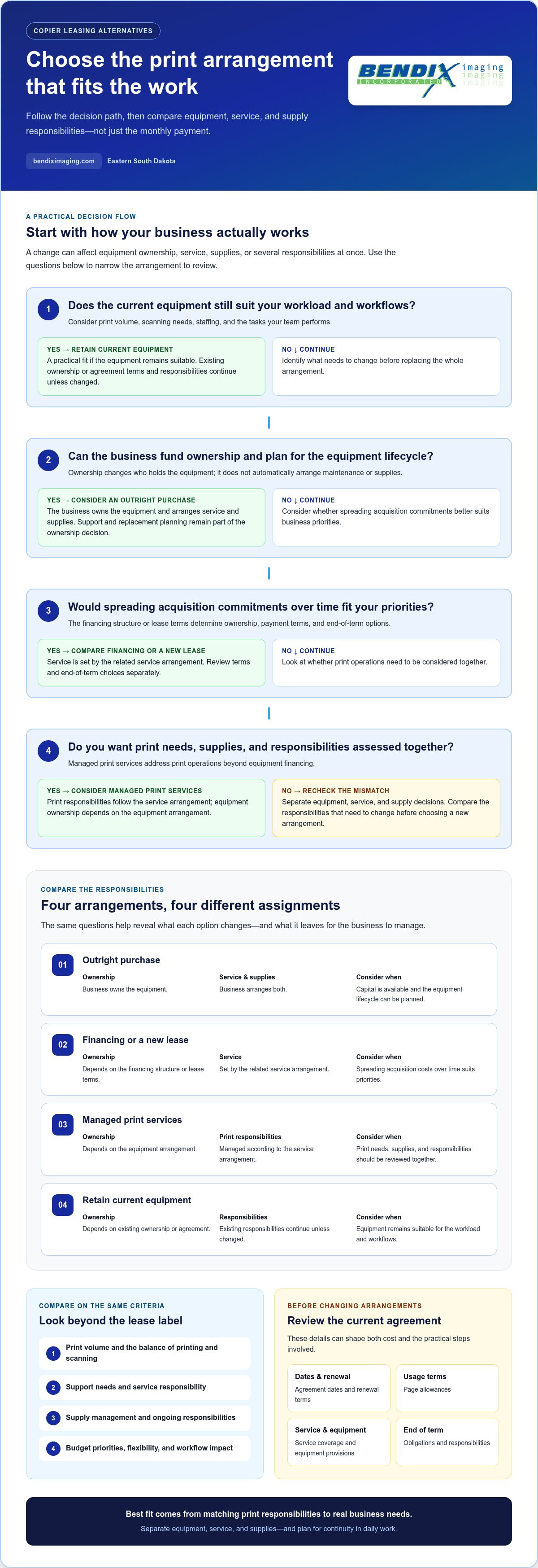
You’re right to want flexibility without creating new headaches. Compare leasing, buying equipment, and managed print using the same criteria: print volume, support needs, supply management, and budget priorities. Before making a change, review the current agreement for renewal terms, page allowances, service coverage, and end-of-term obligations. These details can shape both the cost and the practical steps involved.
Choose the arrangement that fits your print volume and operational needs, not simply the lease label. The guidance below shows how to compare total print responsibilities and plan for continuity. For businesses in Eastern South Dakota, BENDIX imaging provides managed print solutions and printing supplies, helping businesses assess print operations beyond equipment financing.
Key Takeaways
- Century Business Products copier leasing alternatives include buying equipment, arranging a new lease or financing, using managed print services, or keeping current equipment.
- Compare equipment ownership and responsibility for service and supplies, not just the monthly payment.
- Use print volume, support needs, flexibility, and workflow impact to judge which arrangement fits your business.
- Review agreement dates, renewal terms, equipment provisions, and responsibilities before changing arrangements.
- Businesses in Eastern South Dakota can explore managed print solutions and printing supplies from BENDIX imaging.
Why look for Century Business Products copier leasing alternatives?
A lease that once fit your business may no longer match its print volume, staffing, or operating priorities. Perhaps fewer documents are printed, teams now scan more records, or the equipment no longer supports everyday work. If you’re comparing Century Business Products copier leasing alternatives, identify what needs to change before deciding that the whole arrangement is the problem.
An alternative can change who owns the equipment, who handles service, how supplies are managed, or several of these responsibilities at once. Leasing may suit a business that prefers payments spread over time. Another business may prefer ownership or managed print. The goal is to find a practical fit, not to assume that leasing is always right or wrong.
What does “copier leasing alternative” actually mean?
It means a different way to acquire equipment or organize printing. A business might purchase a device, arrange new financing, retain equipment it already has, or use managed print services to address print operations beyond financing. These options aren’t interchangeable: each assigns ownership and ongoing responsibilities differently.
A copier or multifunction printer may support copying alongside printing and scanning. The Photocopier overview provides background on the equipment’s core purpose. For a business comparison, separate the device from its financing, maintenance, supplies, and print-management responsibilities. A lease determines one part of the arrangement. It doesn’t, by itself, explain who handles every print-related task.
When should a business reconsider its current arrangement?
Review the setup when your actual use has shifted. A smaller team, new document workflows, or changing equipment needs can make the original arrangement less suitable. Compare current print activity with the responsibilities and equipment your business is paying to maintain. Look at who prints, what gets scanned, and whether the setup supports daily work without creating avoidable friction.
- Print volume or the balance between printing and scanning has changed.
- Staffing or workflows have shifted, changing who needs access to print functions.
- Equipment requirements no longer match the tasks your team performs.
- Responsibilities for service, supplies, or end-of-term decisions aren’t clear internally.
Also separate dissatisfaction with a provider from dissatisfaction with leasing as a financing model. A business might want different service or supply arrangements while keeping leased equipment. Another might be satisfied with support but ready to reconsider ownership. Treat these as separate questions, then compare the practical effects of changing one part or several.
The right comparison separates equipment, service, and supply decisions. That distinction helps you assess the arrangement by its actual responsibilities, not its label. Before choosing an alternative, establish what’s working, what has changed, and which part of the setup is creating the mismatch.
Four copier leasing alternatives businesses can compare
There isn’t one universal replacement for a copier lease. The right comparison depends on what your business needs to own, manage, and support. These Century Business Products copier leasing alternatives distinguish equipment acquisition from the work of keeping print operations running.
| Model | Equipment ownership | Service responsibility | Flexibility | Best-fit situation |
|---|---|---|---|---|
| Outright purchase | Business owns the equipment | Business arranges service and supplies | Ownership avoids a lease term, but replacement and support planning remain | Capital is available and the business can plan for the equipment lifecycle |
| Financing or a new lease | Depends on the financing structure or lease terms | Set by the related service arrangement | Terms define payment and end-of-term options | Spreading acquisition costs over time better suits business priorities |
| Managed print services | Depends on the equipment arrangement | Print responsibilities are managed according to the service arrangement | Can address print operations beyond equipment financing | The business wants to assess print needs, supplies, and responsibilities together |
| Retain current equipment | Depends on the existing agreement or ownership | Existing responsibilities continue unless changed | Avoids replacing equipment now, but existing terms still apply | Equipment remains suitable for the workload and workflows |
Buying equipment outright or financing a purchase
Buying changes who owns the equipment. It doesn’t automatically settle who maintains it or supplies it. Before choosing ownership, consider available capital, expected usage, the equipment’s remaining useful life, and whether your team can coordinate support. Financing or a new lease may spread acquisition commitments over time, but the terms shape flexibility and end-of-term choices. Treat service and supplies as separate decisions either way.
Managed print services or continuing with current equipment
Managed print services focus on overseeing business print needs, rather than simply financing a device. A managed approach can bring print activity, supply planning, and service responsibilities into the same discussion, while the equipment arrangement remains a separate consideration. For a broader view of how print management relates to day-to-day operations, explore this managed print solutions business guide.
Keeping current equipment may also make sense if it still supports the workload. Compare its condition and capabilities with the tasks employees rely on, then map who handles supplies, service, and usage oversight. If the device meets current needs, changing how printing is managed may be a different decision from replacing the equipment. Businesses reviewing those responsibilities can explore managed print support from BENDIX imaging to consider print operations beyond financing.
Compare copier alternatives by total responsibility, not monthly payment
A lower recurring payment doesn’t tell you who orders supplies, coordinates service, or manages print activity. Compare each arrangement by the work and obligations it places on your business, as well as its payment structure. Compare the full print arrangement, not just its recurring payment. Total cost of ownership is a useful comparison concept: consider all relevant costs and responsibilities over the period you expect to use the equipment. It doesn’t guarantee that one model will save money.
Build a weighted scorecard for your business
Use the sample weights below as a starting point. Rate each alternative from 1 to 5 against your priorities, then multiply each rating by its weight. A higher rating should mean a better fit for your business. Adjust the weights before scoring if, for example, reliable workflow support matters more than flexibility.
- Total responsibility, 25%: Who coordinates equipment needs, maintenance, supplies, and ongoing oversight?
- Print volume, 20%: Does the arrangement suit current use and a realistic view of future demand?
- Support, 20%: Are service responsibilities clear, and does the support structure fit your operating needs?
- Supplies, 15%: Who monitors and orders supplies, and how does that task fit your internal processes?
- Flexibility, 10%: How well can the arrangement accommodate changing requirements or end-of-term decisions?
- Workflow impact, 10%: Will the setup support the way staff print, scan, and complete routine work?
These weights are a decision aid, not an industry benchmark. Score the same criteria across a purchase, a new financing or lease arrangement, managed print, and retaining current equipment. Use actual print records where available, and distinguish documented contract terms from assumptions. If contract language is unclear, flag it for review rather than treating an interpretation as settled.
Account for service and supplies
Changing an equipment or financing arrangement doesn’t have to mean abandoning service or support. Evaluate those responsibilities separately. For each option, identify who coordinates maintenance, orders supplies, tracks print usage, and handles day-to-day questions. The answer may differ between the current agreement and a new print-management approach, so record responsibilities alongside equipment payments.
Supplies also affect the practical workload. If employees order toner as needed, for example, that task still takes staff time even if the equipment payment changes. A business with a separate supply process can compare its internal work with an arrangement that includes more print oversight. For related considerations, see this guide to business printing supplies management in Watertown.
Use the scorecard to expose trade-offs, not to force a single winner. Contract terms, equipment condition, print volume, and support needs all affect the result. Businesses in Eastern South Dakota can also consider how BENDIX imaging’s managed print solutions relate to their print responsibilities, while keeping print management and equipment financing as separate decisions.
Plan a copier arrangement change without disrupting daily work
A copier change affects more than the device. It can touch staff routines, supply ordering, service coordination, and time-sensitive documents. Before acting on Century Business Products copier leasing alternatives, build a transition plan around your actual agreement and print environment. First understand current obligations, define what your team needs, and coordinate any change with business operations. Don’t assume a particular contract outcome or transition speed.
Review the current agreement and print environment
Start with the records, not assumptions. Gather the signed agreement, amendments, invoices, service records, and an inventory of equipment. Review the dates, responsibilities, renewal terms, and equipment provisions as written. Record print volumes, color requirements, finishing needs, and recurring supply or service issues. A business technology audit in Watertown offers related context for reviewing technology needs alongside daily operations.
Set transition requirements before choosing a model
Map the work the equipment supports before selecting a replacement arrangement. Identify essential workflows, users, locations, and time-sensitive output, then assign internal owners for decisions, staff communication, and equipment access. A transition plan starts with documented needs and clear responsibilities. That foundation helps your team compare options and prepare for practical tasks without presuming how quickly a change can happen.
- Gather the documents. Assemble agreements, amendments, invoices, service history, and equipment records in one place. Note missing information so it isn’t mistaken for a confirmed term.
- Review the agreement. Mark key dates, renewal and notice terms, service and supply responsibilities, and equipment provisions. Keep your notes factual. If a clause is unclear, don’t treat an assumption as its meaning.
- Document current use. Track print volume, color needs, finishing requirements, supply patterns, and service interruptions. Include where printing and scanning take place, and which processes depend on specific equipment or settings.
- Map people and workflows. Identify staff who rely on printing, documents that are time-sensitive, and the person responsible for communicating changes. Consider access across departments or locations so an overlooked user doesn’t become a last-minute obstacle.
- Build the transition plan. Set out decision owners, communication steps, equipment access, supply coverage, and a change window that accounts for operating demands. Coordinate timing with business priorities, and leave room to address issues before the new arrangement becomes the everyday process.
Use this checklist to make a change deliberate, not rushed. If managed print is part of your comparison, discuss your print-management needs with BENDIX imaging, which provides managed print solutions for businesses throughout Eastern South Dakota.
Explore managed print support from BENDIX imaging in Eastern South Dakota
A print arrangement is more than a decision about who owns a copier. Businesses also need to account for supplies, usage, equipment needs, and the workflows that depend on printed documents. BENDIX imaging provides managed print solutions and printing supplies to businesses throughout Eastern South Dakota, including Watertown, Brookings, Sioux Falls, Huron, and Montevideo. Its role in this comparison is as a local resource for considering print operations, not an argument that leasing is inherently the wrong choice.
For businesses exploring Century Business Products copier leasing alternatives, managed print can broaden the discussion beyond financing. Leasing may still suit a company’s needs. The useful question is whether equipment arrangements and the way printing is managed align with current operations. Keep those decisions distinct, then consider how each affects staff, supply routines, and everyday document workflows.
What a managed print conversation can help clarify
Bring together your print volumes, equipment needs, supply patterns, and workflow priorities. Looking at these details together helps your business describe what its print environment needs to support, such as routine office documents, color output, or scanning-dependent processes. Managed print focuses on print operations and responsibilities. Financing addresses how equipment is acquired.
That distinction matters. A business can discuss print management without assuming it must change equipment ownership or leave leasing. Likewise, changing how equipment is financed doesn’t automatically address supply ordering or workflow needs. Treat these as connected but separate considerations, and use your records to keep the discussion grounded in your operation.
Choose a next step that fits your business
Before discussing options, gather the information that makes your situation clear. A concise working file can include:
- Current agreement dates, responsibilities, renewal terms, and equipment provisions.
- Available print-volume information and the types of output your staff relies on.
- Supply needs, recurring issues, and workflows that depend on consistent printing or scanning.
- The questions your team wants answered about print management and equipment arrangements.
This preparation helps keep the discussion practical. It also lets your business distinguish a financing question from an operations concern, instead of treating every print issue as a reason to replace equipment. BENDIX imaging serves businesses in Sioux Falls and throughout Eastern South Dakota, including Watertown, Brookings, Huron, and Montevideo, with managed print solutions and printing supplies.
Start with your current documents and a clear picture of your daily print needs. Then consider how managed print could fit alongside your existing equipment and business priorities. Bring your print questions to BENDIX imaging for a practical conversation about your business print needs.
Make your next print decision with confidence
The next step doesn’t have to be an immediate change. Use what you’ve learned about your workload and priorities to decide what deserves a closer look, whether that’s equipment, supply coordination, or the way printing fits into everyday work. A clear set of needs makes the choice among Century Business Products copier leasing alternatives more grounded in your business, rather than just the terms on a payment schedule.
BENDIX imaging serves Eastern South Dakota businesses with managed print solutions, printing supplies, and specialized professional iColor equipment. Bring your print priorities into focus and consider how they align with your broader operations. The goal is a practical arrangement your team can understand and plan around.
Talk with BENDIX imaging about your business print needs and take a thoughtful next step toward a print approach that fits. Your business can move forward with a clearer view of what it needs.
Frequently Asked Questions
Can I switch copier providers before my lease ends?
Possibly, but whether you can switch before the lease ends depends on your signed agreement, amendments, and applicable terms. Review the renewal date, notice requirements, who owns or controls the equipment, and any early-exit provisions before making plans. If wording or potential obligations are unclear, have an appropriate legal or financial adviser review them. Don’t assume a provider-specific contract allows an early change or that alternatives can begin immediately.
What are the main alternatives to leasing a business copier?
Common alternatives include buying outright, financing a purchase, using managed print services, or continuing with suitable equipment you already have. These are different operating models, not interchangeable products: ownership may shift while support and supply duties remain separate. Compare who handles equipment, maintenance, consumables, and changing needs. The right fit among Century Business Products copier leasing alternatives depends on current print volume and operational priorities, not the model name alone.
Is managed print services the same as copier leasing?
No. Leasing is a way to finance equipment; managed print focuses on overseeing business printing needs. You can evaluate them separately, including who is responsible for devices, service coordination, supplies, and usage review. BENDIX imaging provides managed print solutions for businesses in Watertown, Brookings, Sioux Falls, Huron, and Montevideo. That offering concerns print management, not copier leasing. Financing and equipment choices remain separate considerations.
How much does it cost to replace a copier lease with another option?
There’s no single cost for replacing a lease with another model. Your total depends on equipment requirements, print volume, existing agreement terms, service duties, supplies, and whether you buy, finance, retain equipment, or use managed print. Compare the full obligations over the period you expect to use the arrangement, rather than judging one recurring payment alone. A business print discussion with BENDIX imaging can help frame your needs without promising a particular price or savings.
What should I check before a copier lease renews?
Before renewal, check the agreement’s renewal date, required notice period, equipment provisions, service terms, and any amendments. Put the relevant dates on an internal calendar and retain the source document, so planning isn’t based on memory. Then compare current print volumes and supply needs with expected demand. Use that information to consider renewal, a different arrangement, or continued use of suitable equipment. For contract meaning, seek qualified advice rather than guess.
Can a business keep its current copier and change its print management approach?
Yes, a business can consider retaining suitable existing equipment while revisiting how it manages print needs. Whether that makes sense depends on device condition, workload, service responsibilities, supply arrangements, and the terms that govern the equipment. Keeping a device may preserve a familiar workflow, but the business still needs a clear plan for upkeep and consumables. Review each factor before assuming current equipment fits a changed management approach.
What information should I gather to compare copier alternatives?
Collect the signed agreement and amendments, invoices, equipment inventory, print-volume records, supply usage, and service records. Add a brief workflow map showing which teams print or scan, what output is time-sensitive, and where interruptions have occurred. This creates a practical snapshot beyond the monthly invoice. Separate documented terms from assumptions; questions about contractual meaning are best addressed by a qualified legal or financial adviser.
{"@context":"https://schema.org","@type":"FAQPage","mainEntity":[{"@type":"Question","name":"What does “copier leasing alternative” actually mean?","acceptedAnswer":{"@type":"Answer","text":"It means a different way to acquire equipment or organize printing. A business might purchase a device, arrange new financing, retain equipment it already has, or use managed print services to address print operations beyond financing. These options aren’t interchangeable: each assigns ownership and ongoing responsibilities differently. A copier or multifunction printer may support copying alongside printing and scanning. The Photocopier overview provides background on the equipment’s core purpose. For a business comparison, separate the device from its financing, maintenance, supplies, and print-management responsibilities. A lease determines one part of the arrangement. It doesn’t, by itself, explain who handles every print-related task."}},{"@type":"Question","name":"When should a business reconsider its current arrangement?","acceptedAnswer":{"@type":"Answer","text":"Review the setup when your actual use has shifted. A smaller team, new document workflows, or changing equipment needs can make the original arrangement less suitable. Compare current print activity with the responsibilities and equipment your business is paying to maintain. Look at who prints, what gets scanned, and whether the setup supports daily work without creating avoidable friction. Also separate dissatisfaction with a provider from dissatisfaction with leasing as a financing model. A business might want different service or supply arrangements while keeping leased equipment. Another might be satisfied with support but ready to reconsider ownership. Treat these as separate questions, then compare the practical effects of changing one part or several. The right comparison separates equipment, service, and supply decisions. That distinction helps you assess the arrangement by its actual responsibilities, not its label. Before choosing an alternative, establish what’s working, what has changed, and which part of the setup is creating the mismatch. There isn’t one universal replacement for a copier lease. The right comparison depends on what your business needs to own, manage, and support. These Century Business Products copier leasing alternatives distinguish equipment acquisition from the work of keeping print operations running."}},{"@type":"Question","name":"Can I switch copier providers before my lease ends?","acceptedAnswer":{"@type":"Answer","text":"Possibly, but whether you can switch before the lease ends depends on your signed agreement, amendments, and applicable terms. Review the renewal date, notice requirements, who owns or controls the equipment, and any early-exit provisions before making plans. If wording or potential obligations are unclear, have an appropriate legal or financial adviser review them. Don’t assume a provider-specific contract allows an early change or that alternatives can begin immediately."}},{"@type":"Question","name":"What are the main alternatives to leasing a business copier?","acceptedAnswer":{"@type":"Answer","text":"Common alternatives include buying outright, financing a purchase, using managed print services, or continuing with suitable equipment you already have. These are different operating models, not interchangeable products: ownership may shift while support and supply duties remain separate. Compare who handles equipment, maintenance, consumables, and changing needs. The right fit among Century Business Products copier leasing alternatives depends on current print volume and operational priorities, not the model name alone."}},{"@type":"Question","name":"Is managed print services the same as copier leasing?","acceptedAnswer":{"@type":"Answer","text":"No. Leasing is a way to finance equipment; managed print focuses on overseeing business printing needs. You can evaluate them separately, including who is responsible for devices, service coordination, supplies, and usage review. BENDIX imaging provides managed print solutions for businesses in Watertown, Brookings, Sioux Falls, Huron, and Montevideo. That offering concerns print management, not copier leasing. Financing and equipment choices remain separate considerations."}},{"@type":"Question","name":"How much does it cost to replace a copier lease with another option?","acceptedAnswer":{"@type":"Answer","text":"There’s no single cost for replacing a lease with another model. Your total depends on equipment requirements, print volume, existing agreement terms, service duties, supplies, and whether you buy, finance, retain equipment, or use managed print. Compare the full obligations over the period you expect to use the arrangement, rather than judging one recurring payment alone. A business print discussion with BENDIX imaging can help frame your needs without promising a particular price or savings."}},{"@type":"Question","name":"What should I check before a copier lease renews?","acceptedAnswer":{"@type":"Answer","text":"Before renewal, check the agreement’s renewal date, required notice period, equipment provisions, service terms, and any amendments. Put the relevant dates on an internal calendar and retain the source document, so planning isn’t based on memory. Then compare current print volumes and supply needs with expected demand. Use that information to consider renewal, a different arrangement, or continued use of suitable equipment. For contract meaning, seek qualified advice rather than guess."}},{"@type":"Question","name":"Can a business keep its current copier and change its print management approach?","acceptedAnswer":{"@type":"Answer","text":"Yes, a business can consider retaining suitable existing equipment while revisiting how it manages print needs. Whether that makes sense depends on device condition, workload, service responsibilities, supply arrangements, and the terms that govern the equipment. Keeping a device may preserve a familiar workflow, but the business still needs a clear plan for upkeep and consumables. Review each factor before assuming current equipment fits a changed management approach."}},{"@type":"Question","name":"What information should I gather to compare copier alternatives?","acceptedAnswer":{"@type":"Answer","text":"Collect the signed agreement and amendments, invoices, equipment inventory, print-volume records, supply usage, and service records. Add a brief workflow map showing which teams print or scan, what output is time-sensitive, and where interruptions have occurred. This creates a practical snapshot beyond the monthly invoice. Separate documented terms from assumptions; questions about contractual meaning are best addressed by a qualified legal or financial adviser."}}]}


