

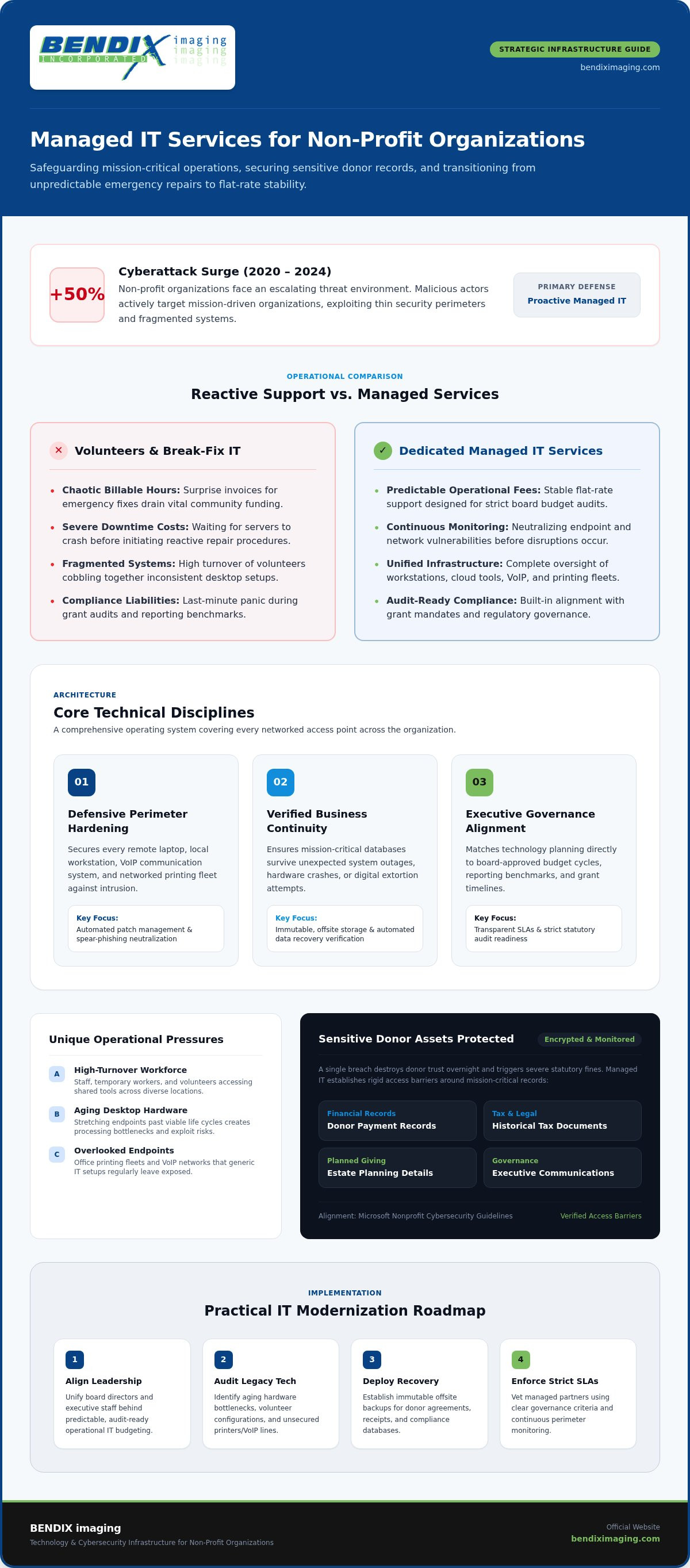
Cyberattacks against non-profits surged by 50% between 2020 and 2024, proving that malicious actors don't care about good intentions. If your organization relies on fragmented systems cobbled together by volunteers or unresponsive break-fix technicians, dedicated managed IT services for non-profits are no longer an optional line item. They are your primary operational defense.
You already know the daily friction: unreliable workstations, grinding network latency, and the constant fear of a donor database breach that could trigger devastating regulatory liabilities. Every surprise invoice for emergency tech repairs drains vital funding directly away from your core community outreach. Your leadership team shouldn't have to choose between digital security and fulfilling your charter.
Discover how the right service model delivers ironclad protection for sensitive donor records, streamlines daily staff workflows, and keeps operational expenses completely predictable for board audits. This 2026 strategic guide examines the essential cybersecurity defenses, compliance standards, and unified infrastructure strategies you need to safeguard your mission and maximize community impact.
Key Takeaways
- Understand how specialized managed IT services for non-profits eliminate volatile emergency repair bills in favor of dependable, audit-ready budgeting.
- Identify the core infrastructure pillars your mission requires, from layered network defense and verified data recovery to modern VoIP systems.
- Expose the severe downtime costs and compliance liabilities tied to informal volunteer support and reactive break-fix contractors.
- Learn how to vet prospective technology partners using strict governance criteria and transparent Service Level Agreements.
- Execute a practical modernization roadmap that aligns leadership, audits legacy hardware, and secures vital community programs.
What Are Managed IT Services for Non-Profits?
Operating a mission-driven organization requires extreme fiscal discipline. Every dollar spent on administrative overhead faces strict scrutiny from board directors, grant makers, and donors. Dedicated managed services replace the chaotic, billable-hour model of reactive break-fix technicians with proactive, flat-rate operational support. Instead of waiting for a server crash or a ransomware incident to halt operations, comprehensive managed IT services for non-profits deliver continuous oversight across networks, physical endpoints, cloud tools, and document infrastructure.
This proactive model unifies core technology functions under one accountable framework:
- Continuous network and endpoint monitoring: Neutralizing system vulnerabilities before they interrupt daily operations.
- Automated data backup and disaster recovery: Securing mission-critical databases and financial records against system failure.
- Regulatory compliance oversight: Ensuring grant requirements and reporting benchmarks are met without last-minute panic.
- Predictable operational budgeting: Replacing fluctuating emergency repair invoices with stable, transparent fees.
Unique Operational Pressures Facing Mission-Driven Organizations
Non-profit directors carry unique burdens that standard corporate IT setups ignore. Organizations manage high-turnover rosters of permanent staff, temporary workers, and community volunteers, all accessing shared systems across varied locations. Compounding this risk, many teams stretch aging desktop hardware past its viable life cycle, creating severe processing bottlenecks and easy targets for digital exploitation.
The Escalating Risk of Donor Data Breaches
Non-profit databases store goldmines of actionable intelligence: donor payment records, tax documents, estate planning details, and confidential executive communications. Opportunistic threat actors know smaller organizations often run minimal security barriers. A single unauthorized breach destroys donor trust overnight, exposes the organization to severe statutory fines, and permanently damages future fundraising momentum. Purpose-built managed IT services for non-profits establish rigid access barriers, verified data encryption, and continuous monitoring to ensure your institutional integrity remains uncompromised.
Core Pillars of Managed IT for Non-Profit Organizations
Relying on piecemeal technical fixes leaves critical vulnerabilities open across your organization. Comprehensive managed IT services for non-profits integrate hardware oversight, communications infrastructure, and digital defense into an unified operating system. When evaluating coverage, leaders must look beyond basic ticketing desks. True resilience requires locking down every networked access point, including modern VoIP systems and office printing fleets that standard corporate IT setups frequently ignore.
A mission-ready IT deployment rests on three core technical disciplines:
- Defensive Perimeter Hardening: Securing every remote laptop, local workstation, and networked device against intrusion.
- Verified Business Continuity: Ensuring critical program records survive unexpected outages or digital extortion attempts.
- Executive Governance Alignment: Matching technology roadmaps directly with board-approved budget cycles and grant timelines.
Layered Cybersecurity and Donor Record Protection
Modern donor cultivation depends on uncompromised digital systems. Automated patch management closes security holes across remote laptops before attackers exploit them. Routine systems monitoring neutralizes sophisticated spear-phishing campaigns designed to divert large wire transfers or compromise board communications. Following frameworks like Microsoft's Nonprofit Cybersecurity Guidelines and partnering with specialists in cybersecurity Eastern South Dakota gives regional organizations the specialized perimeter protection required to retain institutional credibility.
Continuous Monitoring, Backup, and Disaster Recovery
Backups mean nothing if recovery files fail during an active emergency. Immutable, offsite storage ensures historical gift agreements, donor tax receipts, and compliance filings cannot be encrypted by ransomware. Routine disaster recovery simulations test complete file restorations under real-world conditions. Verified backups prevent catastrophic operational downtime, ensuring community programs remain running without missing a single service deadline.
Strategic Technology Planning and Virtual Leadership
Executive leadership rarely has the bandwidth to track shifting compliance regulations or audit digital assets. Virtual Chief Security Officer (vCSO) services provide senior-level guidance to align technology expenditures with audit standards. This structured foresight eliminates sudden emergency capital outlays by mapping workstation refreshes directly to annual budget plans. Forward-looking directors also leverage specialized AI consulting for small business to securely integrate automated workflow tools without exposing protected donor files to public platforms. If your current support model lacks this strategic oversight, partner with BENDIX imaging to audit and defend your vital infrastructure.
Comparing IT Models: In-House vs. Break-Fix vs. Managed Services
How should non-profit directors evaluate their technical support options? Leadership teams typically choose between three paths: hiring internal personnel, calling an hourly contractor when equipment fails, or partnering with an outside managed provider. Each model carries stark trade-offs in budget predictability, response times, and institutional security posture. To examine how organizations structure these systems effectively, consult our comprehensive guide to managed IT support South Dakota.
Here is how the three models contrast in practice:
- Internal Technical Staff: Delivers dedicated on-site focus, but introduces massive overhead costs for salary, benefits, and continuing training. It also creates a single point of failure whenever that individual takes leave or resigns.
- Break-Fix Contractors and Volunteers: Seems economical initially, but provides zero proactive monitoring, guarantees no response times, and results in severe downtime during major crises.
- Managed Service Providers: Delivers an entire team of certified network and security engineers for a predictable operational fee, ensuring continuous monitoring without single-staff dependencies.
The Hidden Risks of the Break-Fix Approach
Hourly technicians operate on conflicting incentives. They profit when your systems break, not when your operations run smoothly. Between emergency service calls, critical software updates get neglected and security patches lapse. When a network switch or server eventually collapses, your team faces prolonged operational downtime alongside steep, unbudgeted repair invoices that immediately deplete capital allocated for community initiatives.
Co-Managed IT vs. Fully Outsourced Management
Adopting managed IT services for non-profits doesn't mean replacing your current personnel. If your organization already employs a dedicated technology coordinator, a co-managed model offloads tier-one help desk tickets and network patching, freeing internal staff to focus on donor software and direct program execution. For organizations without dedicated technical staff, fully outsourced management delivers end-to-end operational defense. Both paths stabilize operational costs and provide the clear reporting non-profit boards demand.
How to Choose the Right Non-Profit IT Service Provider
Selecting a technology vendor isn't just about comparing rate sheets. It's about securing an accountable partner who understands board governance, financial handling requirements, and daily program demands. Many national providers sell watered-down commercial packages, routing your urgent tickets to distant call centers that know nothing about your regional community footprint. Securing dedicated managed IT services for non-profits demands a rigorous evaluation process that holds potential partners to strict standards of operational accountability.
Audit prospective partners against this four-step selection framework:
- Step 1: Audit non-profit compliance familiarity. Confirm the vendor routinely prepares organizations for external financial audits and understands non-profit data privacy obligations.
- Step 2: Require transparent Service Level Agreements (SLAs). Demand binding contract guarantees with aggressive response and resolution timelines, not vague "best effort" promises.
- Step 3: Verify layered cybersecurity controls. Check that multi-factor authentication, perimeter firewalls, and encrypted file access are standard inclusions rather than expensive add-ons.
- Step 4: Demand unified infrastructure management. Ensure the provider supports everything connected to your network, eliminating finger-pointing between computer technicians and print hardware vendors.
Evaluating Security Safeguards and Compliance Expertise
Does the vendor enforce strict role-based access? Non-profit environments see heavy user turnover as interns, volunteers, and committee members cycle through projects. Your technology provider must deploy automated identity management that revokes permissions instantly when personnel depart. They must also enforce robust authentication protocols across donation gateways to keep processing environments fully aligned with modern PCI standards.
The Value of Local Accountability and Responsive Support
Remote troubleshooting solves many software glitches, but it can't fix a fried firewall, a broken network switch, or a jammed production printer during an annual fundraising drive. Distant call centers leave your staff stranded when physical hardware fails. Partnering with a dedicated regional team ensures technicians who understand local operating conditions can respond effectively across Watertown, Brookings, and Sioux Falls. Ready to protect your mission with a partner who stands behind their work? Contact BENDIX imaging to schedule a comprehensive infrastructure assessment.
Securing Your Organization: Practical Steps to Modernize Non-Profit IT
Transitioning from a fragile, reactive tech setup to a disciplined digital environment doesn't happen by accident. It requires a deliberate, step-by-step strategy rather than hasty hardware purchases. When leadership teams implement dedicated managed IT services for non-profits, lingering technical anxiety gives way to predictable operational momentum. Your staff stops wrestling with failing software, and your executive team regains the bandwidth to focus entirely on expanding community impact.
Modernization begins by bridging the gap between daily technical operations and executive governance. Early engagement with board directors and finance committees ensures baseline security priorities receive proper funding before an audit failure or network breach forces emergency spending. Presenting a structured roadmap built around risk reduction, workflow stability, and compliance readiness transforms technology from a feared budget drain into a resilient organizational asset.
Executing an Exhaustive Technology Audit
Never upgrade in the dark. Start by cataloging every active endpoint, operating system, and software license across your organization. Scrutinize shadow IT, including unmanaged personal devices used by volunteers and abandoned software subscriptions that quietly drain monthly funds. Trace your donor data pathways from the initial web contribution down to your financial ledgers to pinpoint unprotected access points. Auditing your workstations alongside recurring print fleet expenses exposes immediate consolidation opportunities, freeing up vital capital for proactive defense.
Partnering with BENDIX imaging for Mission-Driven IT
Managing multiple disjointed vendors creates operational friction, inflated invoices, and endless finger-pointing whenever equipment fails. BENDIX imaging acts as your vigilant local partner, delivering comprehensive managed IT, cybersecurity, network defense, and print optimization across Eastern South Dakota. We protect your operations against costly downtime, lock down sensitive donor records, and keep staff productive. Take control of your technical infrastructure today: schedule an IT assessment with BENDIX imaging to protect your mission.
Transform Your Technology into a Resilient Operational Asset
Your non-profit cannot afford to leave operational resilience to chance. Relying on volunteer goodwill or reactive break-fix technicians drains vital program funding and leaves donor records dangerously exposed. Shifting to comprehensive managed IT services for non-profits replaces volatile emergency repair expenses with disciplined budgeting, verified data protection, and seamless daily workflows.
For decades, BENDIX imaging has stood as a vigilant technical ally for organizations across Eastern South Dakota. We eliminate vendor finger-pointing by delivering unified defense that spans proactive network management, multi-layered cybersecurity, and print optimization. Our dedicated local technicians take personal ownership of your systems so you never lose critical working hours to preventable hardware or software failures.
Don't wait for a data breach or network crash to re-evaluate your digital infrastructure. Protect your mission and donor data with comprehensive managed IT support from BENDIX imaging. With dependable systems guarding your foundation, your leadership team can focus entirely on expanding community impact.
Frequently Asked Questions
Why do non-profits need specialized managed IT services instead of regular commercial support?
Non-profits operate under strict audit guidelines, volunteer access dynamics, and tight operational budgets that standard commercial support plans ignore. Specialized managed IT services for non-profits protect sensitive donor databases and align with grant compliance mandates without billing unpredictable hourly fees. Providers like BENDIX imaging understand how regional organizations in Watertown and Sioux Falls operate, delivering structured technical defenses that protect donor trust while respecting strict overhead limitations.
How do managed IT services help non-profits maintain compliance with donor privacy regulations?
Providers implement automated role-based access, end-to-end data encryption, and verified backup protocols that comply with standards like PCI DSS 4.0. They conduct regular risk assessments to identify configuration oversights across donor CRM platforms and accounting databases. With guidance from virtual CSO leaders, your organization maintains the documented security policies required by state statutes, grant funders, and institutional benefactors without overburdening internal staff.
Can our non-profit keep existing cloud software and grant-funded licenses under managed IT?
Yes, managed service providers routinely integrate, secure, and monitor existing software platforms and non-profit grant licenses. Rather than forcing complete platform migrations, an experienced partner evaluates your active tech stack to eliminate redundant subscriptions and close permission gaps. They optimize tools you already own, ensuring applications run efficiently on updated endpoints while maintaining compliance across all user accounts.
How does managed IT accommodate seasonal volunteers and temporary committee members securely?
Managed providers utilize centralized identity and access management to provision temporary accounts with strictly limited network permissions. Volunteers receive secure access only to the files required for their specific assignments, preventing unauthorized access to core donor records. The moment an event concludes or an assignment ends, automated protocols revoke those credentials instantly, preventing dormant accounts from becoming lingering backdoors for external security breaches.
What is the difference between co-managed IT and fully outsourced IT services for non-profits?
Co-managed IT supplements an existing internal technology coordinator by handling routine system patching, network security, and help desk volume, allowing your staff to focus on strategic initiatives. Fully outsourced managed IT services for non-profits handle your entire infrastructure from network defense to endpoint maintenance. Both models deliver predictable operational budgeting, letting non-profit boards across Brookings and Huron eliminate sudden emergency repair expenses.
How quickly can a managed service provider restore our systems after a ransomware incident?
Recovery timelines depend on pre-established recovery time objectives, but immutable backups typically restore essential operational data within hours rather than days. Providers maintain isolated recovery snapshots that malware cannot encrypt or alter during an attack. Regular restoration drills confirm file integrity in advance, ensuring staff resume core community operations rapidly without paying extortion demands or suffering devastating data loss.
Can managed IT services help our non-profit reduce total printing and document workflow expenses?
Yes, unifying managed IT with managed print services reduces supply waste, eliminates fragmented equipment leases, and consolidates vendor contracts. Providers monitor device fleets across Eastern South Dakota, automating toner replenishment and securing print queues against network vulnerabilities. Consolidating workstations, network switches, and office printing equipment under a single accountable local partner prevents hardware sprawl and cuts unnecessary administrative overhead.
{"@context":"https://schema.org","@type":"FAQPage","mainEntity":[{"@type":"Question","name":"Why do non-profits need specialized managed IT services instead of regular commercial support?","acceptedAnswer":{"@type":"Answer","text":"Non-profits operate under strict audit guidelines, volunteer access dynamics, and tight operational budgets that standard commercial support plans ignore. Specialized managed IT services for non-profits protect sensitive donor databases and align with grant compliance mandates without billing unpredictable hourly fees. Providers like BENDIX imaging understand how regional organizations in Watertown and Sioux Falls operate, delivering structured technical defenses that protect donor trust while respecting strict overhead limitations."}},{"@type":"Question","name":"How do managed IT services help non-profits maintain compliance with donor privacy regulations?","acceptedAnswer":{"@type":"Answer","text":"Providers implement automated role-based access, end-to-end data encryption, and verified backup protocols that comply with standards like PCI DSS 4.0. They conduct regular risk assessments to identify configuration oversights across donor CRM platforms and accounting databases. With guidance from virtual CSO leaders, your organization maintains the documented security policies required by state statutes, grant funders, and institutional benefactors without overburdening internal staff."}},{"@type":"Question","name":"Can our non-profit keep existing cloud software and grant-funded licenses under managed IT?","acceptedAnswer":{"@type":"Answer","text":"Yes, managed service providers routinely integrate, secure, and monitor existing software platforms and non-profit grant licenses. Rather than forcing complete platform migrations, an experienced partner evaluates your active tech stack to eliminate redundant subscriptions and close permission gaps. They optimize tools you already own, ensuring applications run efficiently on updated endpoints while maintaining compliance across all user accounts."}},{"@type":"Question","name":"How does managed IT accommodate seasonal volunteers and temporary committee members securely?","acceptedAnswer":{"@type":"Answer","text":"Managed providers utilize centralized identity and access management to provision temporary accounts with strictly limited network permissions. Volunteers receive secure access only to the files required for their specific assignments, preventing unauthorized access to core donor records. The moment an event concludes or an assignment ends, automated protocols revoke those credentials instantly, preventing dormant accounts from becoming lingering backdoors for external security breaches."}},{"@type":"Question","name":"What is the difference between co-managed IT and fully outsourced IT services for non-profits?","acceptedAnswer":{"@type":"Answer","text":"Co-managed IT supplements an existing internal technology coordinator by handling routine system patching, network security, and help desk volume, allowing your staff to focus on strategic initiatives. Fully outsourced managed IT services for non-profits handle your entire infrastructure from network defense to endpoint maintenance. Both models deliver predictable operational budgeting, letting non-profit boards across Brookings and Huron eliminate sudden emergency repair expenses."}},{"@type":"Question","name":"How quickly can a managed service provider restore our systems after a ransomware incident?","acceptedAnswer":{"@type":"Answer","text":"Recovery timelines depend on pre-established recovery time objectives, but immutable backups typically restore essential operational data within hours rather than days. Providers maintain isolated recovery snapshots that malware cannot encrypt or alter during an attack. Regular restoration drills confirm file integrity in advance, ensuring staff resume core community operations rapidly without paying extortion demands or suffering devastating data loss."}},{"@type":"Question","name":"Can managed IT services help our non-profit reduce total printing and document workflow expenses?","acceptedAnswer":{"@type":"Answer","text":"Yes, unifying managed IT with managed print services reduces supply waste, eliminates fragmented equipment leases, and consolidates vendor contracts. Providers monitor device fleets across Eastern South Dakota, automating toner replenishment and securing print queues against network vulnerabilities. Consolidating workstations, network switches, and office printing equipment under a single accountable local partner prevents hardware sprawl and cuts unnecessary administrative overhead."}}]}


